


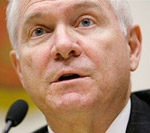
 Reuters: Iran’s neighbors are clearly concerned about Tehran’s “aggressive behavior” and support international sanctions aimed at curbing its nuclear ambitions, U.S. Defense Secretary Robert Gates said on Friday after a week of travel that included stops in two Gulf states.
By David Alexander
ABOARD A U.S. MILITARY AIRCRAFT, Dec 10 (Reuters) – Iran’s neighbors are clearly concerned about Tehran’s “aggressive behavior” and support international sanctions aimed at curbing its nuclear ambitions, U.S. Defense Secretary Robert Gates said on Friday after a week of travel that included stops in two Gulf states.
“You can see the general support in the region for applying the sanctions and for doing what we can to make the sanctions effective and try to influence the Iranian government to walk away from their nuclear weapons program,” Gates told reporters on his plane home after visiting Oman, Afghanistan and the United Arab Emirates.
“There clearly is concern, not just in this region but elsewhere, about Iran’s overall aggressive behavior with respect to Hezbollah and Lebanon and other places around the world,” he said. “And I think that’s a broadly shared concern.”
Iran has moved to reassure Gulf Arab states in recent days after U.S. diplomatic cables released by WikiLeaks showed great alarm in the region over Tehran’s nuclear enrichment program, which the international community believes is aimed at producing atomic weapons but Iran says is for energy production.
Iranian Foreign Minister Manouchehr Mottaki told a Gulf security conference in Bahrain last week that “our power in the region is your power.” But a senior Gulf Arab security official said concerns would remain until Iran dealt “openly” with the international community over its nuclear program.
Gates said he discussed the importance of maintaining diplomatic and economic pressure on Iran during a “very satisfactory” meeting at Mina Palace on Thursday evening with the Abu Dhabi crown prince, Sheikh Mohammed bin Zayed al-Nahayan.
“We talked about our bilateral relationship, particularly our military-to-military relationship, as well as the desirability of greater multilateral cooperation in the Gulf on air and missile defense and maritime surveillance,” Gates said.
“We obviously talked about Iran and the importance of the sanctions and keeping the diplomatic and economic pressure on,” he said.
Gates said he and the crown prince, one of the UAE’s leading defense officials, also discussed the need to continue international support for Yemen and its leader in confronting a range of challenges. Al Qaeda in the Arabian Peninsula is a growing threat in Yemen.
“We talked about Yemen and … the concerns we have about Yemen and President Saleh (Yemeni President Ali Abdullah Saleh) … as he takes on the various challenges there,” Gates said.
Asked what more could be done in Yemen, Gates said the key was to try to address the underlying issues before they produced a crisis whose solution would be primarily military.
“The key is getting in there before there’s a crisis with economic assistance, with building partnership capacity,” he said. “I think that both the UAE and Oman are engaged in these activities, these development projects. Other countries are as well.”
He said the United States had similar efforts in Yemen.
Gates told a town hall meeting at the U.S. Embassy in Afghanistan on Thursday that one of the main lessons to be learned from the conflicts the United States is now fighting is the need to address the underlying problems before they become a crisis.
“The hardest thing for us to sell to legislators is what we in the military call Phase Zero operations, getting into a place that’s got problems and addressing those problems, building the capacity of that government , both civilian and military, so it can deal with those problems so that we don’t subsequently have to send in our troops,” he said. (Editing by Bill Trott)


