


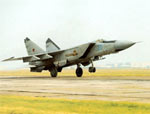
 Philadelphia Inquirer: When a certain F-5 Tiger fighter jet outlived its military use years ago, it was sold for surplus, and the plane became the toy of a rich Californian. He leased it as a big prop for Hollywood movies. This year, the fighter jet became the star of a real-life sting – against an American accused of trying to sell it to Iran.
The Philadelphia Inquirer
By John Shiffman
Inquirer Staff Writer
When a certain F-5 Tiger fighter jet outlived its military use years ago, it was sold for surplus, and the plane became the toy of a rich Californian. He leased it as a big prop for Hollywood movies.
This year, the fighter jet became the star of a real-life sting – against an American accused of trying to sell it to Iran.
The F-5 is the centerpiece of an undercover Homeland Security investigation that stretched from Philadelphia to Los Angeles to Budapest, Hungary.
An arms broker from California has been charged with trying to sell the jet for $3.6 million to Philadelphia-based agents who were pretending to work on behalf of the Iranian military.
The case was unsealed Wednesday. Marc Knapp, 36, a broker from Simi Valley, Calif., is charged with violating the arms embargo, and is scheduled to plead guilty next month in federal court in Wilmington. The unidentified wealthy owner of the plane was not implicated.
Knapp is also accused of attempting to sell other top-shelf avionics to Iran – F-14 ejection seats, anti-gravity flight suits, and search-and-rescue beacons. He has been in prison since his arrest in July.
His lawyer, Christopher S. Koyste, said the F-5 was an outdated plane that probably would not pose a serious risk to U.S. forces. “If the plane were used against the U.S., it would likely be shot down in minutes or seconds,” he said.
In addition, Koyste said, the F-5 would not likely have made it all the way to Iran by boat. “The more you know about this case, the more you realize the plane was never going to be flown out of the United States,” Koyste said.
The maximum penalty on the charges is 40 years in prison and $2 million in fines, but the advisory federal sentencing guidelines call for a far smaller penalty. Knapp has no criminal record, his lawyer said. Compared with similar cases, he probably faces a sentence of two to five years.
The Knapp investigation is the second recent major undercover arms investigation carried out by members of a small counter-proliferation unit based in Philadelphia, part of the Immigration and Customs Enforcement’s division of Homeland Security Investigations.
The other case, chronicled in an eight-part Inquirer series in September, involved an Iranian broker named Amir Ardebili buying U.S.-made technology and weapons for Iran. In that case, agents lured Ardebili from his home in Iran to a sting in the Republic of Georgia.
The two cases are unrelated, but U.S. officials said both were made possible by Iran’s known interest in obtaining American-made weapons.
ICE deploys the undercover agents, said special agent in charge John Kelleghan, as part of an effort to stop state-of-the-art U.S. technology from being used against American and allied troops.
“This case demonstrates the threat to our national security posed by those, like Knapp, who are willing to trade with Iran and attempt to provide that nation with American goods and technology, particularly military components,” said U.S. Attorney for Delaware David C. Weiss.
Much of the case is laid out in a 39-page affidavit unsealed late Wednesday at the federal courthouse in Wilmington. In the affidavit, an ICE agent alleges the following:
Knapp’s first contact with the undercover ICE agent was a telephone call a year ago on Christmas Eve. During the call, Knapp offered to sell an F-14 ejection seat for $29,000.
Sure, the agent said. Let’s meet in January for lunch in Philadelphia. But let’s be careful, the agent said. It’s illegal to send military gear overseas without the proper licenses. No one wants to wind up in jail.
They met Jan. 4, and discussed the ejection seats, F-14 parachutes, flight suits, emergency pilot radio beacons, and a state-of-the-art pilot’s helmet.
Knapp also mentioned that he knew a man in California willing to sell two F-5 fighter jets, adding that the owner would not know to whom Knapp was selling them. The agent agreed that they should say the plane’s final destination would be England and the men discussed whether the plane could be smuggled via Canada, Switzerland, or Mexico.
When Knapp remarked that the Iranians might be interested in obtaining an updated flight manual for the F-4 and F-14 jets, the agent asked Knapp if he were worried about a potential U.S. enemy’s obtaining such information.
No, Knapp allegedly responded. He told the agents he could “compartmentalize,” and justify the sale to Iran, because he believed the United States could shoot down any F-5.
After the meeting, the two men agreed to communicate by code – using “Ireland” for Iran and “train” for jets, for example. They also e-mailed each other using encrypted documents.
Two weeks later, the two men met again in Los Angeles.
The undercover agent agreed to buy flight suits and F-14 manuals, and repeated that they were destined for Iran via Bahrain.
Then the men travelled to the Van Nuys airport to view the F-5, and as they did, Knapp fretted about leaving fingerprints on the plane. They worried about how they would smuggle a fighter jet overseas.
As they planned the plane deal, Knapp allegedly began smuggling flight suits to the undercover agents’ European address in Hungary. But he sent low-quality flight suits, and the agents, acting as any real broker would, objected harshly, demanding that he make good on the deal. The agents apparently also used Knapp’s mistake to help lure him to Budapest. The agents told him that the Iranians were now demanding a face-to-face meeting before they would buy the F-5.
Knapp agreed to meet in Hungary in late April, and the ICE plan seemed to be working well – until it ran into an unexpected roadblock. The volcanic eruption in Iceland, which caused transatlantic flights to be delayed for a week, prevented the agents and Knapp from traveling to Hungary.
The Budapest meeting finally took place the last week in April, and they reached a tentative deal. Knapp offered to have the F-5 flown from its base in Van Nuys to Delaware, where it would be crated and shipped to Hungary and then to Iran. He also promised to supply more anti-gravity suits.
In June, the undercover agent e-mailed Knapp and told him he was preparing a contract for the F-5 sale to a company in Wilmington. Knapp replied that his commission would be $500,000.
On July 20, Knapp met the undercover agent in Wilmington. First, they took care of smaller items, including four handheld search and rescue radios. The agent told Knapp he’d be sending those to Russia.
“Awesome,” Knapp allegedly replied. “Whoever your customer is, I’m happy with.”
They then turned to the F-5 deal, and the agent issued a warning: The Iranians want your personal guarantee that this plane will be operational.
No problem, Knapp allegedly responded. They can see that when it’s flown from California to Wilmington, he said.
The men shook hands and signed the various documents, including a contract. Minutes later, Knapp was arrested.


