


 AP: Chevron Corp. expressed interest in developing oil reserves straddling the Iran-Iraq border, potentially putting the American energy giant at risk of violating U.S. sanctions against Tehran, according to comments made public in a leaked diplomatic cable.
The Associated Press
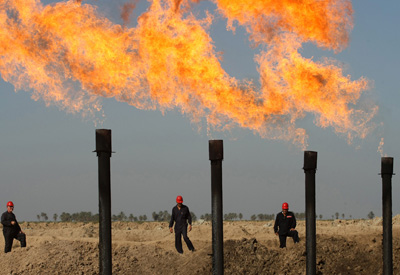 DUBAI, United Arab Emirates (AP) — Chevron Corp. expressed interest in developing oil reserves straddling the Iran-Iraq border, potentially putting the American energy giant at risk of violating U.S. sanctions against Tehran, according to comments made public in a leaked diplomatic cable.
During a March 2009 meeting detailed in the document, Iraqi Prime Minister Nouri al-Maliki told a senior U.S. embassy official he was in talks with Chevron about the cross-border oil field. He added that Chevron, America’s second-largest oil company, had also approached Iran about the project — a claim the memo makes clear the embassy was unable to confirm.
Al-Maliki said Iraq was interested in awarding Chevron rights to develop the unnamed field but wanted the embassy’s guidance about the “political feasibility of such a deal” in light of U.S. sanctions against Iran.
“He prefers to go with Chevron on the deal; however, he remarked that if U.S. rules prevent Chevron from doing this project, he would approach a non-American firm,” said the cable dated March 23, 2009. It described a meeting led by Patricia Butenis, who was the Baghdad embassy’s charge d’affaires at the time.
The cable was obtained by WikiLeaks and first reported in the Thursday edition of the British newspaper The Guardian.
The U.S. has for years prohibited American oil companies from doing business with Iran through sanctions that are now aimed at thwarting Iran’s disputed nuclear program.
In the cable, Butenis told al-Maliki that “U.S. law on sanctions would apply, but added that the administration was reviewing its policies on Iran.”
Chevron denies any wrongdoing.
“We have not engaged in business discussions that are, or could potentially be, in violation of U.S. law. Any suggestion to the contrary is false,” spokesman Lloyd Avram said.
When asked about the cable, Iraqi Oil Ministry spokesman Assem Jihad said only that “no oil deal was signed with Chevron.”
However, an official at Iraq’s state-run South Oil Co. in Basra said the talks with San Ramon, California-based Chevron took place in 2009 and were focused on a cluster of three oil fields in the country’s south. The fields, known as Missan, like the province, currently produce close to 100,000 barrels of crude a day and hold more than 2.6 billion barrels in reserves.
The oil official was granted anonymity to speak freely about the negotiations.
Earlier this year, Baghdad awarded a consortium led by state-run China National Offshore Oil Corp. and its partner the Turkish Petroleum Corp. rights to develop the fields.
Samuel Ciszuk, a London-based Mideast energy analyst with IHS Global Insight, said it was not surprising a major oil company such as Chevron would hold exploratory talks about fields near the still-disputed border.
Even “informal contacts” with Iranian officials wouldn’t necessarily be strange, he said, if only to understand what operating close to the frontier on the Iraqi side might entail.
“You basically need to have an understanding of what you’re getting into,” Ciszuk said, noting that some Iraqi fields are located in areas where the border itself is unclear. Just last year, Iranian troops crossed into Iraq and briefly seized an oil well near the border before withdrawing.
But he said it was unlikely a prominent oil major would openly try to break U.S. sanctions by setting up a drilling operation in Iran directly.
“You can’t keep a thing like that secret,” he said. “Running an oil and gas development project requires a lot of physical work, imports of material. You can’t hide it.”
Associated Press writer Sameer N. Yacoub in Amman, Jordan contributed to this report.


