


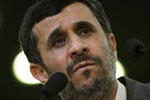
 Reuters: Iranian hardline President Mahmoud Ahmadinejad, whose campaign pledge was to combat corruption, is facing a fresh political blow over the biggest financial scandal in Iran’s history.
By Parisa Hafezi
TEHRAN (Reuters) – Iranian hardline President Mahmoud Ahmadinejad, whose campaign pledge was to combat corruption, is facing a fresh political blow over the biggest financial scandal in Iran’s history.
The $2.6 billion scam has taken on political dimensions as some hardline politicians have linked the main suspect in the fraud to a so-called “deviant current,” allegedly led by Ahmadinejad’s chief of staff and closest ally.
Esfandiar Rahim Mashaie is accused by many Shi’ite clerics and politicians of trying to undermine the central role of the clergy in politics by emphasizing the nationalist strain of Iranian history and culture.
“Now Ahmadinejad’s hands are filled with the scam … Weakened in the eye of the nation, Ahmadinejad has been rendered impotent to initiate any political action ahead of the (March 2012) parliament vote,” said a former senior official, who asked not to be named.
The judiciary has said corruption at this level could not have happened “without the involvement and backing of different individuals,” a reference to high-ranking government officials.
The fraud was made public with Supreme Leader Ayatollah Ali Khamenei’s approval, said some hardline politicians.
“Ahmadinejad’s allies are determined to win the next elections and Khamenei’s allies want to block their way … That is the main reason behind the revelation of this scam,,” said an economist, who identified himself as Saber Lavasani.
“People will not vote for those linked to the scam.”
Some analysts speculated that Ahmadinejad was grooming Mashaei to succeed him in 2013 presidential elections.
“The state of economy is the underlying cause of the nation’s discontent and is considered a crucial factor for political factions’ electoral win,” said an analyst, who asked not to be named. “Who will vote for those involved in a $2.6 billion scam that is equal to one percent of Iran’s Gross Domestic Product?”
Khamenei’s unprecedented public intervention in April to reinstate the intelligence minister sacked by the president displayed “his disapproval of Ahmadinejad’s policies.”
Analysts say by sacking the minister, Ahmadinejad’s allies wanted to secure a majority in the parliamentary elections, since the ministry is in charge of checking the backgrounds of potential candidates. The intelligence minister is appointed by Khamenei.
“It is like a domino … A parliamentary election win will pave the way for winning the next presidential vote,” said analyst Mohsen Sadeghi.
“NATIONAL OBSESSION”
The fraud has become a national obsession, increasing pressure on the clerical establishment to take action at a time when Iran’s economy is badly flagging.
The scam, which involved illegal bank withdrawals, will further put economic pressure on the nation by increasing inflation. It officially hovers around 16 percent. Critics say the figure is really over 30 percent.
Iranian newspapers and websites have given wide coverage to the scandal, criticizing Ahmadinejad and his inner circle of allies. The president has rejected the allegations, calling his government “the cleanest in Iran’s history.”
Khamenei criticized the government for failing to prevent the embezzlement but warned the media not to cover the scam in a way to make ordinary Iranians “lose hope and become disappointed” in the Islamic state.
“Khamenei’s red-line is the economy … more economic pressure on ordinary Iranians means less support for the establishment. His aim is to preserve the establishment,” said analyst Hamid Farahvashi.
Frustration is simmering among lower and middle-class Iranians. Prices of most consumer goods have risen and many Iranians struggle to make ends meet.
“I am struggling to meet my children’s school fees … I am unable to even grasp the number of zeros in this corruption,” said taxi driver Reza Bakhshi, 45, a father of three.
Some MPs say the government was linked to the scam in order to fund monthly compensation of $40 per person introduced since eliminating fuel and energy subsidies in 2010.
“ENDING TERM”
Despite having been criticized for squandering petrodollars and fuelling inflation, Ahmadinejad has shown no hint of revising his unorthodox economic policies.
Oil earnings still account for up to 60 percent of state income and a surge in consumer imports under Ahmadinejad and subsidy cuts have hit local industries and forced some plants to close.
International sanctions imposed on Iran over its disputed nuclear program, coupled with high inflation have led to a general fear that life will get worse before getting any better.
Iranian leaders, concerned revolts in the Arab world will spread to Iran, have made it clear that they will not tolerate any fresh anti-government protests which died down a few months after the 2009 presidential election.
Opposition leaders, who say the vote was rigged, have been put under house arrest since February. Other pro-reform politicians have adopted a “wait and see” policy, analysts say.
Iran’s elite Revolutionary Guards, who quelled post-election protests, also have distanced themselves from Ahmadinejad and remain fiercely loyal to Khamenei.
However, analysts say Ahmadinejad will most likely stay in the office until the end of his term as “an early election might revive anti-government protests in Iran.”
(Editing by Jon Hemming)


