


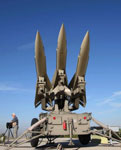
 AFP: Iran on Saturday kept tensions simmering over its threat to close the Strait of Hormuz to oil tankers by readying war game missile tests near the entrance to the Gulf.
By Mohammad Davari
TEHRAN (AFP) — Iran on Saturday kept tensions simmering over its threat to close the Strait of Hormuz to oil tankers by readying war game missile tests near the entrance to the Gulf.
The United States has warned a closure of the strait “will not be tolerated” after Iranian Vice President Reza Rahimi’s threat this week that “not a drop of oil” will pass through the channel if more Western sanctions are imposed over Tehran’s nuclear programme.
Iran has brushed off the warning from the United States, which bases its Fifth Fleet in the Gulf, with Iranian navy chief Admiral Habibollah Sayari saying it would be “really easy” to close the strait.
A spokesman for the Iranian navy, Commodore Mahmoud Mousavi, told state television on Saturday that, “in the next days, we will test-fire all kinds of surface-to-sea, sea-to-sea and surface-to-air as well as shoulder-launched missiles” in the final stages of the war games.
He did not say exactly when the launches would start, but explained they would involve tests of “medium- and long-range missiles” to evaluate their operational effectiveness.
The navy exercises started December 24 and are due to end on Monday.
Twenty percent of the world’s oil moves through the Strait of Hormuz, at the entrance of the Gulf, making it the “most important chokepoint” globally, according to information released Friday by the US Energy Information Administration.
Around 14 crude oil tankers per day pass through the narrow strait, carrying a total 17 million barrels. In all, 35 percent of all seaborne oil transited through there this year.
On Thursday, a US aircraft carrier and an accompanying missile cruiser passed through the zone where the Iranian navy was conducting its drill. US officials insisted it was a routine passage.
No confrontation occurred, though an Iranian military aircraft flew in close to record video of the aircraft carrier, which was then shown on state television.
Analysts and oil market traders have been watching developments in and around the Strait of Hormuz carefully, fearing that the intensifying war of words between arch foes Tehran and Washington could spark open confrontation.
With tensions rising, the United States said it has signed a $29.4-billion deal to supply Iran’s chief rival in the Middle East, Saudi Arabia, with 84 new fighter jets.
The sale was a “strong message” to the Gulf region, Washington said.
Iran is subject to four rounds of UN sanctions over its nuclear programme, which many Western countries allege is being used to develop atomic weapons. Tehran denies the allegation.
The United States and its allies have also imposed unilateral sanctions on Iran’s economy.
The last lot of unilateral sanctions triggered a demonstration in Tehran that led to members of the Basij militia controlled by the Revolutionary Guards ransacking the British embassy. London reacted by closing the mission and ordering Iran’s embassy in Britain closed.
More sanctions are on the way.
US President Barack Obama is expected to soon sign into law additional restrictions on Iran’s central bank, which acts as the main conduit for Iranian oil sales.
The European Union is considering other measures that could include an EU embargo on Iranian oil imports, with foreign ministers to meet on the issue in a month’s time.
Iran’s oil minister, Rostam Qasemi, told the Aseman weekly that sanctions would cause the price of oil to “increase drastically.”
“Sanctions on Iran’s oil will drive up the price of oil to at least 200 dollar” per barrel, he predicted.
As threats and counter-threats pile up, Iran is also reportedly leaving the door open to resuming long-stalled talks on solving the standoff over its nuclear programme.
Iran’s ambassador to Germany, Alireza Sheikh-Attar, told the Mehr news agency on Saturday that “we will soon send a letter, after which (new) talks will be scheduled.”
Foreign Minister Ali Akbar Salehi was also quoted by a website of the state broadcaster as telling a visiting Chinese foreign ministry official that “Iran is prepared for the continuation of nuclear negotiations” on the basis of a Russian proposal.


