


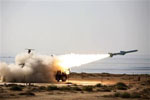
 Reuters: An internal report for the U.S. Congress has concluded that Iran probably is no longer on track, if it ever was, to having an ocean-crossing missile as soon as 2015. By Jim Wolf
 WASHINGTON (Reuters) – An internal report for the U.S. Congress has concluded that Iran probably is no longer on track, if it ever was, to having an ocean-crossing missile as soon as 2015.
The study casts doubt on a view long held by U.S. intelligence agencies that Iran could be able to test-fly by 2015 an intercontinental ballistic missile, or ICBM, if it receives “sufficient foreign assistance.”
“It is increasingly uncertain whether Iran will be able to achieve an ICBM capability by 2015,” said the report by the non-partisan Congressional Research Service, which works exclusively for lawmakers.
Iran does not appear to be receiving as much help as would likely be necessary, notably from China or Russia, to reach that goal, according to the 66-page report dated Thursday.
It is also increasingly tough for Tehran to obtain certain critical components and materials because of international sanctions related to its disputed nuclear program.
In addition, Iran has not demonstrated the kind of flight test program generally deemed necessary to produce an ICBM, said the study by Steven Hildreth, a specialist in missile defense who consulted seven external expert reviewers.
The study appears to be the most detailed unclassified look yet at Iran’s controversial ballistic missile and space programs. It does not address Tehran’s nuclear program, which has prompted international fears that it could lead to atomic weapons at short notice.
An effective nuclear-weapons capability requires three things to work together – enough fissile material, a reliable weapons device and an effective delivery system, such as a ballistic missile that can grow out of a space launch program.
Iran’s efforts to develop, test and field ballistic missiles and build a space launch capability have helped drive billions of dollars of U.S. ballistic missile defense spending, further destabilized the Middle East and contributed to Israel’s push for pre-emptive action.
Iranian missile threats have also prompted a U.S. drive for an increasingly capable shield for Europe, largely built by contractors such as Lockheed Martin Corp, Boeing Co, Raytheon Co and Northrop Grumman Corp.
ASSESSING THE ICBM THREAT
The U.S. intelligence community since 1999 has stuck to the conditional 2015 date, provided Iran gets enough outside help, for a potential Iranian ICBM capable of reaching the United States, which is at least 10,000 kilometers away.
An ICBM is generally defined as having a range greater than 5,500 km (3,400 miles). Such missiles from Iran could threaten targets throughout Europe and the Middle East.
“With sufficient foreign assistance, Iran may be technically capable of flight-testing an intercontinental ballistic missile by 2015,” the Defense Department told Congress in its 2012 annual report on Iranian military power.
Michael Birmingham, a spokesman for the office of the Director of National Intelligence, which leads the 17 organizations which comprise the U.S. intelligence community, said views among spy agencies vary on the Iranian ICBM outlook.
He added that the 2015 date cited by the Defense Department was “heavily caveated.”
Iran appears to have a significant space launch effort, not merely a disguised cover for ICBM development, the Congressional Research Service report said.
Iran became the ninth country to demonstrate an indigenous space launch capability on February 2, 2009, when it launched an Omid satellite from a Safir 2 rocket.
Iran has stated it plans to use future launchers to put intelligence-gathering satellites in orbit, a capability that is a decade or so in the future.
Tom Collina, research director of the private Arms Control Association, a Washington-based advocacy group, said the report suggests the United States could respond in a more “measured” way to a potential Iranian long-range missile threat.
“We do not have to deploy missile defenses on the East Coast by 2015, as some in Congress want, nor do we have to rush missile defenses into Europe, which makes Russia nervous,” he said.
(Reporting By Jim Wolf; Editing by Marilyn W. Thompson and Todd Eastham)


