


On Tuesday, March 17, on the eighteenth day of the large-scale military war between the United States, Israel, and Iran, military and diplomatic developments continue intensely. The war, which began in late February, has now entered a critical phase and is accompanied by precise targeting of the Iranian regime’s leadership, increased domestic restrictions, and global concerns over an energy crisis.
European Union diplomatic efforts to reduce tensions
Kaja Kallas, the European Union’s High Representative for Foreign Affairs, said in an interview with Reuters in Brussels on Tuesday that she called for an immediate end to the conflict and emphasized that the war benefits none of the parties. She stated that the European Union is consulting with Middle Eastern countries to find a diplomatic solution and is ready to help reduce tensions through diplomatic channels. Referring to the critical situation in the Strait of Hormuz, Kallas said Europe does not rule out participating in efforts to restore freedom of navigation, but this must be pursued within a diplomatic framework.
Global Leaders Rally Behind NCRI’s Provisional Government Amidst Historic Upheaval in Iran
She also expressed regret that Europe had not been consulted before the war began, stating that if such consultations had taken place, efforts would have been made to prevent the conflict. Kallas warned that continued tensions in the Strait of Hormuz could lead to an energy and food crisis and widespread disruption of global trade. The European Union has stressed that this is not Europe’s war and has shown no willingness to expand its naval mission to the Strait of Hormuz.
Israeli airstrikes on Tehran and targeting of senior commanders
In early Tuesday airstrikes on Tehran, Israel dealt a heavy blow to the Iranian regime’s security structure and leadership. Israel’s Defense Minister Israel Katz announced that Ali Larijani (Secretary of the Supreme National Security Council) and Gholamreza Soleimani (commander of the IRGC Basij militia) were killed in the attacks. Katz said that he and Israeli Prime Minister Benjamin Netanyahu had ordered the continued targeting of the regime’s leadership cadre. Israeli media and four Israeli officials confirmed the news to Reuters, while Iranian officials have remained silent so far. Tasnim News Agency, affiliated with the IRGC, claimed Larijani would release a message, but what was published was only an undated image of his old handwriting referring to the funeral of sailors from the Dena destroyer. These claims have not yet been officially confirmed or denied by Tehran.
Additionally, images and videos of precise strikes have been منتشرed, including the bombing of the Foundation of Martyrs building (a major state institution) on Bahar and Taleghani streets in Tehran, and a drone strike on a special police unit vehicle in Enghelab Square, which destroyed the vehicle and killed the driver. These attacks indicate Israel’s focus on security and military targets in the capital.
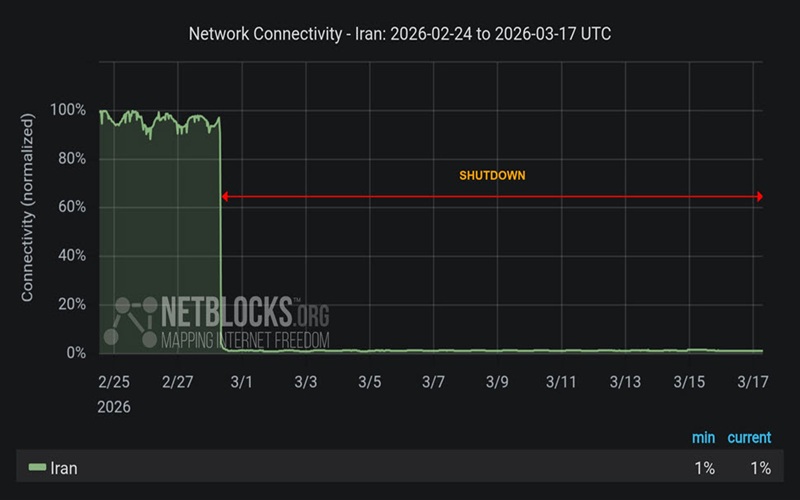
and internal repression
The internet shutdown in Iran has entered its eighteenth day, and citizens remain deprived of free access to communications. The regime’s Ministry of Intelligence claimed it had discovered and confiscated hundreds of Starlink systems (allegedly directed by the United States and Israel). This comes as the authorities have restricted internet access and maintained it only for regime-aligned networks. The shutdown is being used as a tool of repression to prevent the spread of news and images of the attacks and to control the flow of information. International reports indicate that this blackout began in January and internet traffic has dropped to about 1% of normal levels.
Broader consequences of the war
The day was accompanied by rising global energy prices as the threat to the Strait of Hormuz persists. While Israel focuses on targeting the Iranian regime’s leadership, Iran is responding with missile and drone attacks. Developments indicate the war remains a war of attrition, with no signs of an immediate ceasefire. The European Union emphasizes diplomacy, but its reluctance to engage in direct military involvement has kept the pressure on the United States and Israel.
The eighteenth day of the war once again demonstrated that the conflict is not only military but also has deep economic, communication, and humanitarian dimensions, and it has profoundly affected the future of the region.


