


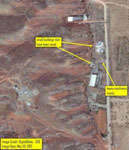
 Al Arabiya: From the Parchin nuclear reactor to obtaining plutonium, Iran is moving closer and closer to producing nuclear weapons.
Al Arabiya News
By Huda al-Husseini
From the Parchin nuclear reactor to obtaining plutonium, Iran is moving closer and closer to producing nuclear weapons. In Parchin Iran has conducted a process simulating the detonation of a nuclear bomb. On 25 May, satellite pictures showed the demolition of two buildings at the scene, leaving nothing but the trails of the bulldozers that cleared the buildings. Since the disclosure of these images Iran has proceeded to deny all this, most recently last Monday when the Iranian Defense Minister Brigadier General Ahmad Vahidi said that allegations that Iran was trying to erase evidence at the Parchin military base are “irrelevant and unwise”. This follows the previous clean-up process at the same site last April, in line with the “sterilization” operations which the regime set out on in Lavizan-Shian in 2004, where secret nuclear research was conducted at the center for physics research.
These activities raised suspicions about Iran’s military nuclear activities and ultimately led exposed this. This also led to some international pressure on Iran with regards to the Parchin site.
On the other hand, there are limits to the extent to which Iran can prevent international inspectors’ access, regardless of the statements that have been issued from Tehran. Iran’s most recent accusations are that the inspectors are “Western spies” whilst in reality Parchin is at the heart of the current conflict, whilst other issues that raise concern regarding Iran’s race to obtain nuclear weapons are also coming to the surface. These issues are complicated by Iran returning to its long-term strategy of stalling, avoiding confrontation and trying to exploit the differences in international players’ stances, taking advantage of talks about the nuclear file until all such talks are exhausted.
Over recent months, the Iranian regime has directly violated all international demands by installing new centrifuges at the Fordow underground facility, near the city of Qom. This has allowed Iran to produce 20-percent enriched uranium faster than ever before. In December 2011, Iran had the capacity to produce approximately 50kg of 20-percent enriched uranium in Qom. However, a few months later in May 2012, this figure had trebled to 150kg in the city of Qom alone. Iran is also producing enriched uranium in the Natanz reactor.
Moreover, instead of freezing this high level of enrichment, as is the international demand, and ceasing all activities in Qom – the site that Iran has tried to keep secret from the entire world – the Iranian regime is not only speeding up its uranium enrichment but it is working to build a facility to contain the gas expelled during nuclear enrichment, in addition to those currently operating in Qom and Natanz. The possibility of a third enrichment station was discussed in a recent report by the Institute for Science and International Security [4 June, 2012]. Thus, if Iran succeeds in its attempts, it will have three uranium-enrichment stations in operation.
It is well known that moving from 20-percent enrichment to 90- percent enrichment (the average required for manufacturing weapons of mass destruction) takes less time and effort than reaching 20-percent enrichment. Therefore, it is no exaggeration to say that there are countries that view Iran – in light of this development – as an existing and future danger. It is noticeable that the pretexts provided by Iran to embark on increasing the level of its uranium-enrichment – to levels required for nuclear weapons – have been mocked by nuclear experts, in the same manner as Iran’s recent statements claiming that International Atomic Energy Agency [IAEA] experts are “western agents”, and therefore should not be allowed to access Iran’s nuclear facilities. Iran, for example, claims that it requires nuclear fuel rods to produce medical radionuclide. According to a nuclear exert, this is incorrect because “Iran was successful in collecting 140 kg of 20-percent enriched uranium, an amount sufficient to operate several research reactors in Tehran for years.” He added that Iran’s claims that it requires greater-enriched uranium for future use cannot be trusted, and it is clear that this represents a blow to the forthcoming round of diplomatic negotiations, whilst it also represents a slap in the face to the efforts that have been exerted by IAEA Secretary-General Yukiya Amano.
In fact, Iran prepared an additional enrichment base within Qum facility with pre-prepared empty castings ready for the installation of a centrifugal pump, in a measure seen as a challenge to the international community’s demands. The nuclear expert also stressed that Iran is doubling its enrichment capabilities and that the observers who are keeping a watchful eye on the statements issued by the Iranian regime are quite certain of this. In June 2011, Dr. Fereydoon Abbasi-Davani announced that the Islamic Republic of Iran intends to triple its 20-percent uranium enrichment in Qom, and this is precisely what happened.
There is another field in which Iran is blatantly violating all its international commitments. Secretly, Tehran is seeking to obtain platinum as an alternative in the production of nuclear weapons. Late last year, one of the systematic crime gang within the “Commonwealth of Independent States” – including Azerbaijan, Armenia, Belarus, Georgia, Kazakhstan, Kyrgyzstan, Moldova, Russia, Tajikistan, Turkmenistan, Uzbekistan and Ukraine – managed to secretly contact an Iranian agent with the purpose of selling plutonium at the price of $2 million per kilogram. Iran requires only 6 kilograms of plutonium for a nuclear weapon, although a nuclear expert claimed that a nuclear bomb could be manufactured with even less.
This Iranian expert is well-known in the arena of nuclear proliferation and he has close connections all across Eastern Europe, Russia and Turkey. According to the same source, samples were sent to Iran for testing. Perhaps, the Iranian middleman is working directly or indirectly with the Iranian state. Yet, without a doubt, if this agent managed to acquire military-grade plutonium, this would no doubt end up in the hands of Iranian officials, whether we are talking about political officials or the mullahs.
The Iranian regime’s long history in utilizing unofficial channels to import fusion weapons material (uranium and plutonium) in order to save time would certainly allow the Iranians to purchase plutonium independently, even without the use of middlemen. In light of all these developments, it is no longer odd that the US envoy to the IAEA expressed his disappointment at the failure of the recent negotiations between the Iranians and the IAEA which aimed to end the state of diplomatic inaction on this issue. Years pass, and Iran continues to violate its international commitments, hiding behind a fatwa issued by Ayatollah Ali Khamenei in which he pledged not to allow the production of nuclear weapons.
Therefore, Iran seems to be trying to fool the IAEA in order to prevent its observers from doing their jobs. It is ironic that the forthcoming round of negotiation will be held in Moscow, a country that sees Iran, Syria and North Korea as members of its axis. Therefore, it is not clear now whether Iran is ready to look for a solution to the prolonged nuclear crisis or not, given that the European Union intends to impose sanctions banning Iranian oil experts beginning from next month.
(The writer is a columnist for Asharq al-Awsat where this article was first published on June 16, 2012.)


