


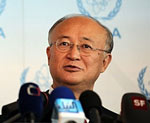
 Reuters: The U.N. nuclear chief told Iran on Monday it was “essential and urgent” for it to address concerns about suspected atomic bomb research, signaling his hope that the new government in Tehran will stop stonewalling his inspectors.
By Fredrik Dahl
VIENNA (Reuters) – The U.N. nuclear chief told Iran on Monday it was “essential and urgent” for it to address concerns about suspected atomic bomb research, signaling his hope that the new government in Tehran will stop stonewalling his inspectors.
Yukiya Amano was addressing a session of the U.N. agency’s 35-nation board, the first since relative moderate Hassan Rouhani took office as Iranian president in early August, raising cautious optimism of progress in the nuclear dispute.
Amano, director general of the International Atomic Energy Agency, said the IAEA was committed to working constructively with Rouhani’s government to “resolve outstanding issues by diplomatic means”.
His carefully chosen words underlined international hopes that Rouhani’s administration will be less confrontational in its dealings with the outside world than his hardline predecessor, Mahmoud Ahmadinejad.
Rouhani, keen to secure a relaxation of harsh international sanctions on Iran, has signaled readiness to be more open about Iranian nuclear activities in return for the acceptance of Tehran’s right to enrich uranium for peaceful purposes.
But Western diplomats stress that it remains to be seen whether Iran is prepared to curb its nuclear program, which they believe may be geared towards developing a nuclear weapons capability. Iran says it is entirely peaceful.
In his speech, Amano made clear that Iran had yet to show the level of cooperation that he wants from Tehran.
“Iran is not providing the necessary cooperation to enable us to provide credible assurance about the absence of undeclared nuclear material and activities,” he told the closed-door board session, according to a copy of his speech.
“The Agency therefore cannot conclude that all nuclear material in Iran is in peaceful activities.”
IAEA HAS “CREDIBLE INFORMATION” ON IRAN
An important test of whether Iran may be willing to soften its nuclear defiance, Vienna-based diplomats say, will be an IAEA-Iran meeting on September 27 to discuss what the agency calls “possible military dimensions” to Tehran’s atomic activities.
The two sides have held 10 rounds of negotiations since early 2012 in an attempt by the IAEA to resume its long-stalled inquiry.
The talks have failed to yield results but Iran last month announced it would replace the envoy who has led the country’s team in the discussions, in a possible sign of its desire for a new start after Rouhani’s election.
Iran’s new IAEA ambassador, Reza Najafi, attended Monday’s board meeting but made no immediate comment.
“Given the nature and extent of credible information available to the agency about possible military dimensions to Iran’s nuclear program, it remains essential and urgent for Iran to engage with us on the substance of our concerns,” Amano said.
He said Iran without further delay should provide access to a military base, Parchin, where U.N. inspectors believe it has carried out tests relevant for nuclear weapons development. Iran denies the charge, saying Parchin is a conventional army base.
So far there is no clear indication of Iran slowing its nuclear campaign. An IAEA report last month showed Iran preparing to test 1,000 advanced uranium enrichment centrifuges, enabling it to produce more quickly nuclear material that can have both military and civilian applications.
Iran says its nuclear energy program is for electricity generation and medical uses only, rejecting Western accusations it is covertly trying to develop the capability to make bombs.
The Iran-IAEA talks are separate, but still closely linked, to negotiations between six major powers – the United States, Russia, China, Britain, France and Germany – and Iran aimed at finding a broader diplomatic solution to the nuclear dispute.
(Reporting by Fredrik Dahl; Editing by Mark Heinrich)


