


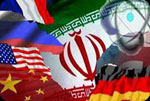
 UPI: When six world powers met with Iranian officials last week for the first time in 15 months, the talks were hailed in Europe as the first step toward a “negotiated solution” over fears of Tehran’s nuclear program. United Press International
By DAVID AMESS, UPI Outside View Commentator
LONDON, April 20 (UPI) — When six world powers met with Iranian officials last week for the first time in 15 months, the talks were hailed in Europe as the first step toward a “negotiated solution” over fears of Tehran’s nuclear program.
But was this really anything more than a public relations event?
Two days after the talks in Istanbul, Iran’s foreign minister made clear what game he was playing — saying only a quick end to the West’s sanctions would bring them closer to the negotiating table.
And then a day later, in a show of defiance, Iran flexed its “military might at a parade to mark National Army Day and its president warned against “foreign interference” from “the enemy.”
The sad truth is that these talks, and the further meeting tabled in Baghdad next month, are nothing more than a smokescreen from the Iranian regime, while behind the scenes it pushes ahead with the uranium enrichment program.
U.S. Secretary of State Hillary Clinton is right to say the “burden of action” is with Iran to prove it is serious in nuclear talks before any promises are made about easing sanctions.
Iran has lost about 40 percent of its oil export in the past six months and the currency has plummeted by almost the same amount: proof, albeit minimal, that sanctions are having some effect.
But if history has taught us anything it is that they will not be enough. Nor is foreign invasion the answer.
There is a third way for Iran, however: to break the shackles of oppression and allow a legitimate opposition to challenge the regime.
In that context, the fate of a group of 3,300 dissidents exiled in Iraq and under grave threat is of paramount importance. Protecting them from persecution is more than a humanitarian prerequisite. It is a geopolitical imperative.
The dissidents, members of Iran’s main opposition movement, the People’s Mujahedin Organization of Iran, want freedom for their country and a democratic future. Their very existence is a threat to the Mullahs, who have sought to destroy them.
One massacre at Camp Ashraf, their home near Baghdad, killed 36 residents and wounded hundreds more in April last year. Iraqi troops, at the behest of Iran, carried out the atrocity. The Shiite officials of Iraqi Prime Minister Nouri al-Maliki’s government went further in their allegiance with Tehran, by vowing to close Ashraf by the end of 2011.
An international campaign averted a disaster and after signing a Memorandum of Understanding between the United Nations and the government of Iraq, Maryam Rajavi, the leader of resistance, agreed for the residents to move to a new home.
At Camp Liberty, a former U.S. military base, they could be interviewed and relocated as refugees to third countries.
But of course it was not that simple. The Iraqis turned the home into a prison, penning the residents into a high-walled space no bigger than 1 square kilometer and subjecting them to inhumane conditions that failed to reach a minimum standard: there is a critical shortage of water and electricity and a broken sewage system.
Despite the duplicity of the Iraqis, the PMOI members have honored their part of the bargain. Four groups of Ashraf residents have now transferred to the camp — more than 1,200 people in total.
The Iraqis have continued to violate the agreement — the most recent batch of residents were searched for five days and then prevented from taking with them any vehicles, electricity generators or the engineering tools required to make Liberty a livable space. Even such items as air conditioners, stereos and satellite dishes were confiscated.
Now is the time for the United Nations and the international community to step in. First the residents’ most basic rights to their own property must be honored. The United Nations must recognize Camp Liberty as a refugee camp designed to be the mid-term home for the PMOI. Instead it is attributed a “Temporary Transition Location,” which deprives the residents of their most essential humanitarian standards.
Crucially, before more blood is shed, Western countries must provide necessary support to the United Nations for faster resettlement of the residents in third countries.
One arcane reason the asylum process is taking so long is that they are still designated as “terrorists” by the United States — a label attached to them in a different era when the West was seeking to appease Iran (in the interests of targeting Iraq).
The European Union and Britain “delisted” the Iranian dissidents years ago — and yet despite assurances from Secretary Clinton that their move to Camp Liberty would be a “key factor” in changing their status, the PMOI are still blacklisted.
If the United States is serious about finding a solution to Iran problem without a foreign invasion, it could do no better than to remove the shackles from the main opposition party.
In the spirit of the Arab Spring, Secretary Clinton may just find they are the most potent answer to Tehran.
(David Amess, a Conservative Member of Parliament from the United Kingdom, is a leading member of the British Parliamentary Committee for Iran Freedom.)


