


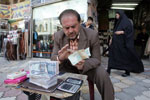
 Wall Street Journal: Sanctions may not bring Tehran to heel on nuclear arms, but they can undermine the regime. The decades of economic mismanagement by Iran’s authoritarian leaders have culminated in five years of increasingly stern sanctions, which are crippling Iran’s economy. The Wall Street Journal
Sanctions may not bring Tehran to heel on nuclear arms, but they can undermine the regime.
By EMANUELE OTTOLENGHI
 Ordinary Iranians are having to tighten their belts since the European Union’s oil embargo came into force on July 1. The decades of economic mismanagement by Iran’s authoritarian leaders have culminated in five years of increasingly stern sanctions, which are crippling Iran’s economy. And notwithstanding the regime’s defiant dismissal of their impact, sanctions have left many Iranian families with empty bank accounts and hollow stomachs.
While government fat cats are unaffected, ordinary Iranians must contend every day with a currency devalued by hyperinflation and an official unemployment rate of 29.1 percent for the under 25, which some analysts believe to be twice as high. And things are about to get worse. The threat of further sanctions in the wake of the oil embargo and a new U.S. ban on doing business with Iran’s central bank won’t only affect Iran’s energy sector.
It’s not just in their quality of life that ordinary Iranians are suffering. The state has long lost any legitimacy through its censorship and human-rights abuses. In recent weeks, not only have special forces begun to enforce the ban against satellite dishes with new intensity, but new raids on coffeehouses and stricter clothing regulations have exasperated an already frustrated population. A brain drain now threatens Iran’s ability to compete in the modern world.
Meanwhile, the regime’s paranoia for dark international conspiracies is running amok. Government officials blame “Zionist bankers” for the global economic downturn and impute a fierce drought in the country’s southern districts to a “soft war” waged by the West.
In a functioning democracy, an ill economy and an increasingly disaffected population would trigger a change of government, a drastic reassessment of national priorities or both. In Iran, the state can only try to pin the blame elsewhere, inventing enemies at home and conspiracies abroad while the house burns down around it.
Given the nuclear threat, however, Western powers dealing with Iran seem content to reach an agreement with this ruthless regime. Their strategic priorities are understandable but shortsighted.
For the West, the best way out of the current impasse is not an agreement that might give the state a lifeline, but a popular uprising in the pattern of the Arab Spring. Triggered by growing economic distress, such an event could topple Iran’s radical and irresponsible regime, allowing the emergence of leaders committed to democracy and ready to uphold Iran’s international obligations in a transparent fashion.
Skeptics will assert that betting on such a scenario is a fool’s errand. Three years ago, the regime successfully crushed post-election protests that the Obama Administration could not bring itself to support. But betting on Tehran’s continued stability under present conditions may be no safer.
Stronger sanctions will not persuade the regime to accept compromise over its nuclear program, as they were initially designed to do. A paranoid and oppressive regime is, after all, not likely to act reasonably at the negotiating table.
Instead, sanctions serve a better role as a tool to precipitate the regime’s collapse. When the oil embargo was adopted, skeptics both feared a dramatic price hike and doubted that an embargo would work without China and India on board. Six months later and with the help of lower global oil prices, Iran’s oil sales are down by more than a third. Even allies such as China are cutting down on their imports of Iranian oil—they can buy the remainder at a discount price.
Iran’s automotive industry’s sales are down by 36%, with 500,000 jobs in jeopardy as a result of sanctions. Layoffs at factories are routine. The country’s exports are rapidly declining. Even innocent sectors such as carpet sales are suffering. Sanctions must pile on the pressure—not because the regime will eventually compromise, but because ordinary Iranians will blame their rulers for the suffering they must endure on account of their nuclear follies.
For too long, the West has ignored Iran’s opposition, preferring a deal with the regime. After nine years of negotiations, there is no deal to be had.
The West should finally abandon its hesitation and more openly and aggressively support efforts by Iran’s opposition to bring about change inside their country. The sooner Iran’s regime collapses, the better. The better-prepared Western powers are when that happens, the less likely a transition is to result in chaos and create a breeding ground for extremism.
Mr. Ottolenghi is a senior fellow at the Foundation for Defense of Democracies and the author of “The Pasdaran: Inside Iran’s Islamic Revolutionary Guards’ Corps” (FDD Press, 2011).


