


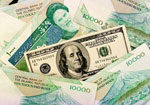
 Los Angeles Times: While the value of the rial has eroded for the past few years as Iran’s economic isolation has deepened, the severity of the drop worsened with surprising speed in recent days as Iranians rushed to sell rials for dollars. The Los Angeles Times
By RICK GLADSTONE
 Iran’s already fragile currency, the rial, has fallen in value by about 40 percent over the past week, battered by a combination of potent Western sanctions over the disputed Iranian nuclear program and new anxieties among Iranians about their government’s economic stewardship, analysts said.
While the value of the rial has eroded for the past few years as Iran’s economic isolation has deepened, the severity of the drop worsened with surprising speed in recent days as Iranians rushed to sell rials for dollars. By the end of the day on Monday, it cost about 34,800 rials to buy $1 in Tehran. The rate had been 24,600 rials as of last Monday.
“It’s sort of in a full-blown stampede mode today,” said Cliff Kupchan, a Washington-based analyst at the Eurasia Group, a political risk consulting firm. “There’s very little confidence among many Iranians in the government’s ability to adroitly manage economic policy.”
In another ominous sign, 10,000 Iranian workers signed a petition addressed to Iran’s labor minister complaining about the declines in their purchasing power and other economic maladies, suggesting that the accumulated impact of sanctions is putting more political pressure on the Iranian leadership, The Associated Press reported. President Mahmoud Ahmadinejad has said the sanctions, which are designed to force concessions on Iran’s nuclear program, would fail.
Mr. Kupchan and others said the catalyst for the currency drop this past week appeared to be a policy change by the Central Bank of Iran on Sept. 23 that had been intended to reduce the volatility of exchange rates but had the opposite effect.
Under the new policy, the central bank established a “foreign exchange center” that gives preferential rates to importers of priority goods like meats, grains and medicine. But economists said the central bank may have inadvertently telegraphed fears that it was low on dollars, or at least lacked access to a large part of its estimated $110 billion in foreign exchange reserves. Some of that money is frozen in offshore accounts.
“What we have now is a massive dumping of rials,” Mr. Kupchan said.
Djavad Salehi-Isfahani, an economics professor at Virginia Tech, said the actions of Iran’s monetary officials showed that “the central bank doesn’t know what to do in crisis times.”
He said the situation had been exacerbated by Mr. Ahmadinejad’s insistence that rates for borrowers and depositers could not exceed the inflation rate. One consequence was that few Iranians keep their money in banks. Worries that the government was not being upfront about inflation may have been further aggravated, Mr. Salehi-Isfahani said, by its decision a few weeks ago to stop publishing the inflation rate, which is officially 23.5 percent but probably much higher.
The shriveling value of the rial is now contributing to fears in Iran of a severe inflationary spiral, as an increasing amount of rials are required to buy food, medicine and machinery needed from abroad. At the same time, Iran’s ability to sell oil, its main export, has been severely hampered by the sanctions on the nuclear program, which Iran says is for the peaceful development of nuclear energy but Western nations suspect is intended to produce nuclear weapons.
Economists said the rial’s decline was one of the clearest signs that the accumulated impact of sanctions had deeply wounded the Iranian economy.
“When a currency collapses, you can be certain that other economic metrics are moving in a negative direction too,” Steve H. Hanke, an economics professor at Johns Hopkins University and a senior fellow at the Cato Institute, a conservative think tank in Washington, wrote in an article published this month in Globe Asia, a business magazine.


