


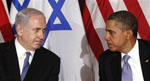
 Bloomberg: President Barack Obama and Israeli Prime Minister Benjamin Netanyahu emerge from their re-election campaigns confronting the same disputes that divided them last year: peace talks with the Palestinians, settlements and, above all, Iran’s suspected nuclear weapons program. Bloomberg
By Calev Ben-David & Nicole Gaouette
 President Barack Obama and Israeli Prime Minister Benjamin Netanyahu emerge from their re-election campaigns confronting the same disputes that divided them last year: peace talks with the Palestinians, settlements and, above all, Iran’s suspected nuclear weapons program.
Those differences will fade as the challenge of stopping Iran’s nuclear efforts forces them to pull together this year, said Zalman Shoval, Netanyahu’s ambassador to the U.S. from 1998-2000 and an adviser to the premier on diplomatic affairs.
“Obama and Netanyahu know they have to work together over the next few years on urgent regional issues, especially Iran,” Shoval said. “Even if there are all sorts of personal and political reasons preventing complete harmony, the cooperation will have to be close.”
Results of this week’s Israeli election may ease the leaders’ sometimes fractious relationship. Pre-election polls predicted that Jewish Home, a party that supports settlement- building and opposes any Palestinian state, would emerge second in size to Netanyahu’s Likud-Beitenu. Instead it was the Yesh Atid party, a more moderate faction led by television presenter Yair Lapid, that won the most votes after Likud-Beitenu.
“Yesh Atid will provide Netanyahu’s coalition with the image of a more moderate government,” assuming the party decides to pursue an alliance, said Eytan Gilboa, a professor of political science at Bar Ilan University outside Tel Aviv, who specializes in U.S.-Israeli relations. “Lapid has said he wants more effort made to negotiate with the Palestinians, and careful consideration given to any action against Iran.”
Iran Discord
White House spokesman Jay Carney said the election results would not affect “our unshakable commitment to Israel’s security.” He called for “direct negotiations” between Israel and the Palestinians toward a two-state solution.
Tensions between the U.S. and Israel flared in September when Obama and Netanyahu disagreed about when Iran would have enough enriched uranium to reach “breakout capacity,” the point at which a nuclear weapon could be assembled quickly.
Netanyahu, 63, called for “red lines” to be set for military action if Iran continues to enrich uranium. U.S. officials said such a move would limit their options, adding that they prefer to focus on economic sanctions with European partners.
The friction eased when the Israeli premier told the United Nations on Sept. 27 that he would extend his horizon for a strike against Iran from October to early this year. The next day, Obama said in a statement that the two leaders were in “full agreement.”
Strategic Relations
“On Iran, the differences have decreased considerably,” said Gerald Steinberg, professor of political science at Bar Ilan University in Ramat Gan, Israel. “These disagreements are more about ideology and personality, not about security or strategic relations.”
U.S. ties with Israel are underpinned by American-Jewish political influence, strong evangelical Christian support and a security relationship in which Israel has been a stable and reliable ally since the Cold War. In the past two months, the U.S. stood behind its ally during the conflict in Gaza in which more than 150 Palestinians and five Israelis died, and the Palestinian bid for statehood at the UN.
The U.S. also is Israel’s single biggest trading partner, with $17.6 billion in exports and $9.4 billion in imports in 2012, according to Israel’s Central Bureau of Statistics. Israel has 54 companies traded on New York’s Nasdaq Stock Market, the most of any country outside the U.S. after China.
Palestinian Issue
Obama, 51, has aired his unhappiness about the construction of Jewish settlements in the West Bank, which Israel captured from Jordan in the 1967 Mideast War. According to Peace Now, an Israeli group that favors negotiations with the Palestinians, Netanyahu’s previous coalition government issued a record number of tenders for West Bank housing during the past 47 months.
Increased settlement construction makes the resumption of the peace process and the possibility of negotiating a two-state solution more remote, said Philip Wilcox, a former State Department Mideast expert who’s now president of the Foundation for Middle East Peace, a Washington policy group.
The issue poses a “huge dilemma” for the U.S., which has built its relationship with Israel on the basis of shared values and interests, Wilcox said. If Israel moves toward a situation where Jews are a ruling minority in a unitary state, the country will be neither Jewish nor democratic, and that “removes the moral underpinnings of the U.S.-Israeli relationship,” he said.
The tension over confronting Iran may worsen if there’s a serious divide on the Palestinian issue, said Yehuda Ben-Meir, a fellow at the Institute of National Security Studies at Tel Aviv University. “It could have a spillover effect on the Iranian issue,” he said.
Hagel Nomination
Obama’s nomination of former Nebraska Republican senator Chuck Hagel to head the Defense Department has deepened concerns about Iran. The speaker of Israel’s parliament, Reuven Rivlin, said Jan. 8 that he was “worried” about how Hagel’s “cautious isolationism” would affect American foreign policy.
Some fellow Republicans, including Arizona Senator John McCain and South Carolina Senator Lindsey Graham, have attacked Hagel for not being supportive enough of Israel or hard enough on Iran. Hagel will be asked about that at his Jan. 31 confirmation hearing before the Senate Armed Services Committee.
Jeremy Ben-Ami, president of J-Street, a Washington-based lobby group for pro-Israel Americans that supports negotiations to create a Palestinian state in the West Bank, said he has noticed a shift in American attitudes toward Israel.
American Shift
Just 33 percent of Democrats in the U.S. House of Representatives signed a letter in December asking the White House to punish Palestinians for seeking recognition at the UN, Ben-Ami said. Such letters get usually unanimous backing, he said.
“To the extent that the new direction of Israeli politics takes that country in a direction that runs counter to American values and interests, that will be very tough for the relationship between the two countries,” Ben-Ami said.
Obama’s Jan. 21 inaugural address suggested his focus in the second term will be on domestic issues rather than foreign policy. His only brief reference to foreign policy indicated he believes there’s more time for diplomacy to resolve the Iran issue.
“We will show the courage to try and resolve our differences with other nations peacefully, not because we are naive about the dangers we face, but because engagement can more durably lift suspicion and fear,” he said.
Diplomatic Process
The nomination of John Kerry for Secretary of State caused less concern among Israel’s supporters. In February 2009, Kerry was the highest-level U.S. official to visit the Gaza Strip since Hamas seized control of the territory in June 2007. He didn’t meet with Hamas, which has been designated a terrorist organization by Israel, the U.S. and the European Union.
Shoval said Netanyahu is aware of the need to present a government that will make it possible for him to engage in “some sort of diplomatic process” with the Palestinians, and noted that there are always points of disagreement over which Israel and the U.S. agree to disagree.
They won’t be able to do that on Iran, said David Makovsky, research director at the Washington Institute for Near East Policy.
“Obama and Netanyahu understand one thing very well,” he said. “The Iran issue in 2013 is going to test their relationship like nothing else has.”


