


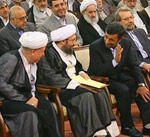
 Roll Call: Dating back to the Carter administration, not long after Ayatollah Khomeini replaced the Shah, the U.S. and other Western governments have been looking for “moderates” in Tehran with whom to negotiate.
Roll Call
By Howard Dean and Tom Ridge
The more things change, the more they remain the same.
These words, written more than a century ago, have a modern application in the history of the West’s impressions of the theocratic government of Iran.
Dating back to the Carter administration, not long after Ayatollah Khomeini replaced the Shah, the U.S. and other Western governments have been looking for “moderates” in Tehran with whom to negotiate.
There was Hashemi Rafsanjani, then Mohammad Khatami, then Mahmoud Ahmadinejad, and now Hassan Rouhani — but looming over them all has been the all-powerful Supreme Leader Ayatollah Ali Khamenei.
Different names, different personalities, different styles — but one thing in common: They are ultimately subservient to the wishes of the supreme leader.
Yet the West continues to seek a silver lining in the cloud that has covered Iran for decades. American and European negotiators keep looking for “moderates” to discuss issues ranging from nuclear weapons to sanctions to Iraq, with much more in between. And while the seemingly unending search continues, Iran keeps its nuclear program moving full speed ahead.
The West keeps looking. The mullahs keep building and they continue to export terrorism around the world, supporting the Assad regime in Syria, Hezbollah in Lebanon, while gaining more influence in Iraq than the United States has.
In Iran, a “moderate” is one who grudgingly receives the approval of the Supreme Leader’s Guardian Council, and is moderate only to the extent that he is less extreme than the few others the Council permitted on the ballot. Is being less extreme than Ahmadinejad a sign of moderation? That would be a strange definition.
Perhaps the greatest danger from Iran is its growing influence in Iraq. The U.S. took Iraq’s (and Saddam Hussein’s) side when those two nations warred for eight years in the 1980s, shortly after the anti-Shah revolution in Iran.
When the Iran-Iraq war ended, there was no real victor. But 20 years later, after the U.S. overthrow of Saddam and installation of a new government in Baghdad, it seems clear that Iran has indeed won that war with a large assist from blundering American foreign policy.
The Nouri al-Maliki government appears subservient to Iran, to the detriment of Iraqis who seek democracy and to the Iranian refugees who had been protected by the U.S. until the withdrawal of the troops in 2011. Particularly at risk are the 3,200 dissidents who had lived peacefully at Camp Ashraf north of Baghdad for a quarter century. At the end of 2011, they agreed to be relocated to Camp Liberty, closer to the capital, supposedly to be processed by the U.N. refugee agency for transfer to third countries. This relocation was mandated by the U.N. and the U.S.
Sadly the UN and the U.S. have looked the other way as these refugees have been housed in sub-human conditions and denied basic rights. Very few have been resettled.
Worse, they have been subjected to three violent armed attacks in little over a year, either by or at the behest of the mullahs in Tehran, resulting in 10 deaths and 170 wounded. The latest took place in June of this year.


