


 American Thinker: Since the June election of Hassan Rowhani as the new president of Iran, optimism in the West for negotiations with the Islamic state over its illicit nuclear program has been increasing. That optimism is misplaced.
American Thinker
By Reza Kahlili
Since the June election of Hassan Rowhani as the new president of Iran, optimism in the West for negotiations with the Islamic state over its illicit nuclear program has been increasing. That optimism is misplaced.
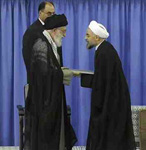
Rowhani, whom the Western media dubs a moderate and who was the head of Iran’s nuclear negotiating team in 2003, took the oath of office on August 4, promising conciliation and openness in future negotiations. In return, the Obama administration and European officials indicated that they are ready for serious and hopefully fruitful negotiations.
There’s only one problem. Rowhani isn’t a moderate — he is the man most trusted by the supreme leader and has served the Islamic Republic at the highest levels since the 1979 revolution, among them as the deputy speaker of Parliament, the head of the Executive Committee of the High Council for War Support during the Iran-Iraq War, the deputy to the second-in-command of Iran’s joint chiefs of staff, a member of the Expediency Council, a member of the Assembly of Experts (the body that chooses the supreme leader), a former nuclear negotiator, and, most importantly, the representative of the supreme leader to the Supreme National Security Council since 1989.
And he knows all too well how to stall.
Based on Iran’s history of stonewalling in the talks while it works feverishly on building nuclear weapons and missile delivery systems, the Islamic regime will continue to play the West as it buys even more time to reach its goal: being a nuclear-armed state.
Last Tuesday, two days after taking office, Rowhani stated that there would be no surrender on the nuclear issue. “Iran’s peaceful nuclear program is a national issue … we will not give up the rights of the Iranian people,” AFP quoted him as saying. “We will preserve our rights based on international regulations.”
For over a decade of negotiations, the regime has stated that Iran has the right under the Nuclear Nonproliferation Treaty to enrich uranium for peaceful purposes and has refused both inspection of several suspected sites and suspension of its enrichment of nuclear materials to the 20 percent level, which could in weeks provide the regime with a breakout for further enrichment to weapons grade.
The supreme leader, Ayatollah Ali Khamenei, isn’t the power behind the presidential throne. He is the power, period, and Rowhani, whom Khamenei approved to enter the election, will do his bidding. And Khamenei wants the ability to counter the United States and Israel.
According to a former intelligent analyst now defected to a Scandinavian country, Rowhani’s election was a calculated move by the supreme leader to not only provide false hope to Iranians suffering under internal policies and external sanctions, but also provide false hope to the West for a negotiated solution, creating another barricade against Israel taking unilateral action.
A proof of such long-term regime strategy is the video I released recently, in which Rowhani, in an interview prior to the June elections, bragged about deceiving the West during his tenure as Iran’s head nuclear negotiator.
“The day that we invited the three European ministers [to the talks],” he said, “only 10 centrifuges were spinning at [the Iranian nuclear facility of] Natanz. We could not produce one gram of U4 or U6 [uranium hexafluoride]. … We did not have the heavy-water production. We could not produce yellow cake. Our total production of centrifuges inside the country was 150. We wanted to complete all of these [nuclear programs] — we needed time.”
And time is exactly what he got — more time to concentrate on building nuclear weapons.
In the video, Rowhani called claims that Iran stopped its nuclear program in 2003 a statement for the uneducated and admitted that the program not only was not stopped, but was significantly expanded under his tenure.
While President George W. Bush was increasing pressure on Iran in 2007, a report by American intelligence agencies concluded that Iran had halted its nuclear program in 2003 and that the program had remained frozen since.
In the interview, Rowhani said that when he took over the country’s nuclear project, the country’s 150 centrifuges grew to over 1,700 by the time he left. It now has more than 10,000 and is well on the way to becoming the world’s next nuclear power. But the threat doesn’t end there. It is estimated that Iran will achieve intercontinental ballistic missile delivery capability by 2015, bringing the U.S. within its reach.
The West must push the new Iranian president for a peaceful resolution to its illicit nuclear program, and as it does so, it must remember the regime’s history of deceit and that by next year, Iran’s nuclear program will most likely be complete.
Think of the consequences to the global economy and world stability if the Islamic regime becomes a nuclear-armed state while it continues its support of terrorism.
Iran sits on the Persian Gulf, through which over 20 percent of world energy passes. Any threat to that waterway would create instability in the energy market, destabilizing the global economy.
The regime, seeing itself as untouchable, would then take the world hostage. That must not be allowed.
Reza Kahlili is a pseudonym for a former CIA operative in Iran’s Revolutionary Guard and author of the award-winning book A Time to Betray (Simon & Schuster, 2010). He serves on the Task Force on National and Homeland Security and the advisory board of the Foundation for Democracy in Iran (FDI).


