


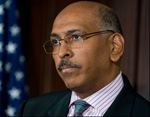
 MSNBC: Maliki’s failure to be a true partner with the U.S. and his cozy relationship with Iranian President Hassan Rouhani, as well as his recent actions, have created more problems than solutions for the United States.
MSNBC
By Michael Steele
 Iraqi Prime Minister Nouri al-Maliki met with President Barack Obama in Washington on November 1st, and leading up to his visit, White House press Secretary Jay Carney put his best diplomatic smiley-face on it by noting “the visit will highlight the importance of the U.S.-Iraq relationship under the U.S.-Iraq Strategic Framework Agreement (SFA),” and that Obama “looks forward to discussing with Prime Minister Maliki efforts to enhance cooperation in the fields covered under the SFA, and to coordinating on a range of regional issues.”
Of course, after the two-hour meeting, President Obama remarked, “The United States wants to be a strong and effective partner with Iraq.” No doubt. Maliki came seeking more weapons and the president sought a “strong and effective partner.” While this face-to-face meeting may have served to raise Maliki’s diplomatic profile, in the eyes of many it diminished the profile of the United States and its professed commitment to justice, human rights, and international law. The president should have refused this meeting.
No one should doubt, least of all Prime Minister Maliki, that he owes his position to the United States, which sacrificed its blood and spent billions of its treasure to pave his way to power. But Maliki’s failure to be a true partner with the U.S. and his cozy relationship with Iranian President Hassan Rouhani, as well as his recent actions, have created more problems than solutions for the United States.
On September 1, 2103, at the apparent request of the Iranian Mullahs and on the orders of Nouri al-Maliki, Iraqi security forces attacked and killed 52 Iranian refugees (and kidnapped seven, including six women) at Camp Ashraf in eastern Iraq.
Camp Ashraf was settled more than 25 years ago by 3,400 members and sympathizers of the principal Iranian opposition known as the People’s Mojahedin Organization of Iran (PMOI/MEK). The U.S. military disarmed Ashraf City in 2003, and in 2009 turned over control of the camp to the Maliki government in Baghdad. At that time, the United States assured residents of Ashraf City that the Iraqi government would treat them humanely in accordance with international law. As refugees, members of the opposition and their families are protected persons according to the Fourth Geneva Convention, and should not be subject to harassment, much less kidnapping and murder by the military forces of Iraq.
Last year, some 3,000 residents of Camp Ashraf were forcibly transferred to Camp Liberty, near Baghdad. 52 of those remaining at Camp Ashraf would meet a different fate.
In the attack, most of the murder victims were handcuffed, identified, and then executed with a bullet to the head, according to a statement by the UN Assistance Mission in Iraq. Some were slaughtered in Ashraf clinic where they had been taken for medical treatment. All of these individuals had signed an agreement in cooperation with the United States, which had guaranteed their safety and protection until their final relocation. The U.S. failed to keep its word.
While the United States, the UN, the European Parliament, and Amnesty International all condemned the massacre and kidnapping, world leaders have been hesitant to affix responsibility, particularly in the face of reports of “coordination” between the Maliki and the office of Iranian Supreme Leader Ali Khamenei.
As Congressman Dana Rohrabacher (R-CA), Chairman of the House Foreign Affairs Subcommittee on Europe, Eurasia and Emerging Threats noted in a statement, “The Iraqi military is murdering unarmed refugees, and there is every reason to believe Prime Minister Maliki, at the behest of the Iranian Mullahs, ordered these criminal acts. Come what may, Maliki will be held responsible for this reprehensible slaughter of civilians in his own country.” Likewise, Senator Robert Menendez (D-NJ), Chairman of the Senate Foreign Relations Committee made clear “I hold the Iraqi government directly responsible to protect the community, to investigate this matter thoroughly, and to prosecute the perpetrators of this heinous act.”
Which makes Maliki’s visit to the White House that much more problematic.
For Maliki, the man whose cooperation with the Iranian clerics was crucial to carrying out this atrocity, to enjoy the prestige of a personal meeting with President Obama is totally unacceptable. For many Americans, let alone Iranians, Maliki has clearly betrayed the trust that the United States displayed in him; and has undermined the very safety and security the United States had promised to those refugees.
No political consideration or calculus to compel Maliki to release the hostages is immoral, misguided, or unacceptable. The lack of meaningful action by the U.S. in support of the hostages and the failure to hold accountable those who slaughtered 52 men and women is inexcusable.
Maliki’s visit presented the perfect occasion for President Obama to honor the commitment made to protect the refugees now at Camp Liberty; a commitment that can only be ensured by moving the refugees out of harm’s way and returning them to their homes.
Moreover, the visit afforded the president the opportunity to make it clear to Maliki that there will be no more U.S. aid, no more arms sales and no further political support unless the 7 refugees taken hostage at Camp Ashraf are released and full protection is provided for the 3000 refugees at Camp Liberty. At least that’s what a “strong and effective partner” would have done last Friday.
Michael Steele was the Chairman of the Republican National Committee


