


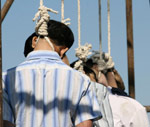
 UPI: This controversial drug control program, financed both bilaterally and via the UNODC, has enabled the regime in Tehran to carry out a “killing spree of staggering proportions” as Amnesty International puts it.
United Press International
By Mosa Zahed, UPI Outside View Commentator
LONDON, Jan. 23 (UPI) — Last year I wrote an op-ed on Iran’s bloody “war on drugs,” which has led to hundreds of executions and sent thousands to death row.
I criticized the U.N. Office on Drugs and Crime and Western countries as they continued to finance a controversial drug control program in an attempt to tackle illicit drug trade on a key route, which goes through Afghanistan, Iran, the Middle East and Europe.
This controversial drug control program, financed both bilaterally and via the UNODC, has enabled the regime in Tehran to carry out a “killing spree of staggering proportions” as Amnesty International puts it.
Iran is a country that lacks proper rule of law or judicial oversight and many of supposed drug-related executions were sanctioned following grossly unfair trials.
Human rights groups have indicated that members of marginalized groups, including impoverished communities, ethnic minorities and foreign nationals, particularly Afghans, are most at risk of execution for drugs offenses.
Some disturbing human rights reports indicate that political prisoners have been executed after being charged with drug-related crimes in an effort to tarnish their names.
There are some politicians in the West who have been voicing hope after Iranian President Hassan Rouhani assumed office in August last year that the overall human rights situation will improve. Former Secretary of State for Foreign Affairs of the United Kingdom Jack Straw, for example, went as far as to say that, “In Hassan Rouhani’s Iran, you can feel the winds of change.”
However, execution figures from 2013 undoubtedly paint a different picture and shatter any hope or optimism whatsoever. The Iranian regime executed 660 people, of whom 430 were put to death after the June presidential elections. There are indeed “winds of change” to be felt; the serious surge of executions, which the likes of Jack Straw shamefully fail to address in their opinion pieces.
In a recent statement issued by Amnesty International, the human rights group underscored the surge of executions. From the start of this year, 40 executions have been carried out of which 21 were officially acknowledged by the Iranian authorities. Amnesty International further argued that, “Most of those executed in Iran had been convicted of alleged drug-related offenses.”
The government of Ireland announced in November last year that it stopped funding the controversial drug-control program in Iran because of human rights concerns related to the death penalty, following a similar decision made a few months earlier by the government of Denmark.
Irish Minister of State at the Department of Foreign Affairs Joe Costello explained the government’s position that it couldn’t be party to funding the death penalty. Costello elaborated that, “We have made it very clear to the UNODC that we could not be party to any funding in relation to where the death penalty is used so liberally and used almost exclusively for drug traffickers.” The Irish government has funded the UNODC from 2005-11 with a total amount of $812,000.
However, Britain and France appear to remain steadfast in financing death by providing the Iranian authorities with millions of dollars over the past few years, which is one of the main reasons why Iran leads the world in per capita execution rate, as it uses this aid to strengthen Iranian enforcement agencies in order to effectively track down and arrest “drug traffickers.”
The UNODC leadership doesn’t appear to be at all bothered by the fact that its funds are used by the Iranian authorities to execute “drug offenders” at such a devastating rate. Yury Fedotov, then executive director of the UNODC, visited Iran in 2011 and had nothing but praise for Iran’s counternarcotics work. He failed to raise the issue of unfair trials and the lack of due process of those whose arrests and executions were made possible through the UNODC funds.
Leik Boonwaat, representative of the UNODC, met with Iran’s Interior minister last December. In an interview with Press TV following his meeting, he stated regarding Iran’s “war on drugs” that, “I think what Iran is doing is very commendable, helping to reduce the drugs that would otherwise end up on the streets of Europe, the [Persian] Gulf states and other parts of the world and every assistance should be extended to Iran in this global effort I think.”
The logic within the higher echelons of the UNODC appears to be that the killing of Iranian “drug traffickers,” mainly vulnerable individuals and innocent victims, is justified as long as the narcotics don’t end up elsewhere around the world.
The ironic part is that while funds reached the Iranian authorities uninterrupted, allowing them to carry on with their bloody “war on drugs,” the Iranian Revolutionary Guard was able to establish an international drug cartel — a very profitable enterprise run directly and through its proxies.
—
(Mosa Zahed is the founding director of the Middle East Forum for Development, a non-governmental organization in London. He is a doctoral student at Leiden University in game theory and conflict analysis.)


