


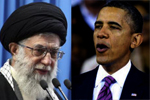
 The Hill: When a leader is in trouble, his instinct is to look elsewhere for a potential success. This suggests to many policy analysts that the president may be sorely tempted to go all-out for a deal with Iran — any deal he can portray as a success, even if it isn’t. What would a serious post-nuclear strategy look like? I have long advocated supporting the internal Iranian opposition.
The Hill
By Michael Ledeen
Everything is coming up thorns for the Obama administration in the Middle East these days, and several of its policies seem to change daily. Take its stand on Syria’s tyrant, Bashar Assad. One day Obama says “Assad must go,” the next his aides whisper that it might be good for Assad to stay for a while longer. This is only one of many policies that have changed with equal speed, such as shifting from opposition to the Egyptian military government to support for, and cooperation with, General Abdel Fattah al-Sisi. And President Obama has crossed so many of his own red lines on Syria and Iraq that it’s hard to keep track of his actual geopolitical position.
All of this is recognized by the American public and foreign leaders, as we see from Obama’s low popularity at home and in the expressions of contempt from both hostile and friendly foreign governments and regimes, from the Middle East to Europe and even Latin America.
When a leader is in trouble, his instinct is to look elsewhere for a potential success. This suggests to many policy analysts that the president may be sorely tempted to go all-out for a deal with Iran — any deal he can portray as a success, even if it isn’t. Two recent examples: Mark Dubowitz and Richard Goldberg have been writing about the “sunset” provisions of any agreement, which sanctions to keep in place (as they are linked to Iranian evil practices aside from making nukes), and how to manage the easing of sanctions; and Graham Allison and Oren Setter worry that we’re focusing too narrowly on how Iran might successfully make nuclear weapons.
These are all serious people. They are raising serious issues, and they are wisely urging congressional leaders to stay on top of the Iran negotiations, and to think ahead, especially if a deal is agreed. Critics always keen to read men’s minds have been quick to read sinister or laudable intent into the discussion, which is what critics do when they can’t deal with the serious substance.
We would do well to avoid trying to read men’s minds, and try to answer two tough questions.
First, our problems with Iran go way beyond the nuclear deal. If we could wave a magic wand and cause the entire nuclear project to disappear, we would still have to contend with a radical Islamist regime that has declared war on us, and is waging it from the Middle East to South America.
What would a serious post-nuclear strategy look like? I have long advocated supporting the internal Iranian opposition.
Second, what if the Iranians are secretly conducting nuclear activities that we do not currently see, and one morning we awake to find they have nukes?
Then what?
We pay our leaders to deal with such questions, and not just to make a limited deal that they can sell as a foreign policy triumph. At most the deal can only manage a small piece of a very big problem.
Ledeen, the author of more than 30 books, is the Freedom Scholar at the Foundation for Defense of Democracies. He was special adviser to former Secretary of State Alexander Haig and a consultant to the national security adviser during the Reagan administration.


