


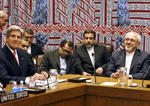
 Wall Street Journal: As it prepares for four more months of nuclear talks with Iran, the U.S. faces a disadvantage: Even if there is ultimately no agreement, Tehran will pocket the considerable concessions Washington has already made. The U.S. will need to correct strategic and tactical shortcomings by bolstering the credibility of the alternatives to making a deal.
The Wall Street Journal
By Michael Singh
As it prepares for four more months of nuclear talks with Iran, the U.S. faces a disadvantage: Even if there is ultimately no agreement, Tehran will pocket the considerable concessions Washington has already made. Iran will then argue to the world that it has proven its reasonableness and that sanctions should no longer be respected; failing that, it will begin the next round of talks having established a new nuclear baseline.
The challenge for U.S. negotiators, then, is not just to reach an agreement but also to change Iranians’ minds about the consequences of not reaching an agreement.
In any negotiation, the zone of possible agreement, or range of outcomes acceptable to both sides, is determined by how each side answers two questions: How valuable is a deal (based on its particulars, the offering party’s trustworthiness and the legal framework upholding it)? And is the most likely alternative to an agreement better or worse for each side’s interests?
The Obama administration has focused on the first question, making clear that it is more willing than its predecessors to accept a large Iranian nuclear program and engaging directly with Tehran to build trust.
Meanwhile, it has failed to persuade Iran that rejecting a deal would have alarming consequences. President Barack Obama’s hesitancy to use force in Syria and Iraq has undermined his military threats against Iran, and the specter of additional sanctions was undercut by the acrimony between the White House and Congress over the Kirk-Menendez bill on Iran sanctions. From Iran’s perspective–borne out by the recent extension of talks–the alternative to negotiations is just more negotiations. This diminishes its incentive to accept even a generous deal.
Negotiating tactics determine which among the possible range of outcomes is realized. So far, Iran’s tactical prowess has outmatched ours. The administration credits crippling economic pressure for bringing Iran to the negotiating table. But the interim agreement with Iran contained a vital concession Tehran had been seeking for years: U.S. acquiescence to uranium enrichment. So as considerable as the economic pressure was, it is impossible to know whether that alone would have been enough to induce an Iranian shift.
What’s more, the U.S. got little in return for this concession. Rather, it belittled its own previous position on zero enrichment as “maximalist” and even “ridiculous.” This enormous concession fundamentally changed American goals in the negotiations, yet our dismissal of the change prevented us from portraying it as such and extracting steps from Iran of similar magnitude.
This and other major concessions–for example, that the restrictions on Iran would be temporary, not permanent–were made in the interim agreement, before the current round of talks even began. As a result, the U.S. began the most recent talks having largely already reached our bottom line. Iran, on the other hand, started from a position that actually was “maximalist”: that it required not only the 19,000 centrifuges it then possessed but an additional 30,000 or more. Washington was thus on its back foot: Iran’s “compromise” of simply maintaining its current centrifuge stocks looked reasonable in comparison to its starting position, while Iranian negotiators could portray the U.S. as inflexible for making few additional concessions.
Going forward, the U.S. will need to correct strategic and tactical shortcomings by bolstering the credibility of the alternatives to making a deal–both sanctions and a military strike–and playing hardball at the negotiating table.
Michael Singh is managing director of the Washington Institute for Near East Policy. From 2005 to 2008, he worked on Middle East issues at the National Security Council.


