Home Blog Page 110

At Least 16 Prisoners Executed in Iran Over Two-Day Period

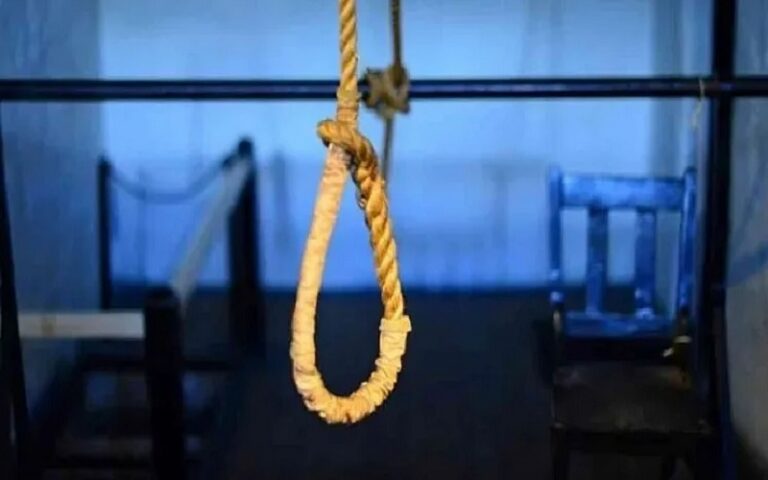
Reports from human rights sources indicate that from Tuesday, April 8 to Wednesday, April 9, at least 16 prisoners—including five political prisoners and three women—were executed in prisons across Iran.

According to the human rights website HRANA, these individuals were hanged in various prisons across Iran, including in the cities of Gonabad, Mashhad, Karaj, and Shahroud.

Among those executed on April 9, at least four were hanged in Ghezel Hesar prison in Karaj, one in Shahroud prison, and one in Gonabad prison.

The prisoners executed in Gonabad and Shahroud were sentenced to death for drug-related charges, while the four executed in Ghezel Hesar prison in Karaj were convicted of murder.

Additionally, on April 8, at least ten prisoners, including five political prisoners and three women, were hanged in Vakilabad prison in Mashhad.

Execution of 1,050 People and Crackdown on 30,000 Women for Not Wearing the Hijab

According to HRANA, four of these prisoners, including two women, had previously been sentenced to death for drug-related offenses. Another female prisoner was executed for murder.

Earlier on April 8, HRANA reported the execution of five political and ideological prisoners in Vakilabad prison in Mashhad, stating that the sentences were carried out without prior notice and without giving the prisoners a chance for a final meeting with their families.

Farhad Shakeri, Abdolhakim Azim Gorgij, Abdolrahman Gorgij, Taj Mohammad Khormali, and Malek-Ali Fadaei-Nasab are the five political prisoners who were executed at dawn on April 8 in Vakilabad prison in Mashhad. They had been convicted of “rebellion against the Islamic ruler through membership in the National Solidarity Front of Sunni Iranians.”

Isa Eid Mohammadi, another defendant sentenced to death in the same case, remains in Ward 6/1 of Vakilabad prison in Mashhad and is at risk of execution.

The death sentences of Hamid Rastbala, Kabir Saadat Jahani, and Mohammad Ali Arayesh, three other defendants in this case, had already been carried out in January 2021.

In recent months, the rising number of executions and the issuance and confirmation of death sentences for political prisoners in Iran have sparked waves of protest both inside and outside the country.

In one of the latest examples, the “Tuesdays Against Executions” campaign issued a statement on April 8 warning of the increasing risk of executions and called on the international community to condition any relations with Iran’s regime on the complete abolition of the death penalty in the country.

On the same day, a group of family members of political prisoners sentenced to death gathered in front of Evin Prison in Tehran, holding photos of the condemned prisoners and placards with slogans such as “No to Execution” and “Immediate Repeal of Death Sentences.”

In its annual report on capital punishment released early on April 8, Amnesty International announced that the regime in Iran was responsible for 972 executions in 2024, accounting for over 64 percent of all recorded executions globally.


U.S. Sanctions on Iran Ahead of Bilateral Talks in Oman

The U.S. Department of the Treasury has imposed new sanctions on Iran’s regime, targeting companies involved in its nuclear program as well as a company executive. These sanctions come ahead of planned bilateral talks between the two countries in Oman.

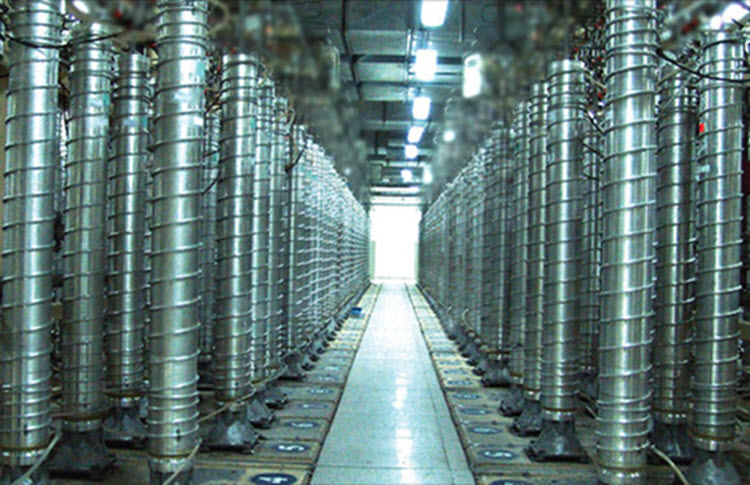
On Wednesday, April 9, the U.S. Treasury Department announced new sanctions on Iran. According to the department, the sanctions target six Iranian companies and one individual who are “directly involved in supplying parts, manufacturing equipment, and providing technical support for centrifuge production and the development of thorium fuel technology.”

The companies listed under the sanctions include “Atbin Ista (AIT),” “Pegah Aluminum Arak Company,” “Thorium Power Company,” “Pars Reactors Construction and Development Company,” and “Azarab Industries.” An individual named Majid Mosallat, identified as the CEO of AIT, is also among those sanctioned.

In its statement, the U.S. Treasury Department said the sanctions are intended to prevent Iran from advancing toward acquiring nuclear weapons.

IAEA Report: Iran’s Uranium Mining Suggests Much Larger Reserves

“The Iranian regime’s reckless pursuit of nuclear weapons remains a grave threat to the United States and a menace to regional stability and global security,” said Secretary of the Treasury Scott Bessent. 

Tehran’s Response to Sanctions and the Outlook for Nuclear Talks

These sanctions were issued following President Donald Trump’s announcement of the start of direct negotiations between the United States and Iran’s regime over Tehran’s nuclear program. However, the foreign minister of Iran’s regime stated that the talks in Oman would be conducted indirectly and through mediation.

In this context, Trump warned that if the negotiations do not succeed, Iran would face serious consequences.

The new U.S. sanctions are being imposed at a time when Ali Khamenei, the supreme leader of Iran’s regime, had previously described American sanctions against Iran as an “opportunity.” Meanwhile, the former governor of Iran’s Central Bank stated in late March that the cost of sanctions on the country’s foreign trade amounted to at least 50 billion dollars.

The Objective of the Sanctions and Their Impact on the Iranian regime

These sanctions are part of the United States’ efforts to prevent the development of Iran’s nuclear program. Western countries view this program as a prelude to the production of nuclear weapons.

U.S. Treasury Secretary Consults Global Banks on Iranian Oil Sanctions

Meanwhile, the sanctions are putting additional strain on Iran’s economy. Given the economic costs involved, the regime is attempting to save face and use indirect negotiations to shift conditions in favor of reaching a nuclear agreement that benefits it.

As Iran’s regime approaches nuclear talks with the United States cautiously, regime officials remain skeptical about U.S. intentions and the likelihood of reaching a deal.

Talks between the two countries are scheduled to take place in Oman in the coming days, and the United States has threatened to increase pressure on Iran’s regime if an agreement is not reached. 


IAEA Report: Iran’s Uranium Mining Suggests Much Larger Reserves

According to the latest data from the International Atomic Energy Agency (IAEA), the Iranian regime is expanding its uranium production and has declared that its reserves of this metal are much larger than previously estimated.

The new statistics, published on Tuesday, April 8, in the “Red Book”—the IAEA’s biennial report on the uranium industry—may raise concerns about the direction of the regime’s nuclear program.

The report states that since 2022, the Iranian regime has been drilling at least 12 new uranium mines, although these resources are not considered economically viable and are far below the amount required to fuel a nuclear reactor.

European Union: The Iranian Regime Must Not Attain Nuclear Weapons

The authors of the report, who are based in the IAEA offices in Vienna and Paris, wrote that Tehran has demonstrated that Iran’s uranium reserves are significantly greater than previously estimated. The country may nearly quadruple its uranium ore production to 71 tons this year.

Unlike other segments of the nuclear fuel cycle—a complex industrial process that converts uranium isotopes into energy fuel—upstream mining activities are not regularly audited. IAEA inspectors track enriched uranium worldwide because it can be used for weapons production, but uranium ore can be extracted and traded under fewer restrictions and regulations.

In 2015, global powers reached an agreement with the Iranian regime, known as the JCPOA, which imposed restrictions on Iran’s nuclear activities in exchange for lifting sanctions. In May 2018, U.S. President Donald Trump withdrew from the nuclear deal and reimposed strict sanctions on Iran’s regime.

Is Domestic-Enriched Uranium Production Economically Viable for Iran?

The IAEA has confirmed that the Iranian regime has increased its enriched uranium production rate sevenfold. Since returning to the presidency, Trump has stated his desire for a new nuclear deal with Iran and has threatened military action if Tehran refuses to enter direct negotiations.

On Monday, April 7, Iranian officials announced their readiness to negotiate with the United States, provided the talks are mediated by Oman.

Nonetheless, Iran’s uranium mining activities have drawn the attention of security analysts, who say the reserves are insufficient for fueling a nuclear reactor, but would be sufficient to produce a nuclear bomb.

Iran’s nuclear reactor at the Bushehr power plant requires approximately 160 tons (more precisely, 145.15 tons) of uranium ore annually, but the regime extracts only 21 tons per year. Russia, which built the Bushehr plant, also supplies its fuel.

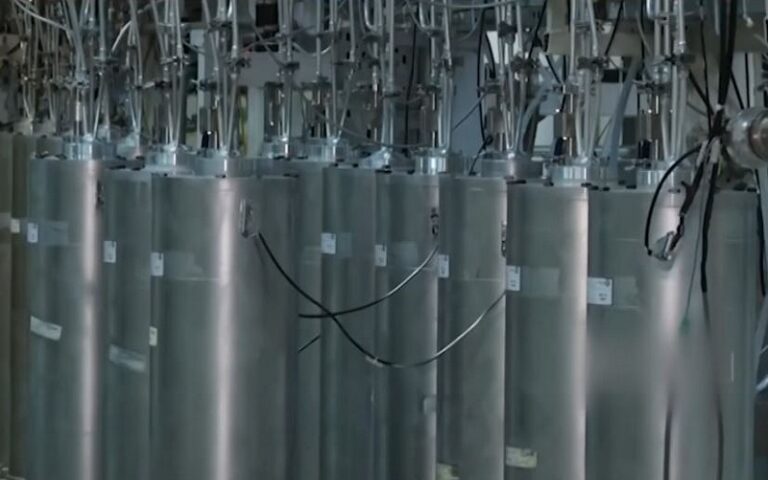
According to IAEA data, Iranian engineers are now producing the equivalent of one nuclear bomb’s worth of 60-percent enriched uranium per month. In a report released in February, the agency stated that Iran’s stockpile of enriched uranium had increased by 50 percent over the past three months, reaching 275 kilograms.


Iran’s Regime Sends Long-Range Missiles to Its Proxy Forces in Iraq

The Times has reported that, as Iran’s regime prepares for nuclear negotiations with Washington, the regime has, for the first time, transferred long-range surface-to-surface missiles to its proxy forces in Iraq. Intelligence sources say these missiles are capable of targeting parts of Europe.

In the report published on Tuesday, The Times, citing regional intelligence sources, stated that the missiles were transferred to Iraq last week by the Aerospace Force of the regime’s Islamic Revolutionary Guard Corps (IRGC).

According to The Times and quoted analysts, this move could be interpreted as an effort by the Iranian regime to strengthen its bargaining position ahead of upcoming negotiations with the United States.

According to the report, two other shorter-range missiles—the Quds-351 cruise missile and the Jamal-69 ballistic missile—were also smuggled into Iraq. The Times’ intelligence sources emphasized that the missiles transferred have ranges sufficient to threaten targets in Europe.

IRGC Once Again Announces the Unveiling of a “Missile City”

A regional intelligence source told The Times that the Iranian regime has recently provided missiles—including longer-range models—to Shia militias in Iraq, which had never before received such weapons. This was described as a desperate move by Iran’s regime that endangers Iraq’s stability.

Experts told The Times that the Iranian regime is scrambling to reclaim its position in the region, which has been significantly weakened in recent years.

According to these experts, the loss of air defense systems around nuclear sites following clashes with Israel in October 2024, the defeat of Tehran’s proxy forces such as Hamas in Gaza and Hezbollah in Lebanon, and the fall of Bashar al-Assad’s regime in Syria are among the developments that have weakened Iran’s regional standing.

On Monday, April 7, at the White House, U.S. President Donald Trump, in a meeting with Israeli Prime Minister Benjamin Netanyahu, stated that if the negotiations are not successful, “I actually think it will be a very bad day for Iran.” These negotiations are scheduled to take place in Oman.

The Houthis in Yemen and Iranian regime-backed militias in Iraq are recognized as the last effective proxy forces of the regime in the region. In recent weeks, the United States has targeted key Houthi positions.

A Shia politician close to the Iraqi government told Reuters that several Iran-backed groups intended to respond positively to Washington’s request for disarmament in order to avoid confrontation with the United States.

However, shortly after those remarks were published, a political source in Iraq told Al Arabiya that, in reality, the armed groups had refused to disarm.

A diplomatic source in the region also said that the recent efforts over the past 48 hours to project an image of militia disarmament were a deception.

According to The Times, analysts believe the Iranian regime has resorted to its remaining proxy forces to preserve its influence in the Middle East, though some of these groups are reassessing their strategies.

However, the Iranian regime has no incentive to abandon its proxy tools, as it benefits from them both in destabilizing the region and in exploiting opportunities that arise in ungoverned areas—such as smuggling and organized crime.

Since its inception, the Iranian regime has fueled regional instability by escalating and supporting terrorism, using it as a tool to maintain its own grip on power. It now appears that, after 20 years of fruitless negotiations with the Iranian regime, the West has concluded that the only effective response is a policy of firmness—not appeasement.


Five Political-Religious Prisoners Executed in Iran

Human rights sources in Iran reported on Tuesday, April 8, that five political-religious prisoners were executed at Vakilabad Prison in Mashhad.

The names of the executed prisoners were announced as: Farhad Shakeri, Abdulrahman Gorgij, Abdolhakim Azim Gorgij, Malek Fadaei-Nasab, and Taj Mohammad Khormali.

According to reports from human rights activists, the executions were carried out abruptly and without prior notice.

These five political-religious prisoners, along with another inmate named Issa Eid Mohammadi, had been sentenced to death in 2019 on charges of “armed rebellion” (Baghi or revolt) through membership in opposition groups.

Subsequently, the death sentences for all six prisoners were overturned by Branch 41 of the Iranian regime’s Supreme Court, headed by Judge Ali Razini, and the cases were referred to an equivalent branch for retrial.

In early August 2023, following a retrial, Branch 4 of the Revolutionary Court in Mashhad once again sentenced each of the prisoners to death.

In January 2025, these prisoners had published a letter exposing the violence and beatings inflicted by prison guards and called on the United Nations and international human rights organizations to hold the Iranian regime accountable for these inhumane acts.

Referring to the “violence, inhumane behavior by prison officials, and harsh conditions faced by inmates,” they wrote: “The guards delete footage from surveillance cameras to hide evidence of these actions.”


Iranian Women Selling Hair Amid Growing Poverty

As the Iranian regime continues to fail in addressing poverty and improving the economic situation of its people, reports from Iran indicate that due to worsening living conditions and low incomes, the market for buying and selling natural women’s hair has grown in Tehran.

The state-run Mehr News Agency reported on Monday, April 7, that due to economic hardship and low-income levels among Iranians, the market for buying and selling women’s natural hair in Tehran is thriving.

This outlet noted that buyers are encouraging women to sell their hair both on city sidewalks and through online platforms.

Mehr quoted one hair buyer as saying: “The price of hair varies depending on its length, thickness, and color—from 200 million rials (approximately $190 USD) for short hair to 600 million rials (approximately $570 USD) for long, healthy hair per kilogram.”

The issue of selling hair to cover living expenses in Iran has made headlines multiple times in recent years.

Over 80% of Iranian Households Below the Global Poverty Line

In March, the Iranian watchdog site Didban Iran reported on the booming market for natural hair, stating: “On social media and apps like Sheypoor and Divar, ads for buying and selling hair have listed prices such as 300 million rials (approximately $285 USD) for 60 centimeters of hair.”
(Sheypoor and Divar are popular Iranian online marketplaces.)

In November 2021, Khorasan newspaper also covered the buying and selling of women’s hair due to poverty, writing that girls as young as 10 and women up to age 50 have turned to selling their hair to cover expenses such as buying mobile phones or paying medical bills.

Female Breadwinners and Students Are the Main Hair Sellers

Mehr, citing a hair buyer, stated: “Female heads of households and students are the main hair sellers, and it seems the lack of stable jobs for low-income women drives them toward this work.”

One seller told Mehr about her motivation for selling her hair: “I was unemployed and had no choice but to sell my hair to cover my son’s medical expenses. But the money wasn’t even enough for a month.”

According to Mehr, some buyers, despite promising “fast cash payments,” pay much less than originally agreed after cutting the hair, citing excuses about its quality.

Narges, a 28-year-old hair seller, told Mehr:” I sold my 30-centimeter-long hair to pay my rent. They promised 60 million rials (approximately $57 USD), but after cutting it, they only paid 30 million rials (approximately $28 USD). When I protested, they said the hair wasn’t good quality.”

In recent months, as the Iranian regime continues to struggle in improving the economic conditions and tackling poverty, numerous reports have been published highlighting the deepening economic crisis and sluggish business activity.


Hamas Request to Iranian Regime: “$500 million to Destroy Israel”

Israel’s Defense Minister revealed a document found in Hamas tunnels in which the Hamas organization requested $500 million from the Iranian regime for the complete destruction of Israel. At the time, a commander from the Islamic Revolutionary Guard Corps (IRGC) agreed to the request.

Israel Katz, Israel’s Minister of Defense, disclosed the existence of an intelligence document showing that the leaders of Hamas, Yahya Al-Sinwar and Mohammed Deif, had sent a letter in June 2021 to Esmail Qaani, the commander of the Quds Force of the Islamic Revolutionary Guard Corps, requesting financial support to carry out a plan to attack Israel—a plan that was eventually carried out on October 7, 2023.

According to Katz, this document proves the direct connection between Iran and Yahya Al-Sinwar and Mohammed Deif and shows how Iran supported Hamas’s plan to destroy Israel.

He added that the document requests the Quds Force commander of the IRGC to provide $500 million to implement the plan to destroy Israel.

According to the contents of the document, Hamas requested $20 million per month from Iran for two years to accomplish “major goals” that, in the words of the letter’s authors, would “change the face of the world.”

One part of the letter reads: “We are confident that by the end of these two years, or during them, God willing, we will uproot this monstrous entity and end this dark chapter in our nation’s history.”

Katz also stated that Saeed Izadi, head of the Palestine division in the Quds Force, agreed to the request and replied that despite Iran’s difficult economic situation and the struggles of its own people, the Iranian regime would continue to fund Hamas because fighting Israel and the United States is its top priority.

The Israeli Defense Minister further emphasized that the conclusion is clear: Iran is the head of the snake, and despite repeated denials, is financing and advancing terrorism in all regions—from Gaza to Lebanon, Syria, and the West Bank, and now alongside the Houthis in Yemen—all with the aim of destroying Israel.

Katz added that Israel will do everything it can to prevent the Iranian regime from obtaining nuclear weapons and will continue striking the regime’s proxy forces in the region until this Iranian axis of evil is ultimately suppressed and destroyed.


Reuters: Khamenei Orders “Military Alert”

Reuters, quoting an Iranian regime official, reported that Tehran has issued a threatening warning to regional countries in the event of participation in an attack on Iran. According to the official, Ali Khamenei, the Supreme Leader of the Iranian regime, has also ordered the armed forces to be placed on “alert.”

A senior Iranian official told Reuters that the Iranian regime is resisting U.S. demands for direct talks over its nuclear program or facing military confrontation.

According to the official, the Iranian regime has warned neighboring countries hosting U.S. military bases that if they participate in an attack, they will be targeted by Tehran’s fire.

Iran’s 2025 Budget: Massive Oil Revenues for Military, State Assets Transferred to IRGC

The Iranian official, speaking to Reuters on condition of anonymity, stated that although Iran has rejected U.S. President Donald Trump’s request for direct talks, it is willing to continue indirect negotiations with the United States through Oman, which has long served as a channel for message exchanges between the two countries.

The Iranian regime official added that indirect negotiations provide an opportunity to assess Washington’s seriousness in achieving a political solution with Iran.

According to the Iranian official, although this path may be “bumpy,” such negotiations could begin soon if the U.S. sends a positive signal.

Khamenei’s “Alert” Order and Warning to Regional Countries

The Iranian regime official also stated that Tehran has informed Iraq, Kuwait, the United Arab Emirates, Qatar, Turkey, and Bahrain that any support for a U.S. attack on Iran — including the use of their airspace or territory by American forces during such an attack — will be considered a “hostile act.”

The official, noting that such an action “would have severe consequences for them,” also stated that Ali Khamenei has placed Iran’s armed forces on “alert.”

Trump’s repeated threats of military action against Iran’s regime have escalated regional tensions, especially following the wars in Gaza and Lebanon, military strikes on the Houthis in Yemen, shifts in the balance of power in Syria, and military confrontations between Israel and Iran’s regime.

The widening conflict in this part of the world has raised concerns among the Gulf countries, which supply a significant portion of global oil demand through the region’s waters.

The regime’s state media reported on April 1 that Kuwait has assured the Iranian regime that no offensive action against other countries will be launched from its territory.

Russia, an ally of the Iranian regime, also called the U.S. threat of military action against the Iranian regime “unacceptable” on April 2 and urged restraint from any provocative actions the following day.

Another Iranian regime official told Reuters that Iran is seeking stronger support from Russia but is doubtful of Moscow’s commitment. According to the official, this depends on the “dynamics” of the Trump-Putin relationship.

Two-Month Deadline

Trump has said that he prefers a nuclear deal with Iran over military confrontation. On March 7, he also announced that he had sent a letter to Khamenei proposing negotiations.

The top Iranian official told Reuters that the first round of indirect talks with the U.S. may involve Omani mediation between the delegations of both sides.

The Iranian regime has consistently denied accusations of seeking nuclear weapons. However, the International Atomic Energy Agency has warned that Iran has significantly increased its enrichment of uranium to 60%, which is close to the 90% level required for nuclear weapons production.

While the Iranian regime has accepted indirect talks with the U.S. to address concerns over its nuclear program, it has rejected direct negotiations under “threats” and has also stated that it is not willing to negotiate over its missile program.


End of New Year Holidays Marked by Continued Decline in the Value of the Iranian Rial

On the first day that markets reopened after the Nowruz (Persian New Year) holidays, the value of the Iranian rial continued its decline, reaching its lowest level against the U.S. dollar. Each dollar was priced at over 1,043,000 rials.

On Saturday, April 5, the value of the Iranian rial fell to its lowest level against the dollar. The exchange rate, which had already surpassed one million rials per dollar during the Nowruz holidays, reached 1,043,000 rials with the reopening of exchange shops.

According to the Associated Press, on Ferdowsi Street in Tehran — the country’s main currency trading hub — some currency exchange dealers have turned off their electronic boards, as they are uncertain about the constant fluctuations in exchange rates.

Foreign Pressure and Tensions with the United States

After Donald Trump withdrew from the Iran nuclear deal with world powers in 2018, Iranian regime’s economy came under severe international sanctions. At the time of the agreement — in which the regime significantly limited its uranium enrichment in exchange for sanctions relief — one U.S. dollar was equivalent to 32,000 rials.

Iran’s Rial Continues to Plummet in New Persian Year

But with Trump’s return to power, the “maximum pressure” campaign was restarted, and sanctions against Iran intensified. Trump also targeted companies involved in trading Iranian oil. He even wrote a letter to Ali Khamenei, the Supreme Leader of the Iranian regime, attempting to initiate direct talks between Tehran and Washington — although so far, Iran has only shown interest in indirect negotiations.

Economic Pressures and Public Discontent

According to the state-run newspaper Eghtesad Online, Mehdi Darabi, a market analyst, believes that recent foreign pressures have led to “expectations of reduced oil sales, higher inflation, and increased foreign exchange rates.”

Economic instability and the falling value of the rial have driven people to safeguard their assets by turning to foreign currencies, gold, cars, and other tangible assets. Many have also turned to cryptocurrencies or entered high-risk investment schemes.

Meanwhile, domestic political pressures continue, particularly around the issue of compulsory hijab. There are also rumors of a potential increase in the price of subsidized gasoline — a move that previously sparked nationwide protests in November 2019.

The collapse of the rial has added further pressure on Masoud Pezeshkian, the President of Iran’s regime. In March, when the exchange rate hit 930,000 rials per dollar, the Iranian regime’s Majlis (parliament) impeached Abdolnaser Hemmati, the Economy Minister, for the sharp devaluation of the currency and allegations of mismanagement.

Public dissatisfaction also prompted Pezeshkian to dismiss his deputy, Shahram Dabbiri, due to a lavish trip to Antarctica that drew heavy criticism. Explaining his decision, Pezeshkian said: “At a time when people are under severe economic pressure, luxury trips by officials are unjustifiable.”

On Saturday, April 5, Pezeshkian also stated that Iran seeks “equal dialogue” with the United States. He added: “If you want to negotiate, why are you threatening?” He continued: “Today, the United States is humiliating not only Iran but the world, and this behavior contradicts the call for negotiations.”


Iran Has Enough Uranium for 6 or 7 Nuclear Weapons

Rafael Grossi, Director General of the International Atomic Energy Agency (IAEA), stated in an interview that while Iran’s regime currently does not possess a nuclear weapon, it has enough enriched uranium to produce six or seven nuclear warheads.

On Saturday, April 5, Rafael Grossi spoke with an Argentine media outlet about the Iranian regime’s nuclear program and the new U.S. policies regarding it.

In the interview, Grossi emphasized that the Iranian regime currently has no nuclear weapons but has acquired the equipment and materials needed to build them. According to him, the amount of enriched uranium in Iran is sufficient to construct six or seven nuclear weapons.

Iranian Regime Accelerates Uranium Enrichment to Concerning Levels

Grossi referred to ongoing correspondence between Tehran and Washington, saying that the United States has presented Iran with two choices: reaching an agreement on the nuclear program or facing airstrikes.

Grossi expressed his concern about the current situation. According to U.S. officials, the Iranian regime has two months to make a decision.

In a phone call between Grossi and the Iranian regime’s Foreign Minister, it was agreed that Grossi would travel to Iran in the coming weeks.

Grossi stated that the main reason for his trip to Iran is to prevent a direct confrontation between the Iranian regime and the United States. He said Iran has agreed to clarify the disputed issues as soon as possible in hopes of avoiding “any destructive conflict.”

Contrary to the regime’s official position of not pursuing nuclear weapons, Ali Larijani, the former Speaker of the Iranian regime’s Majlis (Parliament), said last week: “If the United States makes a wrong move regarding Iran’s nuclear issue, it will force Iran to pursue nuclear weapons, because Iran must defend itself.”

Ali Larijani, who is a member of Iran’s Expediency Council and an advisor to the regime’s Supreme Leader Ali Khamenei, said in a televised program, following discussion of the current situation and recent communications from Donald Trump: “The Supreme Leader’s fatwa (a legal ruling on a point of so called Islamic law) is that we will not pursue [nuclear] weapons. A fatwa is different from political instructions, and his letter [on this issue] has also been registered once at the United Nations. But when they apply pressure, then [building a nuclear bomb] will have a ‘secondary justification’.”