Home Blog Page 2

U.S. Conducts New Wave of Strikes Against Iran’s Regime, IRGC Attacks Bahrain, Kuwait, Jordan

As the United States completed its latest wave of attacks against the Iranian regime, the Islamic Revolutionary Guard Corps (IRGC) announced attacks on Bahrain, Kuwait, and Jordan.

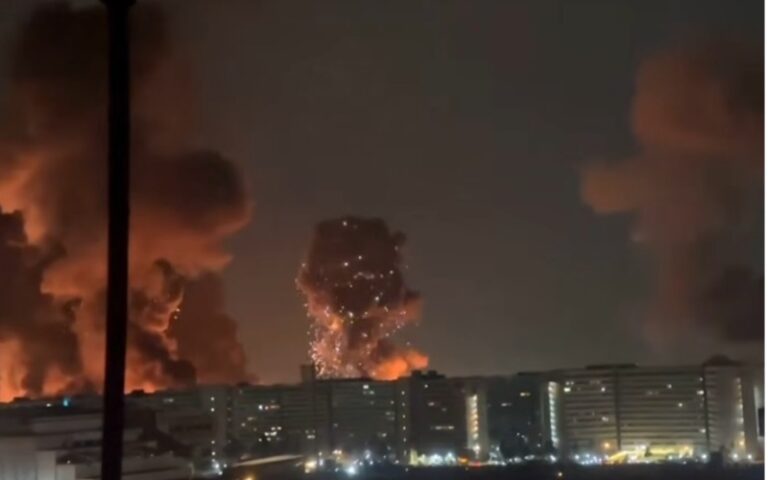
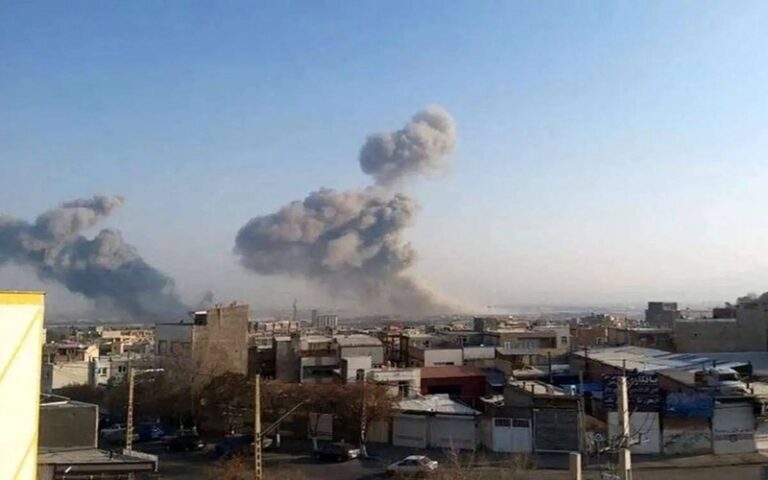
Hours after the United States completed a new wave of strikes against military targets belonging to the Iranian regime, the Islamic Revolutionary Guard Corps (IRGC) announced that it had targeted U.S. bases in Jordan, Bahrain, and Kuwait in several phases using missiles and drones. At the same time, the U.S. Central Command (CENTCOM) announced the completion of its operation against dozens of military targets inside Iran.

The military confrontation between the United States and the Iranian regime entered a new phase early Monday. Hours after the United States launched and completed a new wave of strikes against Iranian military positions, the IRGC announced that it had carried out several phases of retaliatory operations against U.S. military bases in Jordan, Bahrain, and Kuwait. U.S. officials have not yet confirmed or denied these claims.

The U.S. Central Command (CENTCOM) announced on the social media platform X that the latest wave of offensive strikes against military targets in Iran had concluded and that U.S. forces had struck dozens of targets across the country using precision-guided munitions.

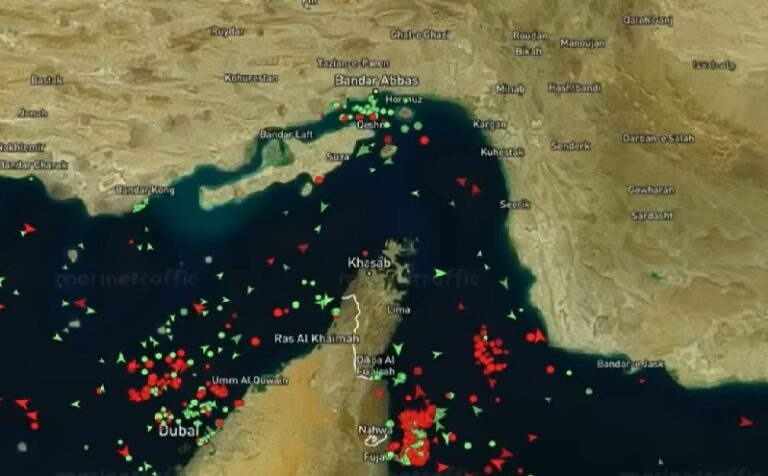
Ship Traffic Through Strait of Hormuz Falls to Lowest Level in Weeks

CENTCOM said that, for the first time, the operation simultaneously employed fighter aircraft, naval vessels, aerial drones, and one-way attack maritime drones. According to the command, the targets included the Iranian regime’s air defense systems, coastal radar installations, missile and drone capabilities, and fast attack boats.

In response, the IRGC announced that it had carried out its retaliatory operation in three phases against U.S. targets in the region.

In its first statement, the IRGC’s public relations office said the U.S. attack on the Iranian regime’s coastal positions came after the IRGC Navy had intercepted two ships, accusing them of disabling tracking systems and traveling along an “illegal route” in the Strait of Hormuz.

The IRGC said that in the first phase of its response it targeted and “destroyed” “several large missile storage facilities and fuel depots” at Prince Hassan Air Base in Jordan with missiles and drones.

In its second statement, the IRGC said its Aerospace Force had targeted and “destroyed” helicopter maintenance facilities, a hangar for a “P-8” electronic warfare aircraft, and a drone command-and-control center at Sheikh Isa Air Base in Bahrain.

In its third statement, the IRGC claimed it had “completely destroyed” fuel storage facilities and a Patriot air defense system at Ali Al Salem Air Base in Kuwait, as well as an “FPS” strategic radar system at Ahmad Al Jaber Air Base in Kuwait.

The IRGC concluded its statement by declaring: “The Strait of Hormuz is our land,” and said it would not allow the U.S. military “to continue its illegal interference there from the other side of the world.”

Minutes later, the public relations office of the Iranian regime’s army also announced in a statement that, hours earlier, in response to the U.S. attacks, it had struck the U.S. military’s “troop deployment areas, air defense and missile systems, shelters, and support facilities” in Kuwait.

Earlier, Nour News, a news outlet affiliated with the Iranian regime’s Supreme National Security Council, reported the start of “large-scale missile and drone attacks” against U.S. bases and naval vessels.

According to Nour News, the attacks were launched from missile bases in western and central Iran and targeted locations that had been identified following the repositioning of U.S. forces over the past 48 hours.

Officials of the Iranian regime had previously reported U.S. strikes on locations in the provinces of Khuzestan, Hormozgan, Bushehr, and Markazi. CENTCOM had stated that the objective of the operation was to reduce the Iranian regime’s capability to attack commercial shipping and to ensure freedom of navigation through the Strait of Hormuz.

As reciprocal attacks continue and both sides make new claims, the military confrontation between the United States and the Iranian regime has entered a phase that extends beyond Iranian territory and now encompasses U.S. military bases in several Arab countries along the Persian Gulf.
Ship Traffic Through Strait of Hormuz Falls to Lowest Level in Weeks

0

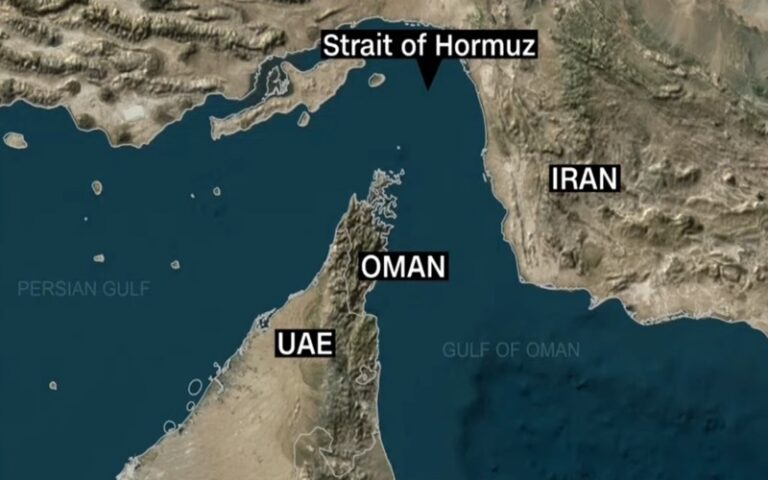
Shipping data show that the number of vessels transiting the Strait of Hormuz on Sunday fell to its lowest level in recent weeks. At the same time, the resumption of attacks between the United States and the Iranian regime, along with strikes targeting ships in the Middle East, has heightened concerns over maritime safety.

Reuters reported on Monday, July 13, that according to vessel-tracking data from Kpler, only six ships transited the Strait of Hormuz on July 12, the lowest number recorded in the past five weeks.

IRGC Announces Closure of Strait of Hormuz After Firing on a Ship

Among the tankers leaving the strait was the very large crude carrier (VLCC) Humanity, carrying 2 million barrels of Iranian oil.

Another tanker, Captain Andreas, also exited the Strait of Hormuz carrying about 500,000 barrels of refined petroleum products from Kuwait.

According to the data, three empty oil tankers also entered the Persian Gulf to load crude oil. Most tankers switched off their identification transmitters while transiting the Strait of Hormuz.

Over the weekend, no liquefied natural gas (LNG) tanker whose entry into the Strait of Hormuz was visible in vessel-tracking data was recorded.

According to Kpler data, a tanker operated by the Abu Dhabi National Oil Company (ADNOC) exited the Strait of Hormuz between July 10 and July 12. The vessel is en route to Dahej Port in India.

Rising Concerns Over Maritime Security

As the latest round of U.S. strikes began, Iranian officials reported projectile impacts at locations in the provinces of Hormozgan, Markazi, Khuzestan, and Bushehr.

The U.S. Central Command (CENTCOM) announced that on July 12, U.S. forces carried out another wave of attacks against the Iranian regime, striking dozens of targets at multiple locations using precision-guided munitions.

CENTCOM said the objective of the strikes was to reduce the Iranian regime’s capability to attack commercial vessels in the Strait of Hormuz.

U.S. President Donald Trump said in an interview with NBC’s Meet the Press on July 12 that the Strait of Hormuz remains open to commercial shipping.

The remarks came as the United States and the Iranian regime continue exchanging attacks, raising concerns about maritime safety along one of the world’s most important oil shipping routes.

The Iranian regime had previously announced that it had closed the Strait of Hormuz after a vessel transited through an unauthorized route and was targeted.

On July 13, the Islamic Revolutionary Guard Corps (IRGC) announced that its navy had disabled the systems of two vessels the previous night and intercepted them in the Strait of Hormuz.

Protests Expand Across Iranian Cities, From Retirees and Workers to Students and Bakers

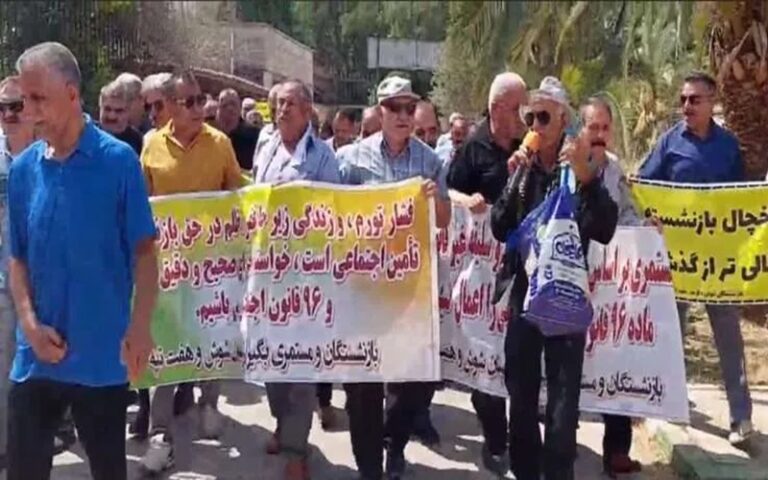
As the livelihood crisis, inflation, rising prices, and economic discontent continued to deepen, cities across Iran witnessed protests and rallies on Sunday, July 12, involving various groups including retirees, workers, drivers, students, bakers, and people who lost money in fraud schemes. In most of these gatherings, protesters emphasized labor and livelihood demands while voicing opposition to poverty, discrimination, corruption, repression, and the authorities’ disregard for their concerns.

Kermanshah; Social Security Retirees Protest Poverty and Discrimination

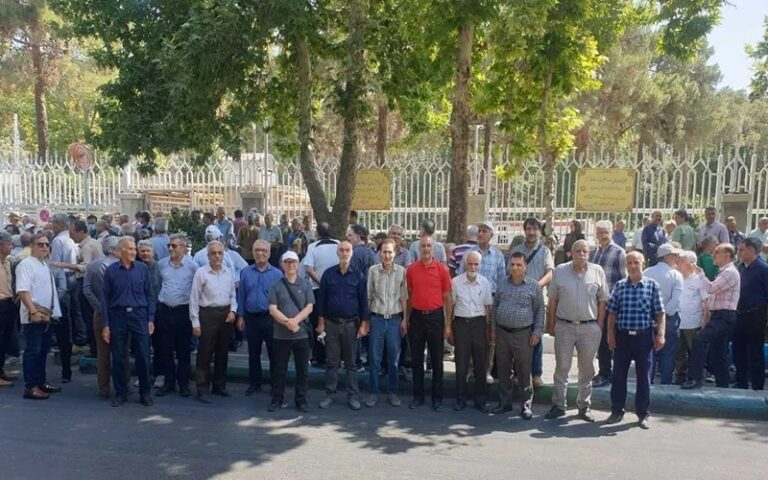
A group of Social Security retirees and pension recipients in Kermanshah held a protest, demanding the immediate fulfillment of their livelihood and healthcare-related demands.

The protesters chanted slogans including “Enough warmongering, our tables are empty,” “Inflation, high prices, no to war and destruction,” “The streets are the stronghold of working people,” “Imprisoned workers must be freed,” and “Imprisoned teachers must be freed,” expressing their dissatisfaction with the current situation.

Protest Gatherings by Retirees and Steel Workers in Iran

The retirees identified the full implementation of Article 96 of Iran’s Social Security Law, pension equalization, payment of overdue benefits, free healthcare, settlement of the government’s debts to the Social Security Organization and transferring the organization’s management to representatives of workers and retirees as their main demands.

During the rally, a retired woman criticized the failure to implement promised pension increases, the suspension of survivors’ benefits, and unpaid entitlements. She also criticized the availability of financial resources for propaganda and alleged managerial corruption within Shasta, the Social Security Investment Company.

Tehran; Heavy Vehicle Drivers and Victims of Tabriz Companies Protest

In Tehran, heavy vehicle drivers who purchased trucks from the companies Ayan Tejarat, Maral Tejarat, and Kalaye Momtaz Iranian gathered to protest the companies’ failure to deliver the vehicles.

Pointing to corruption and inefficiency in Iran’s Ministry of Industry, Mine and Trade and other responsible institutions, the protesters demanded the immediate resolution of their contracts.

At the same time, people who said they had lost money through three Tabriz-based companies held a protest demanding action on their legal cases. They said that despite filing complaints against the managers of Ayan, Elyal, and Momtaz, proceedings at the Tabriz Prosecutor’s Office have been delayed and remain unclear.

The gathering featured the slogan, “Enough promises, our tables are empty.”

Also in the capital, a group of retirees protested deteriorating living conditions and declining purchasing power, demanding pension increases in line with the cost of living.

Damghan; Strike by Tazareh Coal Mine Workers

Workers at the Tazareh coal mine, operated by the Alborz Sharghi Coal Company in Damghan, went on strike and staged a protest.

The miners cited unpaid wages, unpaid insurance contributions, overdue payments, and disregard for workers’ rights as their main grievances.

Gilan; Retirees Protest While Calling for Prisoners’ Release

Retirees in Gilan also took to the streets alongside protesters in other cities across Iran.

Participants chanted slogans including “Imprisoned teachers must be freed,” “Imprisoned workers must be freed,” “No to executions,” “Oppression and injustice have driven us to the streets,” and “With these empty tables, we continue to protest,” calling for the release of imprisoned protesters, a halt to executions, and action on livelihood demands.

Ahvaz; Demand for Free Healthcare

Social Security retirees in Ahvaz gathered outside the local Social Security office to demand the implementation of their right to free healthcare.

The protesters stressed, “Free healthcare is our undeniable right,” while protesting rising medical costs and reduced insurance coverage.

Shiraz; Medical Students Protest Food Quality

A group of students at Shiraz University of Medical Sciences placed their meal trays on the ground in protest against the poor quality of dormitory food.

Through this protest, the students demanded that university officials address welfare services and improve the quality of dormitory meals.

Alborz Province; Bakers Demand Bread Price Revision

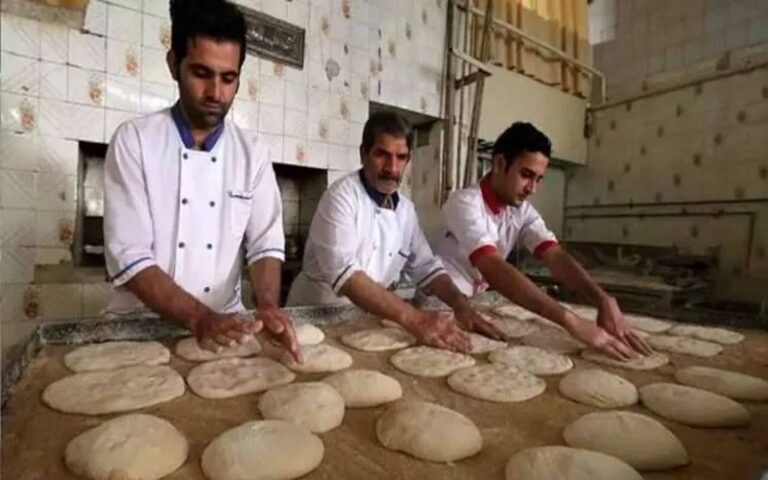
A group of bakers in Alborz Province also held a protest over the economic crisis, rising production costs, and the unchanged official price of bread.

Their key demands included adjusting bread prices in line with inflation, increasing subsidized flour allocations, compensating production costs, regular payment of government subsidies, and reforming the flour quota allocation system.

Shush; Retirees March in Temperatures Above 50°C

Despite temperatures exceeding 50°C, Social Security retirees in Shush marched and held a protest.

Participants chanted slogans including “Inflation, high prices, no to war and destruction,” “The streets are the stronghold of working people,” “Retirees, rise up to end discrimination,” “Neither the government nor the Majlis (parliament) cares about the people,” “We will not stop until we get our rights,” and “Livelihood and dignity are our undeniable rights,” protesting poverty, discrimination, high prices, low wages, the privatization of healthcare services, and the authorities’ indifference.

A Common Demand Among Protesters; Bread, Justice, and Freedom

The common theme of Sunday’s protests was opposition to worsening living conditions, inflation, corruption, discrimination, and restrictions on civil liberties.

At many of the rallies, protesters repeatedly chanted, “Only in the streets can we win our rights,” emphasizing demands including higher wages, curbing inflation, job creation, rent controls, free education and healthcare, the right to protest and strike, the release of prisoners, combating corruption, and achieving social justice.

IRGC Announces Closure of Strait of Hormuz After Firing on a Ship

While the United States had demanded that the Iranian regime confirm that the Strait of Hormuz would remain open, Iranian state-run media reported that the Islamic Revolutionary Guard Corps (IRGC) Navy announced the closure of the strategic waterway after firing on a ship in the Persian Gulf.

Reuters also reported, citing the IRGC Navy, that a vessel which the IRGC claimed was attempting to transit the Strait of Hormuz through an “unauthorized route” was stopped with warning shots after allegedly ignoring repeated warnings.

Third Round of U.S. Strikes Against Iran’s Regime After IRGC Closes Strait Of Hormuz

In a statement, the IRGC claimed that several vessels, “incited by foreign powers,” had attempted to travel outside designated shipping lanes and had ignored issued warnings. The statement also claimed that one of the vessels had endangered maritime security by turning off its identification systems and was therefore targeted with warning fire.

The statement further said that, due to what the IRGC described as “insecurity caused by the unlawful intervention of foreign powers,” the Strait of Hormuz will remain closed until further notice and until what it called “U.S. interference in the region” comes to an end. It added that no vessel will be permitted to pass through the waterway.

The IRGC also warned that if the United States or other parties use the incident as a pretext for new military action, the Iranian regime will respond with greater force and will attack additional U.S. military targets in the region.

Third Round of U.S. Strikes Against Iran’s Regime After IRGC Closes Strait Of Hormuz

0

The United States Central Command (CENTCOM) announced that U.S. forces have launched the third round of strikes against the Iranian regime this week following an attack by the Islamic Revolutionary Guard Corps (IRGC) on the Cyprus-flagged container ship M/V GFS Galaxy in the Strait of Hormuz.

CENTCOM said in its statement that the vessel caught fire during the attack and sustained heavy damage to its engine room. It also said that one civilian crew member is missing, leaving the ship unable to continue its voyage.

U.S. Military Attacks More Than 90 Targets in Iran

The U.S. Central Command emphasized that the operation is intended to reduce the Iranian regime’s ability to attack commercial shipping and ensure freedom of navigation through the Strait of Hormuz. It added that the operation will continue under the orders of the Commander-in-Chief of the U.S. Armed Forces.

U.S. Secretary of Defense Pete Hegseth wrote in a post on X minutes after the new operation began: “Iran made a poor choice. Now they pay.”

In response, Iranian state-run media reported that cruise missiles and suicide drones had been launched toward the U.S. naval fleet in the Gulf of Oman, and that more than 10 ballistic missiles had also targeted U.S. bases in Jordan. Following these attacks, Jordan activated its air defense systems.

State-run news agencies also reported hearing explosions in Kuwait, Bahrain, the United Arab Emirates, and Qatar.

CENTCOM further announced that U.S. forces used precision-guided munitions to strike approximately 140 military targets belonging to the Iranian regime. The targets included missile and drone bases, naval facilities, ammunition depots, and communications networks.

According to the U.S. military, the strikes began after IRGC forces attacked two vessels transiting the Strait of Hormuz on Saturday night. The U.S. military said that one of the vessels, which was sailing under the Cypriot flag, caught fire as a result of the IRGC attack.

State-run media also reported airstrikes in various parts of Iran, including Kerman, Dezful, Izeh, Mahshahr, Abadan, Bandar Jask, Sirik, Bandar Deylam, Kangan, Qeshm, Chabahar, Hendijan, Bandar Dayyer, and Asaluyeh.

CENTCOM announced this morning that the third round of military operations against Iranian regime targets had been completed successfully.

Protest Gatherings by Retirees and Steel Workers in Iran

On Saturday, July 11, a group of buyers holding purchase vouchers for vehicles from the Iranian automaker Saipa gathered outside the company’s customer service building in Tehran to protest the prolonged delay in the delivery of the vehicles they had ordered.

The protesters said that despite paying the full purchase price for their vehicles, months had passed—and in some cases more than one year beyond the promised delivery date—yet Saipa had still failed to fulfill its commitments. Criticizing the automaker’s performance, they demanded the immediate delivery of their vehicles and accountability from officials for the lengthy delays. The demonstrators also criticized the responsible authorities for ignoring buyers’ demands and leaving people’s investments in limbo.

At the same time in Isfahan, a group of retired steel workers gathered outside the governor’s office to protest the incomplete implementation of the pension adjustment plan following the transfer of the Steel Pension Fund. Pointing out that four months of the year had already passed, they demanded the full and proper implementation of pension adjustments and the settlement of their outstanding claims.

On the same day, retired employees of the Telecommunications Company of Iran also held a protest outside the Isfahan governor’s office. The protesters criticized the management of the Telecommunications Company of Iran, the Execution of Imam Khomeini’s Order (EIKO), and the Etemad-e Mobin Consortium, accusing them of ignoring their professional and livelihood-related demands and calling for their grievances to be addressed immediately.

U.S. Treasury Targets Khamenei-Linked Financial Network

The U.S. Department of the Treasury sanctioned Ali Ansari, an individual linked to a network of exchange houses and affiliated companies.

In its latest action, the U.S. Department of the Treasury sanctioned a network of exchange houses and commercial companies affiliated with Mojtaba Khamenei, the new leader of Iran’s regime.

The U.S. Department of the Treasury announced that it has added eight individuals and six companies to its Specially Designated Nationals and Blocked Persons (SDN) sanctions list. Among those sanctioned is Ali Ansari, who was identified in the official announcement as being linked to Mojtaba Khamenei and the Islamic Revolutionary Guard Corps (IRGC).

Sanctioned individuals: Shokufeh Rostam Abadi, Ali Ansari, Mohammad Darbani, Ali Asghar Khandan, Mohsen Khandan, Ahmad Navai Lavasani, Amir Navai Lavasani, and Zahra Sarshari.

The sanctioned companies and exchange houses are registered in Iran, the United Arab Emirates, Hong Kong, and Saint Kitts and Nevis. They include Lavasani & Partners Exchange, Mohammad Darbani & Partners Exchange, Mohsen Khandan & Partners Exchange, and Smart Global Limited. The Treasury Department’s Office of Foreign Assets Control (OFAC) also issued General License Y to authorize the wind-down of transactions related to Smart Global.

Sharp Increase in Bread Prices in Iran

For years in Iran, it was commonly said that even if people could no longer afford meat, chicken, dairy products, or fruit, at least bread—the staple of the country’s food basket—would never disappear from their tables. Today, however, even that assumption is collapsing.

Official reports by the Statistical Center of Iran show that food inflation in recent years has forced households to sharply reduce their consumption of red meat, dairy products, fruit, and even rice. According to the data, consumption of these items has fallen by an average of about 50% in recent years, with bread becoming the primary substitute for meeting calorie needs. (State-run Donya-ye Eqtesad newspaper)

Bread Prices Rise Again in Tehran; Fresh Pressure on Household Budgets

Year-on-year inflation for bread and cereals reached approximately 81.8% in July 2025, according to the Statistical Center of Iran. Some reports have stated that bread prices in Tehran have increased by as much as 52%.

Overall food inflation has, during certain periods, exceeded 100%, and even reached 110% to 134% in some months. These figures indicate that bread—once the cheapest source of calories—is now directly placing additional pressure on the poorest segments of society.

In contrast, the Iranian regime attributes the price increases primarily to higher production costs, rising wages for bakery workers, and increased energy prices. Officials from the Plan and Budget Organization have also emphasized that the government can no longer afford to fully subsidize bread, as the financial burden of the program has risen significantly. However, many economists argue that shifting these costs onto consumers, at a time when household purchasing power has sharply declined, will only deepen the country’s cost-of-living crisis.

Structural Causes and Social Consequences. Field reports from the first days following the implementation of the new prices indicate widespread confusion among bakeries and growing tensions between customers and sellers. Beyond being an economic issue, the situation has had a direct impact on social stability and people’s sense of economic security.

The increase in bread prices cannot be examined separately from Iran’s broader economic and political conditions. Chronic inflation, the sharp depreciation of the rial, persistent budget deficits, and the allocation of resources to military and nuclear projects have significantly limited the government’s room for maneuver. Many economists warn that this trend is unsustainable and that food prices have nearly doubled in recent years.

U.S. Officials Call for Iran’s Regime to Publicly Declare an End to Attacks on Ships in Strait of Hormuz

0

Reuters reported that senior U.S. officials said on Friday, July 10, that Washington has asked Iran’s regime to formally and publicly commit to ending attacks on ships in the Strait of Hormuz and to ensure that all shipping lanes through the international waterway remain open to vessels without tolls or restrictions.

Speaking to a group of reporters during a conference call, the officials described the recent talks between the two sides as constructive.

Oil Tanker Attacked Near the Strait of Hormuz

One U.S. official said: “What we’re demanding is that the Iranians issue a public statement that acknowledges all channels of the Strait of Hormuz are open and they’re not shooting at ships anymore. They’re either going to give us that statement or we’re not having a good outcome for them.”

Another senior U.S. official said that Iran’s regime had informed Washington that the recent attacks on ships in the Strait of Hormuz were carried out by “an errant part of their system.”

Another U.S. official also claimed that a power struggle is underway within Iran’s ruling establishment between hardline and pragmatic factions, and that these internal divisions have affected decision-making.

The remarks came after attacks on three ships earlier this week prompted U.S. President Donald Trump to order military strikes against targets in Iran and declare that the ceasefire established between the two countries in June had come to an end.

Reuters reported that Washington is now insisting on a public guarantee from Iran’s regime to ensure maritime security and preserve freedom of navigation through the Strait of Hormuz.

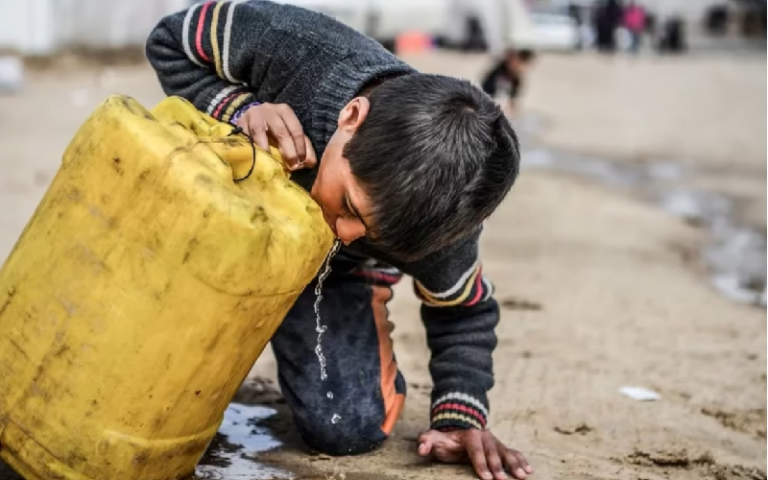
Water Shortages in Iran Have Become a Chronic Crisis, and Alarm Bells Are Ringing

0

Statements by Iranian regime officials at the beginning of the summer indicate that water stress has spread across most of the country’s provinces, with the situation particularly alarming in Tehran.

Under these circumstances, experts say that short-term measures such as water conservation or water transfer projects may ease some of the current pressure, but they are insufficient on their own to address the full scale of the crisis.

Water stress in 58 cities across 23 provinces.

Hashem Amini, chairman of the National Water and Wastewater Engineering Company, said that 58 cities in 23 provinces are currently experiencing water resource stress.

The water crisis has become so severe that even Iran’s mountainous provinces are experiencing water stress. For example, Lorestan Province, despite being one of Iran’s wettest provinces and the source of many rivers, is facing water shortages due to both natural and managerial factors.

Rama Habibi, deputy director for protection and operations at the Tehran Regional Water Company, recently told the state-run ILNA news agency that population growth is the greatest challenge to Tehran’s water supply. He said, “Without securing sustainable water resources, no additional population should be added to the capital.”

According to him, about 45% of Tehran’s water supply currently comes from groundwater and 55% from surface water.

Tehran’s Subsidence and Drying Wetlands Reveal New Dimensions of Iran’s Water Crisis

The water crisis in Tehran is largely the result of uncontrolled urban development. The city’s ecological capacity has been ignored. Tehran has a large population, and water consumption is correspondingly high. While drought may have intensified the crisis, it is not the primary cause. Poor governance, excessive centralization, and development without regard for ecological limits are among the key factors that have led to the current situation.

Water consumption patterns in Tehran differ significantly from those in the rest of the country. Agricultural water use in Tehran Province is well below the national average, while urban water consumption is considerably higher. Excessive reliance on groundwater has also made the region increasingly unsustainable and poses a major risk.

How much are the people to blame?

Iran’s regime has long urged citizens to conserve water, but household consumption accounts for only a small share of the country’s total water use.

Fatemeh Mohajerani, spokesperson for the government of Iranian regime president Masoud Pezeshkian, recently said at a press conference regarding the government’s efforts to address the water crisis: “The government has implemented measures such as restrictions, including allocating water based on agricultural patterns, distributing water according to production models, and prioritizing drinking water. These are among the policies the government has pursued over the past two years.”

However, she once again shifted the responsibility to the public, saying that “per capita water consumption should be reduced to 130 liters per person. At present, in some areas, per capita consumption exceeds 250 liters per person, which is approximately two to two and a half times the global standard.”

The government’s flawed solutions to the crisis.

Alongside managing existing resources, the regime has also launched new projects. These include transferring water from the highlands of Tonekabon and operating the second Taleghan water transfer pipeline to increase the capital’s water resilience.

The methods adopted to secure water supplies in recent years have consistently been temporary fixes. Iranian regime officials have failed to pursue logical and sustainable solutions, making governance a critical issue in addressing the crisis.

Cloud seeding is another approach that can only have a limited effect under very specific conditions, when humidity is high and suitable cloud formations exist. It is therefore not considered a practical long-term solution.

The continuing land subsidence crisis.

Iran’s water crisis is the worsening problem of land subsidence.

The deputy director for protection and operations at the Tehran Regional Water Company told the state-run ILNA news agency that the highest rate of land subsidence has been recorded in the Varamin area. He added that more than 5,700 illegal wells have been sealed over the past two years, but this has failed to halt the subsidence.

To stop land subsidence and prevent further depletion of groundwater resources, closing legal and illegal wells alone is not sufficient. Conditions must also be created to allow aquifers to recharge.

In Tehran, construction, asphalt paving, concrete surfaces, highways, and urban expansion have all increased significantly. As a result, the ground has become increasingly impermeable, groundwater extraction exceeds natural recharge, and this imbalance has lowered groundwater levels, leading to land subsidence.

Overall, the statements made by officials and experts indicate that Iran’s water crisis is no longer merely a temporary or seasonal challenge. It has become a structural and multidimensional problem tied to patterns of urban development, groundwater management, and climate change. Most importantly, the Iranian regime’s mismanagement has brought the country’s water crisis dangerously close to a point of no return.