Home Blog Page 222

The Rial Continues To Sink, Hits Record 500,000 Marks Against The Dollar

0

The US dollar increased in price by more than 11 percent in February and grew to more than 500,000 rials. Experts and traders say that the increase in the price of “gold coins” and gold is also a function of the “strange and scary” upward trend of the dollar price.

According to Iranian media, the dollar price consistently increased throughout February. Despite the Central Bank’s efforts to stabilize the currency price, in February, the US dollar price increased by more than 11 percent and reached more than 500,000 rials.

Currency traders have said this model of devaluation is unprecedented and now inflation trends are guiding the market.

According to a Tejarat News report, the package of new EU sanctions against Iran’s regime has disturbed the market and put traders in a buying position.

On Monday, February 20, the European Union added the remaining Iranian banks to its sanctions list. According to some traders, this news may cause the continuation of the rise of gold coins and currencies.

Market analysts believe that during the 40 days since Mohammad Reza Farzin became the head of the Central Bank, the bank has tried hard to keep the price at the bottom of the 40,000-rial range. Analysts say the dollar cost has risen regardless of the rhetoric therapy and does not follow force and orders.

While the regime will continue to claim that the continued depreciation of the rial is caused by foreign powers and sanctions, government-owned and -backed institutions will continue to benefit from the fluctuations in the price of the rial. As the gatekeeper for currency exchange, the regime benefits from the instability of prices. Meanwhile, the people of Iran, who have been suffering from the deteriorating economic conditions caused by the regime’s policies, will feel the brunt of the effects caused by the further devaluation of the rial. Higher prices and inflation will directly impact the lives of millions of people. And given that the regime is benefiting from increased imports at the cost of deteriorating domestic production, the price of many staples and essential goods is directly affected by the price of the dollar.

Gold coins will soon reach the 300-million-rial range

The gold, coins and currency markets are very turbulent these days, so prices hiked on the first day after the holidays marking the anniversary of the 1979 revolution. This jump in prices and rising volatility occurs while, according to the head of the Tehran Jewelry Union, the increase in demand did not play a role in it.

The price of coins reached 290 million rials on February 19, and the dollar cost influenced the coin market’s fluctuation.

Hojjat Shafaei, head of the gold and jewelry producers’ union, complains about the minting of various coins by the central bank in recent years. He criticizes that the high supply of coins causes people to invest instead of buying gold artefacts.

“Iran is among the seven gold-producing countries and almost among the ten gold-consuming countries in the world; this is while the increase in the minting of coins by the central bank and placing various pieces of coins at the disposal of the public has caused people’s taste to change. The cultural attitudes towards gold consumption and value have shifted in the country including India and the Persian Gulf nations.”

In an interview with Khabar Online, Nader Bazrafshan, head of the Tehran Jewelry Association, said, “In Tehran alone, 700 requests for permits to sell coins have been submitted to the union of gold and jewelry. And the Central Bank has given permits to 598 exchanges. Therefore, around 1,300-coin dealers are in Tehran, which is very significant across Iran.”

The head of the jewelry producers’ union believes that many of the price fluctuations we are experiencing today come back to the currency market.

According to the latest statistics, the Central Bank has minted around 80 million coins.

Iran Sees Another Surge Of Anti-Regime Protests

0

On Thursday and Friday, Iran’s ongoing protests saw another surge of rallies against the regime despite strict security measures and suppression of dissidents.

On Thursday, people took to the streets to mark the 40th day of the execution of Mohammad Mehdi Karami and Mohammad Hosseini, who were arrested and hanged for taking part in the nationwide protests. Both of them were severely tortured, forced to make incriminating confessions, and were deprived of a fair judicial process.

While the regime had dispatched security forces to prevent protests, rallies were reported in many cities. including Tehran, Mashhad, Sanandaj, Shiraz, Karaj, Qazvin, Arak, Izeh, Ahvaz, Khorramabad, Rasht, Yazd, Javanrud, and Qorveh. Protesters chanted slogans against regime supreme leader Ali Khamenei and called for regime change. They also pledged to avenge Karami, Hosseini, and hundreds of other protesters who have been killed by security forces in the past five months.

In several locations, protesters blocked roads by lighting fires and clashed with security forces who were dispatched to suppress them.

On Friday, the province of Sistan and Baluchestan saw another round of protests following the Friday prayers. These protest rallies are taking place on a weekly basis despite videos showing the regime sending troops and taking extra security measures to prevent rallies from taking place.

The protesters chanted slogans in support of regime change but also in opposition to a return to the dictatorship of the Shah regime. Protesters were chanting, “Death to the oppressor, whether it be the Shah or the Mullahs” and “No to monarchy, no to the supreme leader, democracy and equality.”

Nightly protests were also held in several cities, including Tehran, Sanandaj, and Isfahan, where protesters marched in the streets and chanted anti-regime slogans.

These protests were taking place at the same time as the first day of the annual Munich Security Conference was being held. Thousands of supporters of the Iranian Resistance held a protest rally in Munich to voice their support for the ongoing protests in Iran and to call on the world leaders to hold the regime accountable for its crimes. The rally was also in support of the slogan “No to Shah and no to Mullahs,” which has become very popular inside Iran.

This rally was also significant since representatives of the remnants of the Shah regime were invited to the Munich Security Conference. The demonstrators in Munich voiced their opposition to this invitation and made it clear that the people of Iran will not accept a return to the Shah dictatorship.

Leo Dautzenberg, Chair of the German Solidarity Committee for a Free Iran (DSFI) and former Member of German Bundestag, warned against the promotion of the son of Iran’s ousted Shah.

Dautzenberg emphasized that during the 1979 revolution, Khomeini promised not to seek power and leave it to the people to choose their leaders.

“But we know that he seized power when he came to Iran. Reza Pahlavi has also made similar moves. He claims not to want power, but he has already sworn an oath of being the King of Iran. And he has even declared his heir,” Dautzenberg said.

Pahlavi has not condemned the crimes of SAVAK, the secret police of his father’s regime that was tasked with arresting, torturing, and killing dissidents. Neither has he revoked his claim to the throne.

“This is dangerous,” Dautzenberg said. “This is why the participation of the Shah’s son at the Munich Security Conference is a dangerous decision and welcomed by the regime. It distracts discussions focused on unity and solidarity for freedom.”

Hanif Mahoutchian, Legal Advisor of the JU-Hamburg, said, “Whatever the media try to promote fake alternatives, the true face of the Iranian revolution is different. The people of Iran are relaying their own message to the world.”

The supporters of the Iranian Resistance resumed their rally on Saturday.

Why Iran Will Not Return To The Pahlavi Era

0

Iran’s nationwide uprising has entered its sixth month despite a heavy crackdown by security forces. As spectators see the mullahs’ demise on the horizon, one question remains unanswered: Who or what will replace the clerical regime?

From France to Russia and to Afghanistan, where monarchic systems were booted, the return of those deposed royal families to power became a myth. Although in some countries, like Afghanistan, the royal family was toppled through foreign invasion, foreign powers couldn’t return the power to the monarchic system.

While Iranians have demonstrated their desire to establish a democratic country, some observers suggest that the return of the Pahlavi dictatorship to Iran is one option on the table. Is this real, or is it just a fake alternative and part of Tehran’s strategy to discredit its principal opposition movement and detract the nationwide uprising from its main course?

Social media is filled with photos of women without the hijab during the Shah’s rule, trying to create this illusion that Iranians lived affluent lives in comparison with the current deplorable situation in Iran, particularly the women’s harsh conditions under the misogynous regime.

So, did Iranians make a mistake in ousting Pahlavi’s dictatorship?

In 1979, millions of Iranians poured into the streets, calling out the corrupt Shah regime that had plundered their wealth, squandering it on building its army. While the remnants of the deposed monarchy claim that Shah modernized Iran, a closer look at facts and figures proves the opposite.

In the 1950s, the Middle East and Asia were hotbeds of communist revolutions spearheaded by farmers and peasants. Shah, who owed his throne to the American-led coup against Dr. Mohammad Mossadegh, was directed by his masters to counter the possibility of a revolution inside Iran, which could have sent a shockwave through the region.

Therefore, Shah started his so-called “White Revolution,” or land reforms. He made a lot of fanfare about distributing land among farmers and modernizing Iran’s agriculture. The real intention was first to diminish any motivation for revolution in farmers and, secondly, further plunder people’s wealth.  This so-called reform was meant to preserve the traditional power pattern and safeguard the regime. The nobility and ruling elites, including the Pahlavi family, received the lion’s share of lands by owning the new industrial farms. As a result, Iran’s agricultural exports were reduced by half in less than a year, and by the mid-70s, Iran was no longer exporting agricultural goods.

Shah also started a series of so-called modernizing plans. Delusional about the huge oil revenue following the Arab-Israeli war in 1973, Shah started a series of so-called “modernization plans” while ignoring the country’s lack of infrastructure. By increasing imports and foreign investments, Iran’s economy caught the “Dutch disease.” So, when the oil prices suddenly dropped in 1975, Iran’s inflation and prices skyrocketed, adding to the people’s pain.

The combination of economic and social crises, most importantly Shah’s oppression and creation of a one-party state, prompted Iran’s middle and lower classes, who suffered both politically and economically, to revolt against the regime and topple it. The people also wanted to ouster the Shah for the many crimes of his regime, including the torture, murder, and execution of dissidents and freedom fighters. The SAVAK, the Shah’s secret police, is still known as one of the most notorious and brutal security agencies of contemporary times. It later became the basis for the VEVAK, the intelligence ministry of the mullahs’ regime.

Although the crimes of Shah’s regime pale in comparison to those of the incumbent theocracy, their common goal of plundering the national wealth and oppressing freedoms makes them de facto allies. Neither the Islamic Republic nor the Pahlavi dictatorship was seeking Iran’s progress. The ruling clerics and the comprador elites of the Pahlavi dynasty are not an economically and socially productive force.

The Iranian people’s revolution is the revolution of productive forces. The revolution of a people who actually turn the wheels of industry, agriculture, factories, workshops, etc., and want to participate in the society’s political governance and take over the affairs. Naturally, such a demand will find its appropriate answer in a pluralistic and democratic republic. This will not be achieved by replacing one dictatorship with another.

So, the return of a monarchic revolution in Iran is a mirage, and following it bears no result rather than political exhaustion and hinders the process of a revolution in the making in Iran against any form of tyranny. The international community should embrace this democratic change in Iran, as it will be the beginning of a flourishing era in the crisis-riddled region of the Middle East.

The Voice Of Iran’s Revolution Echoed Loudly In Paris Rally

Ten thousand Iranians gathered in Paris on Sunday to voice their support for the ongoing revolution in Iran. The rally, organized by the supporters of the People’s Mojahedin Organization of Iran (PMOI/MEK) and the National Council of Resistance of Iran (NCRI), featured speeches from opposition figures, Iranian communities, and western politicians.

The rally took place as Iran has seen five months of relentless protests despite repression, arrests, executions, and the murder of more than 750 protesters in the streets. At the same time, the remnants of the overthrown Shah regime and proponents of the mullahs’ regime have been trying to promote solutions such as a return to monarchy and a compromise with the current regime and the Revolutionary Guards (IRGC).

The Persian-language TV and radio channels located outside of Iran that promote the narrative of the monarchy enjoy financial support from governments known for their policy of appeasement towards the regime. However, this promotion does not align with the true aspirations of the Iranian people, who are striving for a democratic and free country. The fixation on the Shah’s son and the monarchy serves only to distract and obstruct the Iranian people’s efforts to achieve a more democratic and free society, hindering progress towards their collective vision for the future of their country.

The Paris rally was a clear echo of a slogan that has become very popular in the past five months of protests in Iran and has been widely censored by these so-called Persian media: “Death to the oppressor, whether it be the Shah or the mullahs!”

“Dictatorship, whether draped in a turban or a crown, remains dictatorship,” said Mrs. Maryam Rajavi, the president-elect of the National Council of Resistance of Iran (NCRI), who spoke at the event.

Mrs. Rajavi stressed that the international community has a duty to recognize the Iranian people’s right to resist against the fascist regime and to defend themselves “against the IRGC, covert agents, and the barrage of bullets that pierce their eyes, heads, and hearts.”

She also called on world leaders to back the protests in Iran by designating the IRGC as a terrorist entity. “This is what people of Iran demand and indispensable to promoting regional and global peace,” she said.

John Bercow, the former Speaker of the UK House of Commons, emphasized that the Shah was “a corrupt killer” who did not believe in “democracy, freedom, the rights of media, the rights of women, or the rights of minorities.”

Bercow said that the mullahs hijacked “what should have been a revolution by and for the people of Iran” and are “dictators every bit as much as the Shah was a dictatorship.”

“We don’t want dictatorship for the people of Iran,” Bercow said. “We want democracy. We want freedom, the rule of law, respect for the media, equality for women, and the protection of the equal rights of minorities.”

Colombian presidential candidate Ingrid Betancourt stressed that 44 years ago, Khomeini stole the democratic revolution of the Iranian people. “He took advantage of the Shah’s repression of the opposition to seize power,” she said. “Today, the opposition is back in the streets. Protesters are chanting, ‘Death to the dictator, whether it be the Shah or the mullahs!’”

The rally for several hours and included speeches from Iranian communities, including youth, lawyers, and experts.

“In the past five months of uprisings, the people of Iran have made it clear that they will settle for nothing short of regime change,” said physicist Farhang Pouya. “The end of the regime is near. This is why the regime, and its intelligence services are trying to put different hurdles in place. But with the Resistance Units, the people of Iran are guaranteed to be victorious.”


U.S. Congress Resolution Calls For International Support For Iran Protests

Members of the US Congress introduced H. RES. 100, a resolution in support of the Iranian people’s quest for a democratic, secular, and non-nuclear republic. The resolution, introduced by Congressman Tom McClintock, already has the backing of 166 members of Congress. The resolution acknowledges the long history of the Iranian people’s fight for freedom, including past nationwide uprisings in 2017 and 2019 and protest movements in 1999 and 2009, all of which were brutally suppressed by the regime.

The “Iranian people have been deprived of their fundamental freedoms for which reason they are rejecting monarchic dictatorship and religious tyranny, as evident in their protest slogans,” the resolution reads in part, referring to the popular slogan that is being chanted in Iran’s streets these days: “Death to the tyrant, be it the Shah or the Supreme Leader.”

The resolution also condemns the regime’s long history of human rights abuses, including the 1988 massacre of thousands of political prisoners, in which the current president of Iran, Ebrahim Raisi, played a key role as one of the main judges who sent prisoners to their death in Tehran and Karaj.

The lawmakers draw attention to the ongoing abuse against religious and ethnic minorities, such as Kurds, Baluchis, Arabs, Christians, Jews, Baha’is, Zoroastrians, and Sunni Muslims.

Moreover, the resolution warns about the regime’s use of terrorism abroad, including a foiled plot led by a Vienna-based Iranian diplomat to bomb a rally of the Iranian Resistance in Paris in 2018, and the regime’s continuous espionage and terror plots against members of the People’s Mojahedin Organization of Iran (PMOI/MEK) in Albania.

In addition to supporting the protests and the Iranian people’s fight for a democratic republic, the lawmakers are calling on US government agencies to work with European allies to hold Iran accountable for its breaches of diplomatic privileges and to prevent its malign activities by closing its diplomatic facilities and expelling its agents.

The resolution comes as Iran’s uprisings, which began in September, have continued for nearly five months. So far, the regime has murdered over 750 protesters and arrested at least 30,000 people. Iranian authorities also executed four prisoners so far, and many others are under the threat of being executed.

At a press conference in which the lawmakers presented the resolution, they voiced their support for the Iranian Resistance and Mrs. Maryam Rajavi, the president-elect of the National Council of Resistance of Iran (NCRI).

“The bipartisan house majority is telling the Iranian people and the world that it stands with the organized resistance and against the tyrannical rulers who have wrecked their country and plagued the Middle East with terrorism and brutality,” Mr. McClintock said.

Mrs. Rajavi, who spoke at the event, said that the people of Iran “want to put an end to one century of dictatorship and establish a democratic, pluralistic, and secular republic. What you see in Iran today is another revolution in the making. This is the result of 40 years of organized resistance and struggle against the regime, with 120,000 political executions.”

Rep. Randy Weber, another sponsor of the resolution, stressed that the ongoing revolution in Iran aims to end “any kind of dictatorship in Iran. This is evident in the popular slogan: death to the dictator be it the Shah or the leader. I applaud all who are demanding an end to the totalitarian regime and seek a form of governance that derives its legitimacy from the people, not from an unelected dictatorial single party.”


Ebrahim Raisi’s Lies About Iran’s Economy

In a recent TV interview, Iranian regime president Ebrahim Raisi presented economic statistics rejected by experts and the media run by his regime. In what cases are the numbers and figures of Ebrahim Raisi incorrect?

On January 30, in response to the recent increase in the price of goods, including food, Raisi said, “At the beginning of our administration, we faced a budget deficit, and we tried to change the situation by increasing income without printing money and borrowing from the central bank. We had nearly 60 percent inflation, which has now reduced to 40 percent.”

The website Aftab News rejected this claim, saying, “According to the latest report by the Statistics Center, inflation reached over 51 percent in January, and Raisi still insists on reducing inflation by 20 percent.”

According to the official report of the Ministry of Cooperatives, Labor, and Social Welfare, “in 2021, more than 31.5 percent of Iran’s population dropped below the poverty line.”

Poor government performance

Referring to the promise of building four million housing units during the four years of the government’s activity, Raisi claimed, “It remains the government’s promise to build one million homes every year, and people, institutions, and mass builders will assist.”

Raisi made this claim despite his government having one of the worst performances in house building in Iran.

According to the Statistical Centre of Iran, in January, point-to-point inflation of food items was at 70 percent and healthcare at 58 percent. Also, the inflation rate in January reached over 51 percent.

Regarding the “good and reliable” foreign exchange reserves, Raisi said, “In the past few years, many food items depended on the dollar, and we are working to reduce their dependency so that people’s tables are not affected by fluctuations in the dollar. People’s demand for price stability is completely reasonable. We suffer from high prices even more than the people; governments are affected by what people suffer.”

Experts predict that Iran’s currency will continue to lose value if the current trend in economic indicators continues for the following year.

“The currency of all exporters must be under the central bank’s supervision. The oil revenues covered last year’s budget deficit. The government has made serious efforts not to have a budget deficit in 2022,” Raisi added.

Putting behind an awful year

Despite the numbers announced by the government, there is substantial concern about the budget deficit and the sources for financing next year’s budget. In the last days of 2022, the Majlis Research Center announced the government’s budget deficit at 3,000 trillion rials.

“To secure the public budget by the end of 2022, the government will need about 3,000 trillion rials assuming all public expenses are paid. Considering the financial burden transferred from 2021, this figure reaches about 3,600 trillion rials,” the Research Center reported.

The Research Center further estimated that only 73 percent of the total budget resources were realized in the first seven months. Meanwhile, the average oil revenue realization was at most 56 percent.

The same report also indicates that only 27 percent of the construction budget materialized in the first six months. It means the government has once again reduced the construction budget due to its inability to realize revenues and has paid salaries and wages 73 percent of it.

All these deficits and inefficiencies will likely carry over like dominoes into next year with increased intensity.

Growing unemployment and poverty

In another part of his TV interview, Raisi claimed having reduced unemployment and succeeded in creating one million jobs per year and said, “The day I assumed the presidency, the unemployment rate was 8.9 percent, and today it is 8.2 percent. The percentage of unemployment has decreased especially in 11 provinces.”

Raisi claimed to have created one million jobs, but the labor force report for the fall season categorically refutes his assertion. The Statistics Center announced that only 535,000 jobs were created compared to the previous year.

According to Ebrahim Raisi’s claim, economic growth was 0.4 percent before his government, but in the fall of 2022, growth shot above 3 percent.

This claim is also false, and the economic growth has visibly decreased during Raisi’s presidency, from 6.7 percent to 2.3 percent.

Donya-e-Eqtesad daily reported on January 5 that the results of poverty monitoring in 2022 indicate a prevalent poverty level in Iran and a fall in the average calorie intake per capita. “Due to high general inflation and a significant drop in per capita income, more than 31 percent of Iran’s population could not afford the minimum living expenses in 2022.”

The “Poverty Monitoring in 2022” results show that the average number of calories in households in Iran has fallen. This index reached about 2700 kcals per day in 2011 to about 2190 kilocalories in 2022.

Ham-Mihan daily reported, “Per capita meat consumption for each person has reached four kilograms per year, while this per capita in Kuwait is 67 kilograms per person per year. Even the annual per capita meat consumption in Djibouti is 15 kilos per person. It means that every citizen of Kuwait consumes 16 times more meat, and every citizen of Djibouti consumes 3.5 more than their Iranian counterparts.”

People can’t pay for house rent

Iran’s annual house rent inflation exceeded 40 percent in 2020 and 2021, which has been one factor in families becoming poorer.

The sharp growth of rents in Tehran and other parts of the country reached the point where, based on official statistics, 2021 was the worst year for home renters.

Beitullah Satarian, an expert on the housing market, told Etemad Online, “Should the nuclear deal be finalized, and economic openings take place in the country, the housing market would face a higher inflation rate. But since there will be no economic improvement, apart from the sharp increase in housing prices, the rental fee will also go up.”

Some experts believe this price increase will persist until the end of this year, both in the purchase and rental sectors.

To Stay in Power, Iran’s Regime Liquidates National Assets

0

For several decades, Iranian regime supreme leader Ali Khamenei has sold Iran’s resources and wealth for the survival of his rule.

On January 30, under the pretext of “economic growth”, “government support for privatization” and “weakness inefficiency”, Khamenei announced his implicit support for the “Productivity” plan.

The productivity plan is the continuation of the privatization and handing over of state-owned companies to individuals and entities with close ties to the regime.

The seven-member committee

The Supreme Council of Government Branch Leaders was established in 2018. The weightiest decision of this council was the 300-percent increase in the price of gasoline in November 2019, which triggered the largest social protests in Iran’s contemporary history until that time.

Recently, the Council approved a seven-member committee chaired by Vice President Mohammad Mokhber. Other members include the ministers of economy, interior, road, and urbanization; the head of the Planning and Budget Organization, and two members of the parliament and the judiciary. The committee’s role is to identify government property that will be sold to people of interest and deposit the funds to the government body that owns the property.

This decision, coming on the heels of an ongoing nationwide uprising, is remarkably like the 300-percent increase in the price of gasoline in 2019.

The “plan to increase the productivity of government assets” was approved in November 2020 and entered the implementation phase in October 2022 at Khamenei’s behest.

According to Hossein Ghorbanzadeh, the head of the privatization organization, “On November 12, the Supreme Leader approved the plan to increase the productivity of government assets, which was ratified by the Supreme Council of Economic Coordination of Government Branch Leaders.”

According to the plan, “All institutions in charge of the above-mentioned properties are required to follow the approvals of this council.” The plan further states that if anyone who fails to comply with the orders strictly and fully will be punished. The plan also exempts council members from prosecution.

Likewise, the executors of the decisions of this council have the same immunity.

Along with judicial immunity, this seven-member panel “suspended” all “enacted laws” contrary to their decisions.

Cracking down on dissent

Recently, the parliament has been considering adding an article to the Islamic Penal Code.

In accordance with Article 512, “every person who has a social reach, whether real or online, expresses something that has a widespread impact about matters that require the opinion of official authorities that have not yet been announced, in addition to being sentenced to third-degree punishment, will be sentenced to a financial penalty equal to twice the damages caused to the physical integrity of people or public and private property and will be responsible for compensating the damages.”

According to the Islamic Penal Code, these sentences include “imprisonment of more than 10 to 15 years” and “a fine of more than 360 to 550 million rials”.

Therefore, while the country’s economy is suffering from inflation, stagnation, and the gradual decline in the value of the national currency, domestic policy is based on the suppression and elimination of the opposition. Khamenei is thus trying to loot the country’s wealth and oppress people at the same time.

The government claims this plan is meant to compensate for the budget deficit. Even regime-linked media consider it impractical to cover the government’s budget deficit.

“The realization of 1,080 trillion rials expected resources from this plan in the next year is doubtful,” according to the Bazar website on January 28.

Stealing the people’s wealth

Now, does it matter how the property is identified? Who does the pricing and with what qualification? To whom is it sold? What are the conditions of the property after the sale? What will happen to the workers and employees of these organizations? This is the wealth of the people who can barely make ends meet.

The tragedy is such that Ali Nikzad, a member of the Majlis (Parliament), says, “Criticisms against this plan should not be raised in public.”

“The Supreme Council of Government Branch Leaders should not be able to approve anything they want, excluding the 290 MPs and the Guardian Council. How can we look at the eyes of 86 million Iranians and remain silent?” said MP Mohammadreza Sabaghian in an interview with the Mardomsalari daily, published on January 29.

The regime is experiencing difficulties receiving money from oil exports, with a small portion of the revenue reaching the country. Plans like these not only do not solve any economic problems but also exacerbate poverty and corruption.

Of course, the Iranian people’s share of these assets is poverty and misery, and in the future, we must expect a fierce storm of popular protests and uprisings.

Iran’s 2023 Budget Shrouded In Doubt

0

On January 22, the Majlis (parliament) approved the draft of the 2023 budget bill proposed by regime president Ebrahim Raisi, despite a 4,760-trillion-rial (approx. $105 billion) deficit. There is still a procedure to approve the budget expenditure. It usually takes two months after the approval of the totality of the budget bill by the Majlis.

Previously, MP Mohsen Pirhadi said the proposed budget has an income-expenditure gap of 4,760 trillion rials. The figure is the result of the difference of 14,540 trillion rials in the expenditure part from 9,780 trillion rials in revenue.

The budget bill also explicitly mentions this income-expenditure gap, which is a 58 percent year-over-year increase.

If the current situation persists, the inflation rate next year will be above 40 percent, Pirhadi warns.

Vague oil revenue

The government bill considers the export of 1.4 million barrels of oil per day at an average of $85 per barrel and the exchange rate of 230,000 rials per dollar. It is worth mentioning that the figure calculated above is assuming that each dollar is equal to 450,000 rials, which is approximately the current price of the dollar in the exchange market.

Therefore, according to the budget bill, the government will earn about $43.43 billion from oil exports next year.

If the situation of oil sales in the next year is similar to this year, it is unlikely that these oil revenues will be realized, and earning a such income should be considered optimistic.

Rampant inflation

From the beginning of his administration, Ebrahim Raisi claimed to control inflation. But according to the new report of the Statistics Centre of Iran, inflation in January this year has reached over 51 percent compared to the same month last year.

The next year’s budget bill of 51,090 trillion rials has increased by about 40 percent compared to the current year. This figure includes 21,640 trillion rials of the public budget and the remaining 30,970 trillion rials for state-owned companies and banks.

Preliminary evaluations show that next year’s budget faces the same problems that have been plaguing the economy in recent years: Incomes that will probably not be realized and expenses that burden the Iranian government and economy year after year.

The operating balance deficit of next year’s budget has increased by 58 percent compared to this year.

Unpaid wages, growing poverty, rising taxes

Salaries of government employees and retirees will increase by an average of 20 percent. Meanwhile, the inflation rate fluctuates at around 40 percent and above.

In other words, the salary of government employees and pensioners will increase by less than half of the inflation rate, and their purchasing power will be reduced. Recently, with the publication of the 2022 poverty monitoring report, the Ministry of Welfare announced that the average monthly poverty line for a family of four in Iran is 77 million rials.

But the reality is much worse. Recently, Faramarz Tofighi, the head of the wage committee for the Center of Islamic Labor Councils, announced that the relative poverty line of families in Iran had reached 182.9 million rials. He described Iran’s labor community as a patient who lives with 10 percent of his heart.

The total tax revenues predicted in the next year’s budget bill are about 8,390 trillion rials, which shows a nearly 58-percent growth compared to this year’s budget bill.

Based on this calculation, the government will earn 42.3 percent of its public resources from tax revenues.

The biggest tax pressure in the coming year will be on companies and legal entities. The tax share of legal entities in the next year’s budget bill is 2,960 trillion rials, which has increased by 122 percent compared to this year.

The environment will continue to suffer

The lowest share of the budget among the 10 basic issues is the share of “Environmental Affairs” with 0.2 percent of the total budget, which has not changed compared to this year.

The examination of the process of changes in Iran’s ecosystem by experts has determined that if the current trend persists, within the next 10 years, a major part of Iran’s ecosystem will be destroyed.

However, the regime not only does not allocate any budget for this but also has no plans to restore Iran’s environment.

Iran: People of Khoy Still Reeling From 5.9-Magnitude Earthquake

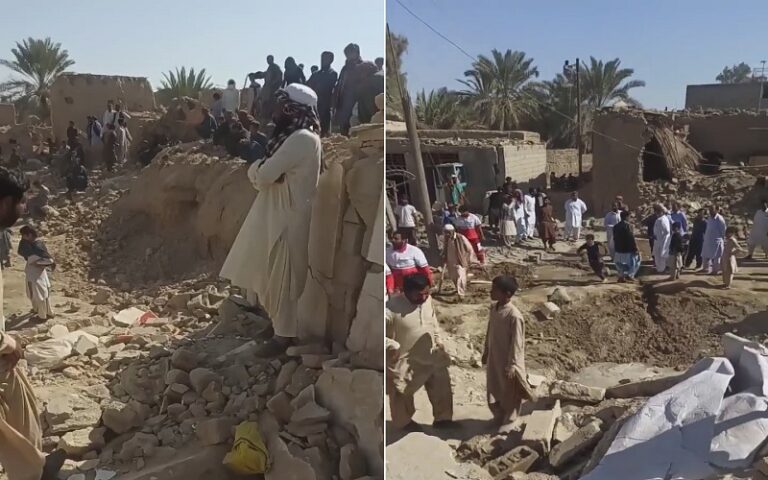
An earthquake with a magnitude of 5.9 struck northwest Iran on Saturday, killing at least three people and injuring more than 1,000.

An emergency official told state TV that it was snowing in some of the affected areas, with freezing temperatures and some power cuts reported. The freezing weather continues to this day and the people of the region have been left stranded with no government aid.

According to the Nasr News website, which covers the news of East and West Azerbaijan provinces, “Following the 5.9-magnitude earthquake, the people of Khoy spent the night in the streets at minus seven degrees (Celsius) and complain about authorities ignoring their situation.”

The government-linked ISNA news agency reported that people had gathered at the local Red Crescent warehouse to receive supplies. Security forces used water cannons to disperse them.

“The depth of the crisis and damages in the earthquake-affected areas of Khoy is high,” said Ruhollah Hazrat Poor, MP from West Azerbaijan Province.

In a video that has been shared widely on social media, a local from the disaster-struck city says, “Where should we go? What should we eat? Who can we talk to? Little children, mothers, everyone are all left in the cold, help us…”

More than 40 aftershocks have been reported after the 5.9-magnitude earthquake in Khoy.

Ali Beitollahi, a member of the academic staff of the Road, Housing and Urban Development Research Center, said that up to 123 villages were damaged by the earthquake. In three cities, nearly 5,000 residential units were damaged.

Some villages have suffered 20 to 50 percent destruction. Electricity has been cut in more than 30 villages. Many earthquake victims have no shelter in the snow and extreme cold. The regime’s entities and Red Crescent did not help the people.

“In total, about 262,000 people, including nearly 78,000 families, were affected by the earthquake,” said the regime’s deputy of the Red Crescent. “On Saturday night after the earthquake, the people, afraid of the subsequent earthquakes, spent the night in the streets despite the unbearable cold.”

After four days, the people of Khoy are still suffering from the damages caused by the earthquake. And the regime is doing nothing to help them. Videos and photos posted online show lines of people out in the cold, seeking food and shelter.

Meanwhile, the regime is turning down offers of aid from neighboring. According to the head of Turkey’s Red Crescent, “After the earthquake, we declared our preparedness to help [Iran]. They said that can handle the situation.”


Iran’s Unsolvable Air Pollution Problem

Air pollution will remain at dangerous levels and will increase for the next few days in most big cities, including Tehran, Karaj, Isfahan, and Mashhad, according to Iran Meteorological Organization. For this reason, schools have been closed for about two weeks and education is held online. Large parts of Iran are struggling with air pollution, gas shortages, and freezing weather.

But at the same time, the regime exports gas and gas condensates and uses mazut to supply the fuel needed by power plants, industries, and refineries to keep its source of income.

Recently, Ebrahim Raisi’s government decided to raise the air pollution standards and index to avoid closing schools.

In an interview with the ISNA news agency on January 23, Minister of Education Yousef Nouri said, “If you look at the global indices of air quality, in other countries they don’t close schools if the index is less than 300. But for us, they set the index to close schools at 150. The closure was like the Covid-19 period, while our pollution indices are below 200. We are going to propose to suspend these indicators in the next government board meeting.”

Last year, Interior Minister Ahmad Vahidi said that important programs regarding air pollution would be implemented by the end of the year.

“Today, important plans regarding the reduction of air pollution were approved, and we are trying to design and implement parts of these plans by the end of 2022,” Vahidi said in November 2021, according to Fars News Agency. “Vehicles account for 60 percent of pollution in big cities. In this regard, it is necessary to put the production of electric vehicles on the agenda with the cooperation of the president’s office for Science and Technology.”

But today, the air situation in Iran’s big cities is much worse than last year.

“With the help of the environmental organization, we determined a new proposal for the government to slightly change the standards so that it is not necessary to close our schools,” Vahidi claimed.

But the Ministry of Health does not agree. In an interview with the Armanmeli website on January 25, Abbas Shahsavani, head of the air health and climate change department of the Ministry of Health said, ” Some days in Tehran, the concentration of suspended PM2.5 particles is more than 10 times the World Health Organization guidelines, which means that the concentration of particulate matter is so high that it is dangerous for the health of people and especially sensitive groups. It is not right to eliminate the problem by simply changing the air pollution index.”

“Directives and orders cannot change air pollution indicators. Respiratory infection is the most common cause of death in children. The annual standard of particles in the country is six times more than the guidelines of the World Health Organization and this means that people’s exposure to air pollution is high. So, instead of changing indicators, we should focus on reducing pollutants and controlling emission sources,” Shahsavani added.

A recent study by the Air Pollution Research Center of Tehran University of Medical Sciences indicates that about 40,000 people in the country die every year due to exposure to a concentration of particulate matter smaller than 2.5 microns in the air. This is equivalent to 10 percent of all deaths.

“But the risk of this disease is higher in children than in other age groups. Some other diseases, including leukemia (blood cancer), are one of the most common cancers in children. Studies show a significant correlation between exposure to traffic pollutants and the risk of leukemia in children. Also, air pollution affects the residents of many Iranian cities in the form of cardiovascular, respiratory, and stroke diseases,” Shahsavani continued.

Is there any plan to deal with air pollution? Obviously, no.

Behzad Ashjaee, the former deputy of the Environmental Organization, told ISNA news agency on January 25, 2022, “There is no special attention to the issue of air pollution in the 2022 budget bill.”

Iran ranks sixth in the world in terms of greenhouse gas emissions. Schools and offices in the capital and some other cities were closed many times during the past weeks due to severe air pollution, and there is no prospect of improving the situation.