Home Blog Page 253

Iran’s Education System Remains Closed Down

Caring about other priorities, Iran’s government puts the country’s education system in such a situation that until now no one is introduced as the education minister, and everything is uncertain, and the choices seem not to be desirable.

More than one and half months have been passed since the start of the new school year, and everyday news and rumors are published about the regime’s decision to reopen schools, while the number of cities being a subset of the red cities because of the coronavirus is increasing.

This is something that has raised even the concerns of the regime’s health officials who are warning the government about the consequences of such a decision.

Ali Sharafi Zarchi, Director of the Statistics Center of the Ministry of Health, fearing the consequences of this decision, was forced to confess about the danger of this decision and said:

“In November, in some cities, the coronavirus trend increased, and some cities have turned red. Now I can’t imagine that schools will open in red cities, and we should prevent vigilantly the sixth peak from spreading across the country because it may not threaten the student, but their families are in danger.

“In August, at the highest peak of the coronavirus, the number of red cities had reached 359, which decreased to seven cities until October 9, but now it has reached 33 red cities again, and at the same time the number of blue cities has increased because the overall trend of the country is downward, on the other hand, in some places we have an increase in the number of coronavirus cases, and that’s why the number of red cities has increased.” (State-run daily Entekhab, November 7, 2021)

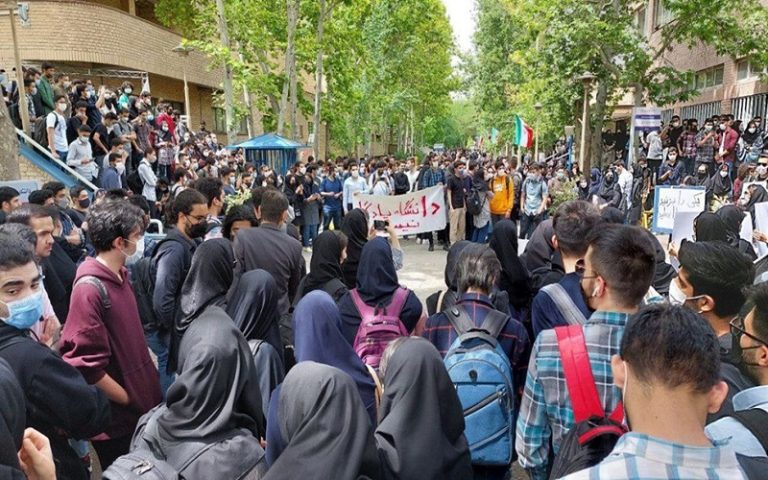
On the other hand, the virtual education system (Shad System), started by the government to cover the school closures, did not have the desired result, and its outcome was that many students have suffered from a noticeable academic failure, and many of the students were forced to drop out because of not having access to the virtual system.

The supervisor of the Education Ministry said:

“Currently, statistics show that we have about 210,000 primary school students and about 760,000 secondary school students who dropped out, which is serious harm, and we need to plan for it and focus on it. One of the most important challenges is dropping out of school in some areas.” (State-run news agency Tasnim, November 6, 2021)

Something very sad that is happening now in the country’s schools is the fund collections of the schools from the parents of the students to buy hygiene products for the disinfection of the schools. This is while this subject is one of the duties of the Ministry of Education, and they must provide the financial conditions so that the schools can provide hygiene facilities.

This rejection of the Ministry of Education will increase the risk of coronavirus expansion undoubtedly. On the other hand, the country’s school enrollment system is facing serious problems so that many registrations are done with delays and many of the students were not able to register regular time.

Statistics show that more than one million students at different levels have completely quit, which will be a serious challenge for the education system to return them to the classroom. Television lessons have also been much less noticed this year. Realistically, the regime’s Ministry of Education has not achieved any success in virtual and visual education, and most students have faced academic failure.

This is one of the results of the regime’s refusal to import the coronavirus vaccine and to start the country’s vaccination at the proper time, analysts say.

A month and a half have passed since the beginning of the Iranian school year, but even online many students don’t have teachers, which means it is not yet clear who is going to teach them. This has become a circle of endless problems for the country’s youth and children, in which the country’s future is being sacrificed.

Iran’s Government Creates a Smokescreen To Hide Its Retreat

On November 5, the Iranian Friday Prayer leaders tried to introduce the story of the Revolutionary Guards (IRGC)’s oil tanker retake as a victory for the regime. One of them, cleric Mohammad Ali Al-Hashem, called this incident a victory by ‘hitting seven targets with one bullet.’

Meanwhile, cleric Hassan Ameli called it an exceptional humiliation of the US military and defeat of the American awe.’

These dictated speeches by the regime’s Friday Prayer Leaders were with the goal of a ‘smoke screen’ to protect the regime and distract the public opinion from the regime’s main problem, analysts say. The question is what is the regime’s main problem? It does not take much research to understand the regime’s motivation to trumpet the news about an oil tanker capture in the Gulf of Oman.

The state-run news agency Fars the next day after this event in a note entitled, ‘Crossing the twofold subject of the field and diplomacy/ Why was Raisi’s praise about the IRGC’s power important?’ revealed the reality about the regime’s goal in this event.

“In the new administration, the first military incident was the collision of IRGC speedboats with American piracy. This is significant because on Wednesday (November 3), Ali Bagheri, the Deputy Foreign Minister for Political Affairs, announced that the Vienna talks would resume on November 29 this year.”

Easily translated, this smokescreen (confronting the US Army) was to hide the regime’s retreat, better said the retreat of the new Hezbollahi government who all are the regime supreme leader’s beloved people, accepting to negotiate with the US government about its nuclear case.

Previously, before every strategic decision whose outcome would be against the regime, Tehran attacked its opposition, the People’s Mojahedin Organization of Iran (PMOI/MEK), whose members were stationed in Iraq and who are now in Albania, to compensate for its weakness.

Now, losing this opportunity, they are forced to show their fake power in such James Bond-style theatrics- But who are they trying to scare?

This answer is given by the Fars: “Negotiations may have a tortuous path, but as long as the negotiators have the thought that the negotiations are not about life-and-death, there is a possibility of a diplomatic victory. In war, that one who fears more will lose sooner.”

So, the purpose of this drumming is not to intimidate the other side. It is to encourage its hopeless forces. In addition, to create this image that its new Hezollahi government is going to the negotiation desk with courage and power.

Amazingly, before this event and the regime’s acceptance to sit behind the negotiation desk, Supreme Leader Ali Khamenei defined negotiations with the United States as concessions and said that they would not negotiate with the United States.

“I have been repeating for years that we do not negotiate with the United States. [If] you take a step back, they will take a step forward. That we keep saying we do not negotiate, [but] some say, sir, there is nothing wrong with negotiation, the wrong thing about negotiation is this:

“It diverts you from the right path, it takes one concession from you. When you negotiate, it means giving a concession and taking another. This is the meaning of negotiation; Negotiation is not sitting and chatting and talking and laughing and joking, negotiation means giving something, taking something. Then it takes what he owes you, he does not give you what he owes. This is bullying.” (Khamenei.ir, August 1, 2016)

Now according to the speeches of the regime’s supreme leader, accepting the negotiations is due to the regime’s weakness, giving concession and accepting to be bullied.

Before Ebrahim Raisi’s government, he said that the JCPOA was not his real choice, and his inner circle said that accepting the ‘Heroic flexibility’ was because of the insist of the then officials and he would new retread in front of the USA. But what about now? Now Khamenei’s desired government has the power.

The truth is that the regime has no cards to play with, Iran watchers say. And on every occasion, it is calling for negotiations but with a ‘humiliating flexibility.’ But in an invert way.

“The Americans are constantly impatient to negotiate with Iran, we have made our decision, you are still hesitant. We did not leave the JPCOA at all, you have disturbed the JCPOA, now if you won’t come back and negotiate, Islamic Iran will not accept erosive negotiations.”

Corruption and Nepotism Rife Throughout the Iranian Government

As the Iranian economy is in ruins, and more and more people are falling below the poverty line, instead of finding solutions to rectify the problems, the Iranian regime is too busy with internal disputes over who has the bigger share of power.

The top officials are focused on ensuring that key posts in the government are filled with people they know and trust to push forward with the same ideologies. As a result, family members and close friends are often preferred than people who hold genuine qualifications for the roles.

officials are appointed to many ministries, governorates, and other high-ranking government positions simply because they actively contributed to the regime’s suppression of protesters and dissidents.

Currently, the ministers and governors who have been appointed to the administration of the regime’s president Ebrahim Raisi are either loyalists to supreme leader Ali Khamenei, officials who have served in cabinets of previous presidents, or have strong ties to the Revolutionary Guards (IRGC).

The Minister of Cooperatives, Labour and Social Welfare, Hojatollah Abdolmaleki spoke to the state-run Keyhan daily on November 3 and accused the heads of previous governments of many security and economic crimes. He claimed many were involved in cases of corruption, with some already having convictions against them.

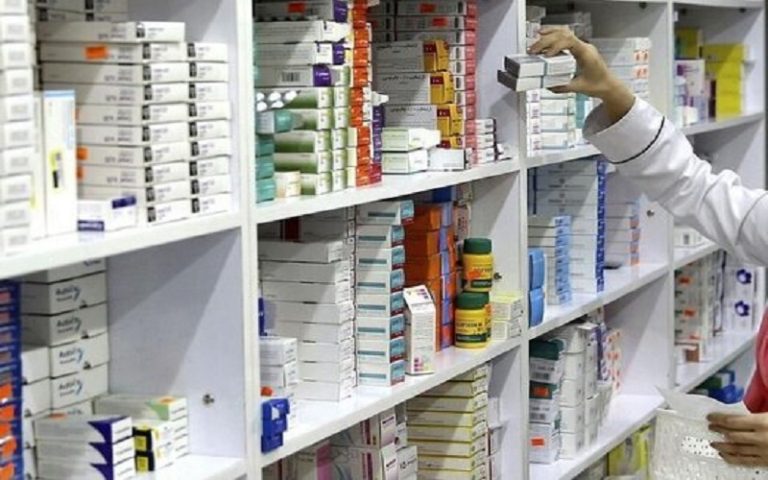
Corruption and looting in the Food and Drug Administration of the Ministry of Health are also some of the cases acknowledged by government officials.

In a quote from Abdolreza Mesri, the former Minister of Cooperatives, Labor and Social Welfare, in the Aftab-e Yazd daily last month, it was revealed that a former manager of the Food and Drug Administration was also the CEO of a state-owned company, which he used to conduct his crimes through. He imported medicine through his pharmaceutical companies, but then through his state-owned companies purchased the medicine from his private companies at 1,050 times the price.

The fact is that cases of corruption and looting of the Iranian people’s property, as well as nepotism and comradeship in government positions, are common. They are not limited to one administration and have become a common denominator of all administrations.

The state-run Jomhouri-e Eslami daily stated in their November 3 publication that this culture adopted by the regime ‘has dominated appointments in significant sectors of the Islamic Republic for many years’.

Corruption and nepotism are completed institutionalized when it comes to the regime. These factors, along with the inhumane repression of Iranian society are what binds the regime officials and leaders together in their desperate attempt to seize and hold onto power in an already fragile regime.

This is what meritocracy means under the rules of the mullahs, where Khamenei and institutions linked to him are sitting at the top and continue to loot the country’s wealth. And it is this corrupt nature of the regime that is backfiring against it, manifested by continued protests across the country by all walks of life.

Iran’s Officials Claim To Run an Independent Oil Industry, but It Is Bankrupted

0

Iran’s oil industry is the bottleneck of the country’s economy. This is something that the regime has not been able to change over the past 43 years, and 85 percent of the country’s income relies on oil.

Therefore, the country’s economy is struggling to survive because of the sanctions, as many regime experts are saying. This industry in addition to the sanctions is also facing other challenges, which of course it due to the sanctions too, and are enough to collapse the economy.

There is a conflict in the speeches of the regime’s officials. On the one hand, they claim that despite the sanctions the oil industry is facing a boom, and on the other hand, they are forced to confess that this industry is so outdated and wracked that in the future Iran is forced to import gas while having the second most gas resources in the world.

The regime’s claim of self-sufficiency in the oil industry is something like that: “The Chairman of the Board of Directors of the Association of Oil Industry Equipment Manufacturers announced 85% self-sufficiency in the oil industry in the manufacture of equipment for the oil, gas, and petrochemical industry.”

Javad Oji, the regime’s oil minister, increased this number and claimed that the oil industry has become 100 percent independent, something that did not happen even in the best years of the regime in Rafsanjani’s and Khatami’s presidencies.

Oji in an interview with the state-TV News Channel on October 29, 2021, said: “We have a 100% readiness in the upstream sector to produce gas and our refineries, which their overhaul has been fulfilled. With the liquid fuel reserves we have in power plants and industries; Inshallah we will overpass the winter unchallenged.”

This claim is at the time, that this minister before said that because they did not prepare the South Pars gas fields and several other projects in due time, they are suffering irreparable losses.

What the regime’s oil minister has generally called ‘irreparable losses’ has been explained more explicitly by the regime’s oil experts and circles. Although the Iranian regime ranks third in the world in terms of natural resources for oil and gas, it was removed from the list of the world’s 20 largest oil and gas companies due to U.S. sanctions and regime mismanagement, and lack of proper infrastructure.

The State-run news agency ILNA on November 2, 2021, exposed that the regime is not able to invest in the country’s oil industry and wrote:

“Unfortunately, in the past years, the necessary investment in the oil and gas industry has not been made, while we need $160 billion in investment in this area to respond to the country’s needs,’ Oji said Sunday (October 31) at a meeting to coordinate the 2021 budget bill.

“He stated that if there is no investment for development, we will become importers of these products in the future, he added: ‘Projects that do not have economic justification will make trouble for the government, parliament, the economy, and the whole country.’”

The dark prospect for Iran’s oil industry has become obvious even just with these few confessions which reveal the regime’s lies. The truth is that the regime has destroyed the people’s assets due to insufficient attention and exploiting more than the capacity of the oil pits.

Iran’s Government Unable To Create Even One Million Jobs

In the latest meeting of Iran’s Supreme Employment Council, the main resolution that was approved was the creation of 1.85 million new jobs until the spring of 2023.

This resolution is facing skepticism in the government because many government economists say that the government does not have the opportunities for such a decision according to the country’s economic situation.

One thing adding to this skepticism is that over the past two years because of the expansion of the coronavirus, while Iran is one of the worst-hit countries in the world, according to the government’s statistics more than two million jobs have been lost.

Over the past decade, about 54 percent of the jobs in the country belong to the service sector, and this sector was the worst hit because of the coronavirus. The tourism and service sectors are not working properly, and most of the stores and supermarkets are facing lower visits because of the coronavirus protocols. Thus, most of the jobs that have been lost belong to the service sector.

Not having an acceptable vaccine outcome, this situation is getting worse without any progress, while many of Iran’s healthcare officials are warning the government about the sixth peak of the coronavirus pandemic.

Analysts expect some of these jobs to start again if the coronavirus crisis ends, but this has nothing to do with the government’s claim about the creation of about 2 million jobs, and it is strange but not unexpected from Iran’s government to use these numbers for its success of the creation of 2 million jobs.

The government is not able to create 2 million jobs, because they do not have the facilities, equipment, tools, and fields, and space in the country, according to Hamid Haj Esmaili, a market expert.

The reason for this is clear: in the tenth government, they tried it without any success. Therefore, they cannot claim that the previous government has created even one million jobs each year, to use it as an indicator for the success of the new government, and over the past decade, this did not happen in Iran at all.

The calculation about jobs created and lost shows exactly that the government was not able to create even one million jobs. In addition, the increasing number of people under the poverty line and the migration are other indicators of this reality.

The other question is with which capital will the government realize this. This is while the country is facing a huge budget deficit, and in the budget of this year nothing has been considered as the fund for job creation, and most of the budget’s destinations are not clear.

Accordingly, there is no budget to be invested in construction work, nor any investment to create employment.

The second important subject that should be considered for job creation is foreign investment. For a country like Iran, this reality is undeniable that without foreign investment they are not able to create jobs. Due to the regime’s policies, this is impossible in the coming decade.

The sanctions and the regime’s refusal to accept the condition of the FATF have made international money transfer for the regime impossible, therefore no one can make any investment in the country’s economy. Something that could be used but is not possible too is the use of the country’s private sector because in Iran there is no real private sector, and the only thing that exists is the so-called ‘government-run private sector,’ which is not in favor of the country’s economic interests.

The other two subjects that are making such a thing impossible are the imbalance of the banks which is one of the causes of the increasing inflation and the liquidity which has reached an unbelievable number. Something that is happening due to the regime’s wrong economic policies and a brokerage system that has created uncontrollable corruption.

Troubling Statistics on Malnutrition in Iran

Today in all nations, especially industrial and developed societies, human resources are playing an important role, and are referred to as the “Development Factor”. In this factor, elites play the most important role, something that is not in the interest of Iran’s government, which is wasting and destroying this most important value of the country.

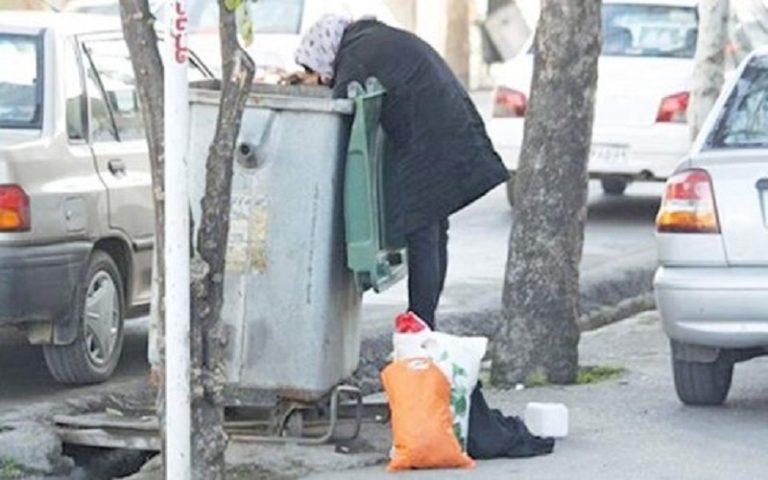
Therefore, both the rate of depression and the lack of proper nutrition are skyrocketing in the country. The most important factor to fight these two damages is the enjoyment of any person to provide a proper livelihood, which in Iran due to the high costs and inflation has become a dream.

It has been announced by the country’s official statistics that the consumption of protein and dairy products is lower than half of the world’s standards. The high costs and reduced purchasing power of people have caused demand for Iranian groceries to fall by 30 to 35 percent compared to the same period a year ago.

Earlier, there was news that the people of Iran due to their financial inability are forced to pay with credit for the goods, even for commodities with low prices, something that indicates the dire situation of the people.

At the same time, the latest statistics provided by the Central Bank show that the poverty line in the country has reached 11 million tomans ($400), and accordingly, it can be concluded that the majority of people live below the poverty line and have the least access to food and proteins.

The state-run website Tejarat News on September 22, 2021, quoted the head of the Dietetic Association as saying that people’s food security is severely damaged and that people could no longer afford the standard calories they needed per day.

This media outlet went on to point out the prices of some of the essential items of people’s daily lives, which have been removed from the household nutrition basket due to expensiveness, such as:

“Beans that in August 2021 compared to last year has increased more than 50 percent, Iranian rice about 42 percent, pasta more than 20 percent and bread more than 50 percent.”

In the end, this report pointed out that, “Although the head of the Iranian Nutrition Association recommends that people should replace cheaper food with expensive food, some people do not even have the economic power to replace them.”

Zahra Abdollahi, director-general of the Nutrition Improvement Office of Iran’s Ministry of Health, in an interview with the state-run news agency ILNA, while trying to hide the regime’s responsibility for the starvation of the people, on October 9, 2021, said:

“Rising food prices all together have increased the risk of food insecurity in the country, especially in low-income and poor deciles. Currently, there is concern that, given the above-mentioned cases, i.e., drought and economic conditions, conditions in low-income provinces will worsen and food insecurity will increase.”

A progressive country means educating people who can manage the country’s future. A man who must constantly care about his/her livelihood will definitely do not care about the country’s future.

About this concerning situation and the country’s future the lawmaker of Khomein Shahr in an interview with the state-run website Eghtesad-24 said:

“Imam Ali says that if oppression is done, it will cause that the people do not tolerate the rule anymore. The implementation of justice shows its manifestations in this material supply and is perceptible. If the masses feel deprived of the most basic facilities that will contribute to their physical health, they will not tolerate the rulers, certainly.” (State-run website Eghtesad-24, November 3, 2021)

Iranian Oil Tanker Seized by IRGC Who Blame US for Trying To ‘Steal’ the Vessel

According to Iranian state media on November 4, the supposed theft of an Iranian oil tanker in the Sea of Oman was blocked by the Islamic Revolutionary Guard Corps (IRGC) navy. Reports claimed that the United States navy was attempting to steal the vessel, which has been vehemently rejected by the Pentagon.

Pentagon spokesman John Kirby gave a statement saying, “I’ve seen the Iranian claims. They are absolutely totally false and untrue. It’s a bogus claim.”

The regime, in fact, had seized a Vietnamese-flagged oil tanker in October. Two U.S. Navy ships, backed by air support, had monitored the situation but did not try to prevent the vessel. The vessel is identified as ‘Southys’.

A report on the Tanker Trackers website indicated that the vessel was attempting to make a delivery of 700,000 barrels of crude oil to China, but the shipment was rejected. As a result, Southys was forced to return to Iran, dropping anchor off the coast of Bandar Abbas, before later being relocated to the Strait of Hormuz.

Since the regime has not paid the price of its regional adventurism and nuclear extortion, it continues its malign activities. Why does Tehran take the risk of creating an international fiasco which could lead to a standoff rather than attempting to restore the 2015 nuclear deal, formally known as the Joint Comprehensive Plan of Action (JCPOA)?

The state-run Aftab-e Yazd daily wrote in their November 2 publication that if the Iranian regime return to the JCPOA, then the U.S. and other signatories would not be limited to the terms of the current deal. If the regime chooses to leave the JCPOA, then they must start negotiations all over again with countries that may wish to extend nuclear discussions to other issues. Whatever the decision is that Tehran makes will likely end in a standoff.

It should be noted that Iran’s state-TV broadcasted the entire attack on the oil tanker to somehow boost the morale of the regime’s forces.

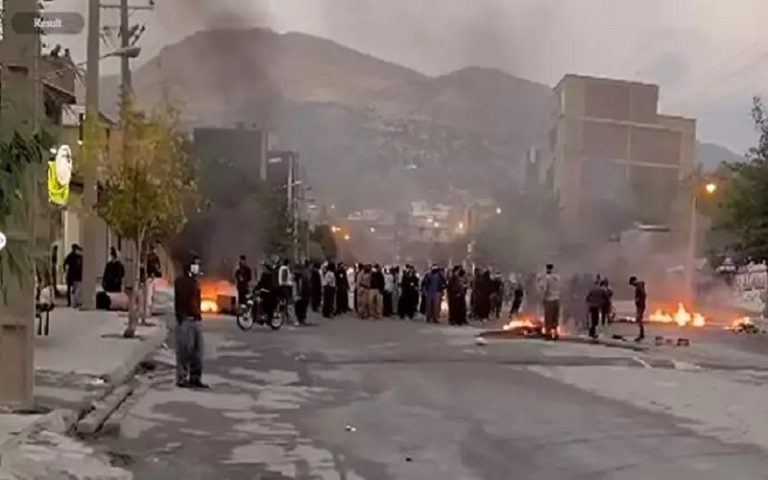
This latest ploy by the regime comes at a time where Iran is suffering from crisis after crisis. Iran’s economy has practically collapsed, the Covid-19 pandemic is ravaging the country and society is becoming more restive as the crises worsen daily. Protests are commonplace across the country, with dozens taking place every day and the situation is so intense that the regime is fearing another uprising akin to the one in November 2019, if not worse.

The Mostaghel daily wrote on October 30 that, “The political system in Iran has been facing the crises of political legitimacy, economic efficiency, and structural corruption for many years.”

Warnings of endangerment to state security were issued by the Aftab-e Yazd daily on October 31 who said with the number of people in Iran living in poverty and unable to provide for their families, tensions will only worsen and with nothing to lose, people may resort to violence.

The western powers should not concede to the regime’s extortion campaign. Such provocative actions, which destabilized international peace and security, should not be left unanswered. The regime should be held accountable, and this is the only way to end its malign activities.

Harming Iranian People’s Interests, the Result of Khamenei’s ‘Look to the East’

0

Ardeshir Dadras, the head of the Iranian Compressed Gas Association (CNG), announced on November 2 that Iran, according to an agreement with Russia, has no right to withdraw from eight gas wells in the Caspian Sea. Although this statement was rejected by Kazem Jalali, the Iranian ambassador to Moscow, international observers said that the reaction of the regime’s ambassador to Moscow is due to the reaction of the Iranian people on the internet and social media.

In an interview with ILNA, Dadras stated that according to the agreement between the Iranian and Russian governments, Iran has no right to extract gas from the Caspian Sea’s gas resources as long as Iran’s gas balance is positive and domestic production meets consumption.

Dadres added, therefore, that we should think about the gas resources of the Caspian Sea at this time. Dadres attributed this to the agreement between the Iranian and Russian governments that Iran’s government is not allowed to increase Iran’s gas reserves to a level higher than Russia’s gas reserves.

Russia currently has 18.1 percent of the world’s gas reserves, and Iran’s share of the world’s gas reserves is 17.9 percent.

According to the Dadres, if the Iranian government withdraws from the Caspian Sea gas reserves, Iran’s share of world gas reserves will increase to 18.2%, which according to Dadres is contrary to the agreements that the Iranian government has already made with Russia.

The news of Iran’s ban on gas extraction from eight gas wells in the Caspian Sea, which is located in the waters of Iran, provoked many negative reactions among social media users.

While condemning this act and diminishing Iran’s interest in gas extraction, Iranian citizens cited the incompetence of Iranian government officials as the reason for the ban on gas extraction from wells in the Caspian Sea, and many of them attributed this to Russia’s expanding dominance over Iranian resources.

In the past, the division of the Caspian Sea water area in recent years had caused widespread criticism among Iranian society and on social networks.

Jalali reacted to Dadres’ remarks on Tuesday, November 2, stating that ‘this has not been the case during the more than 1.5 years he has been Iran’s ambassador to Russia.’ He described Dadres’ statement as ‘influential to Iran-Russia relations.’

Despite all the regime’s rejection which was expected and something usual by the regime, the state-run daily previously about this agreement wrote:

“Last week, Iran unveiled a large gas field in the country’s waters in the Caspian Sea, the Oil Price website reported. The Chalus gas field is to be constructed with the aim of creating a new gas pole in northern Iran to complement the country’s gas south pole with the focus of the massive South Pars field.

“The main developer of the Chalus gas field is Khazar Oil Company (KEPCO), but technical and financial assistance is also received from Russia and China.

“If initial estimates of gas reserves in the Chalous field are correct, Iranian gas will be able to supply at least 20 percent of Europe’s gas requirements. However, the number of exports, prices, and destinations of this gas is aligned with Russia, adding to Moscow’s dominance of Europe in energy, which is now one of the main themes of the dispute between Europe and its NATO partner, the United States.

“According to the author of the analysis, the reason Iran accepted this terrible change in its share of the spoils of the Caspian Sea was that it was negotiating a 25-year deal with China at the time, including a major important agreement with Russia.

“The deal with Russia was a legal necessity for a 25-year contract with China. For example, the deal allows Russian and Chinese aircraft and ships to use shared sites throughout Iran. It was added to existing multi-layered, 10-year agreements that Iran had signed with Russia until then.” (Bourse News, August 23, 2021)

The ’25-year agreement with China’ and the ’20-year agreement with Russia’ are the result of the regime’s policy of ‘looking to the East’. With the excuses such as benefiting from becoming a member of the Shanghai Cooperation Organization (SCO), which is, in fact, to have the opportunity of a veto in the UN Security Council if its nuclear case becomes worse and facing inclusion under Chapter 7 of the United Nations Charter.

Iran: Mother and Daughter Denied Prison Leave, Despite Ongoing Medical Issues

Two women’s rights activists, Yasaman Aryani and her mother, Monireh Arabshahi are being deprived of receiving prison leave despite Monireh needing ongoing medical care. The women were sentenced to 5.5 years in prison for their opposition to the Iranian regime’s policy of mandatory Hijab wearing.

Farzad Aryani, the husband of Monireh and the father of Yasaman, said, “My wife and daughter have not embezzled any money, nor have they committed murder. They spoke out in the best possible form by presenting flowers [to women on the International Women’s Day.] They must not be deprived of their right to have prison leave.”

Monireh and Yasaman were initially arrested in April 2019 and imprisoned at Qarchak Prison in Tehran. In August 2019, the women were transferred to the notorious Evin Prison, before later being sent to exile in Kachouii Prison in Karaj in October 2020.

Farzad Aryani, Yasaman’s father, posted an audio recording on social media, in which he said, Why the rights of prisoners, including my wife and daughter, are not observed?

Monireh Arabshahi first fell ill in December 2020, suffering from a swollen throat and having trouble breathing. Doctors at the prison recommended that she needed to go to the hospital to have her thyroid glands scanned to assess the situation, but this was denied by prison authorities.

Eventually, she was granted a medical leave at the beginning of May 2021 after paying a bail of 500 million Tomans. Following a thyroid gland operation, she was returned to Kachouii Prison on July 23, before being sent back to the hospital the following week after her health deteriorated but was forced to return to prison without receiving treatment.

A further medical leave was granted on August 4 until October for ongoing treatment, at which point she was once again summoned back to prison without fully completing her course of treatment.

Efforts to obtain prison leave for Yasaman Aryani to attend to her sick mother did not lead anywhere.

The Iranian regime has often resorted to the method of torturing political prisoners by depriving them of desperately needed medical treatment. This method has worsened in the case of the Covid-19 pandemic, where prisoners infected with the virus have been left unattended in contaminated sub-standard quarantine areas.

In Farzad Aryani’s audio recording he explained how in the past two years and seven months, his wife had only been granted a few days of medical leave to undergo her thyroid surgery, as did his daughter who needed dental surgery. He told how Monireh and Yasaman were both told by prison authorities that they did not deserve to have prison leave because of the fact that they were activists.

He said, “Political prisoners are imprisoned for expressing their views or defending people’s rights. Even prisoners detained on drug-related and murder charges enjoy prison leave. However, prison authorities do not allow [political prisoners] to enjoy their right to have prison leave.”

The JCPOA a Non-Maneuverable Trap

In recent days, the positions and actions of the Western countries who are parties involved in the international nuclear agreement with Iran, known as the JCPOA, show that the situation for the regime has become more critical.

The G20 summit ended with a heavy shadow of ambiguity putting its burden on the fate of the JCPOA. The Western powers are witnessing that the regime with its actions is playing for time, and there is no outlook to return to the negotiations.

Thus, the tone of their officials has changed, and even Russia’s officials who the regime considers as its allies are mocking the regime’s position.

After some new sanctions against the regime’s drone systems, now US President Joe Biden is warning the regime that they will respond to the regime’s drone attacks, relying on all options on the table.

Germany, France, and the United Kingdom, along with the United States, stated on the sidelines of the G20 summit, warning that the regime’s actions would only mean building a nuclear bomb.

Stressing that the regime should come to the negotiating table, they emphasized that other destructive actions of the regime should be addressed in the negotiations, in addition to the nuclear issue.

Seyed Jalal Sadatian, the regime’s former ambassador to London, warned: “In the statement of the four countries, their positions are becoming closer and this dangerous for the system.”

In parallel to this statement, strategic bombers of the US army flew over the Persian Gulf close to the regime’s borders and in a maneuver.

The regime has no way out and must accept the demands of the world powers who are demanding to put the regime’s missile and regional activities on the table, or it will face harsher reactions, analysts say. This has become more critical for the regime because no one is trusting the regime anymore and time is running out for the regime.

The state-run daily Mostaghel on November 2, 2021, in an article entitled ‘The Inconclusive JCPOA’ wrote: “It seems that the future of the JCPOA remains unclear, and everything is ambiguous.

“Iran has announced that it will return to negotiations before the end of November, but U.S. officials are looking at the matter with skepticism. Sources in Washington told CNN that talks are underway to increase pressure on Iran under the Biden administration as Iran moves closer to building a nuclear weapon.

“Despite the willingness of the U.S. and Iranian sides to continue negotiations, the future of the JCPOA seems to remain unclear and everything is in an aura of ambiguity.”

Hidden dangers are what other state-run media in Iran are warning about. The state-run daily Siasat-e-Rooz on November 1, 2021, wrote:

“The agreement that the United States and Europe are seeking is an agreement that will force Iran to trade on its missile advances and capabilities and reduce the influence in the region. Such a thing would actually disarm (the system).”

Mostaghel daily warned that the regime was facing a dangerous future and wrote:

“The nuclear program has become the first embankment beyond its cost-sized nature. In other words, it has become the first stronghold, which if conquered by the enemy, will lead to the fall of other strongholds. They see the next strongholds as regional roles, weapons capacities, human rights and even the existence of a system called the Islamic Republic.” (State-run daily Mostaghel, November 1, 2021)

Meanwhile, the state-run daily Setareh-e-Sobh introduced the regime’s dreams of becoming a nuclear power as the main barrier to the progress and wrote:

“The Islamic Republic has stated several times that it does not want to build an atomic bomb, but at the same time a large portion of Iran’s power, wealth, and assets have been spent on developing nuclear energy over the past years. It seems that if the Islamic Republic does not even want to build a nuclear bomb to strengthen its defensive or military position in the region or for its negotiations with the West and its diplomatic dealings, it is willing to potentially have the possibility of building a nuclear bomb.”

There are much more examples about the critical situation of the regime written by its media, and the result is that this time the regime must decide between worse and the worst.