Home Blog Page 276

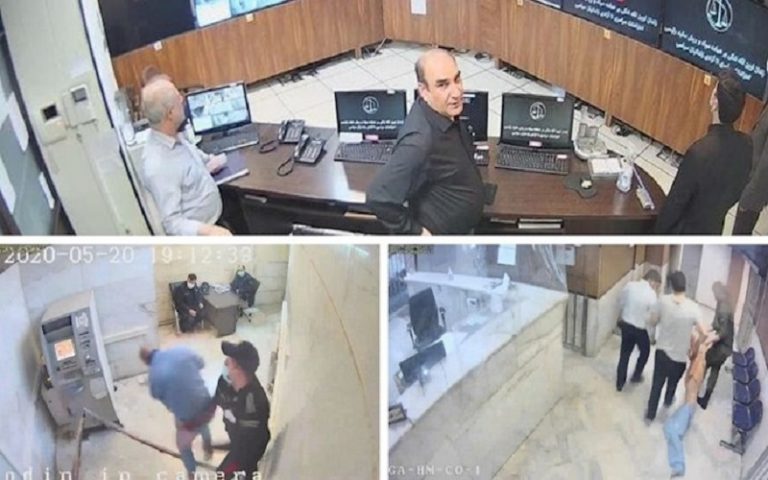
Leaked Images of Iran’s Evin Prison Scare the Officials

Four days after the release of images and videos of some hacked cameras in Evin Prison on social media which is showing only a corner of the brutal and inhumane treatment with defenseless prisoners by the Iranian regime, many of the regime’s officials have been forced to react to this event.

This chain of desperate reactions started with the apology of Mohammad Mehdi HajMohammadi, the head of the prisons organization which was expressed in a tweet.

The shared reaction between all of them is the blow on the Iranian regime, fearing its consequences in the public, while the situation of the regime is very unstable and facing many challenges. This event was absolutely not with pleasure for the regime’s news President Ebrahim Raisi and his entering government who are trying to show a ‘Justice Seeking’ face of themselves.

Some fearing its consequences on the regime’s human rights case, especially at a time when the trial of one of the perpetrators of the 1988 massacre Hamid Nouri is taking place now in Sweden. Other officials and regime officials are fearing its impact on the JCPOA negotiations (Iran’s 2015 nuclear deal with world powers) and raising their concerns that the regime’s human rights case will be attached to the JCPOA case, and the regime will have no chance to reject or circumvent this situation.

But despite all this, this is just a small proof of the years-long struggle of the Iranian opposition, the MEK, and NCRI to attract the attention of western governments to the human rights situation in Iran.

Below are just some of the hundred reactions by the regime’s officials.

MP Ebrahim Rezaei at the parliament meeting of Wednesday said: “It must be dealt with the doers of the Evin events.”

Parliament Speaker Mohammad Bagher Ghalibaf said: “The Commission of Principle 90 has followed up on the issue.”

“A member of parliament called for dealing with the perpetrators of what happened in Evin prison. Prosecutor General’s Office investigates Evin prison pictures.” (State-TV, August 25, 2021)

“The First Deputy of the Judiciary is investigating the publication of images of Evin Prison.” (State-run news agency Daneshjoo)

“The Speaker of the parliament instructed the Commission on Article 90, in coordination with the Attorney General, to investigate the story of the films released from Evin.” (Parliament Session August 25, 2021)

“Mahmoud Sadeghi’s letter to Ejei following the publication of CCTV footage of Evin Prison: Your immediate order to address this issue, as well as the head of the Prisons Organization, to accept responsibility for the unacceptable behavior of the guards and to declare the commitment not to attempt to repeat such bitter events…” (Asr-e-Iran, August 25, 2021)

“Mir Mohammad Sadeghi, lawyer: The prisons organization’s stance after the publication of images of Evin prison should be taken as a good omen.” (Official Parliament website Mizan, August 25, 2021)

“The shock of leaking controversial images from Evin prison sparks storm. With the release of CCTV footage from Evin Detention Center, the country is in a strange shock. – These pictures are in Iran’s most famous detention center in the north of the capital, which has been repeatedly named because of the presence of political defendants…” (State-run website Hadeseh 24, August 25, 2021)

“Esmaili, the then head of the Prisons Organization, denied beatings in Ward 350 of Evin Prisons. In the recent issue of the leaked films of Evin Prison, an apology is not enough. The perpetrators of this tragedy, which shows that beating prisoners has been a routine task, including by the officers.” (State-run website Tik Tak, August 25, 2021)

The Jomhouri Eslami (Islamic Republic) newspaper reacted to the publication of Evin prison videos, saying: “Should public opinion know what is going on in prisons and what is all this violence for? And as soon as possible, Evin officials and the prison guards will be prosecuted so that the system is not more in the crosshairs of the opposition’s goals.”

“A TV presenter reacts sharply to leaked films from Evin prison. Television presenter Mohammad Delavari reacted to the footage released from Evin prison, describing it as unfortunate.” (State-run website Jamehe 24, August 25, 2021)

“Evin Prison from within: The release of CCTV footage of Evin Prison over the past two, three days has been met with widespread public reaction, especially from social media users.” (State-run website Rooz-e-no, August 25, 2021)

“Ejei order to the attorney general: Check the mistreatment of Evin prisoners without wasting time.” (State-run website, Ofogh News, August 25, 2021)

“Mohammad Hassan Asefri calls for treatment of sewing officers in Evin prison: The Representative of Arak, regarding the publication of images of Evin Prison, says that prison is not a place for creating criminal and that the perpetrators should be treated seriously.”

“What is behind the story of the images of Evin Prison? Some of the images from the Evin Prison are neither defensible nor acceptable. It is worthy to appoint an experienced team to handle and announce the results publicly.” (State-run daily Ofogh News, August 25, 2021)

“What pictures have been published of Evin Prison? The head of the Prisons Organization, emphasizing on respecting the rights of prisoners, promised to compensate for unacceptable behavior in Evin.” (State-run daily Aftab, August 25, 2021)
Iran’s Taxing System, Extortion of the Underprivileged

In Iran gold and the supreme leader Ali Khamenei’s financial foundations are not subject to tax, but the poor society especially the working class must tolerate the burden of much of the government’s spending by paying taxes.

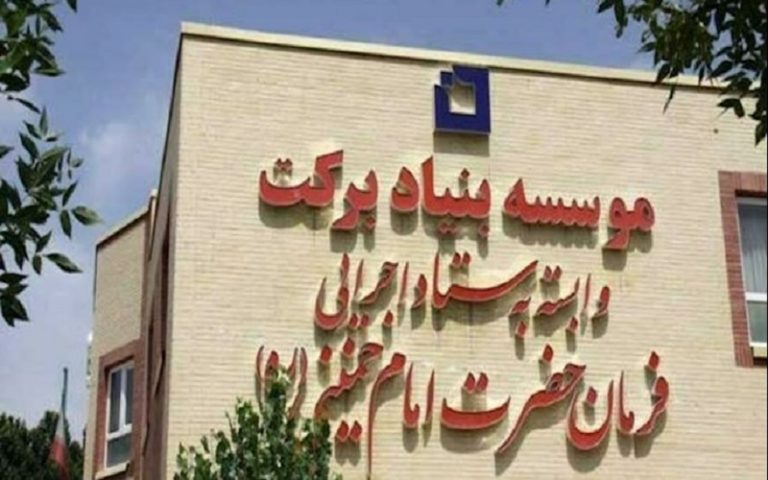
Rich institutions like the Execution of Imam Khomeini’s Order (EIKO), the Mostazafan Foundation, the Foundation of Martyrs and Veterans Affairs, etc., and other entities, such as the financial empires of the Revolutionary Guards (IRGC), are exempt from paying taxes.

Furthermore, the gold tax has shrunk to zero. It is in large part in the hands of government officials and institutions.

On July 7, 2021, the newspaper Industry, Mine and Trade wrote, “With the current inverted tax system, the main burden of taxation has fallen on wage earners.”

And the state-run daily Vatan-e-Emrooz confirming this process on August 22, 2021, wrote: “Due to poor regulatory structure and lack of transparent information systems, the lower classes of society have always been at the forefront of paying taxes, and the main beneficiaries of the economy most of whom are active in the unrealistic and speculative sector are exempt from paying taxes.”

‘The main beneficiaries are the institutions mentioned above. Government economic experts estimate that institutions affiliated with Khamenei hold 80 percent of the country’s economy and resources, while 96 percent of people live below the poverty line.

And their share of the country’s incomes and wealth is so low that it is not counted, as we see during the Coronavirus crisis that the country’s health and treatment system is so backward that they cannot afford to treat the patients.

The state-run daily Hamdeli on August 15, 2021, wrote: “Now that COVID-19 is killing many Iranians, the authorities should be asked what you did with people’s money. Tax money and oil sales in all previous years, if it was not supposed to help the Iranian people in a critical situation like a disease, then what was its purpose? Where has the money been spent? What have the people achieved?

“If the authorities say there is money, but it is not possible to provide vaccines, medicines, and other items for any reason, why should people give their money to those who don’t know how to break down barriers and provide them with the right services at the lowest cost?

“If people are going to treat themselves at home in the face of illness, why should they pay for health care services under the name of premiums? These people who now do all the health work by themselves have no right to ask the authorities what you did with the tax and oil money that was sold in all the past years?”

In the meantime, the government’s budget deficit is an unbelievable amount of 400 to 450 trillion tomans. According to a lawmaker, most of the budget deficit is related to the lack of tax collection from the government institutions as a pending tax, which amounts to ‘270 trillion tomans.’

In July 2021, media outlets affiliated with both regime factions wrote, as the head of the Tax Administration said, tax evasion in the country reached 100 trillion tomans.

Regarding the tax evasion, the regime’s TV moderator said to Mohammad Reza Pour Ebrahimi, chairman of the Economic Commission of the parliament:

“The share of taxes in GDP is almost an average of around 20 percent all over the world, we approved in the Sixth Plan law around 10 percent. The number that was approved in 2020 is 5.5 percent, the simple concept is that as much as we are taxing, almost we are witnessing the amount of tax evasion.” (State-TV Channel Five, August 5, 2021)

Jabar Koochaki Nejad, an MP from Rasht city, pointing 120 trillion tomans of the government’s budget, about the tax exemptions and evasion said:

“Unfortunately, tax evasion in our country is more than 70 trillion tomans. Of course, this is other than tax exemptions, and the number of tax exemptions is very high.” (State-run website Bazar News, August 8, 2021)

Iran’s Next Foreign Minister Shows Support for Middle Eastern Terror Groups

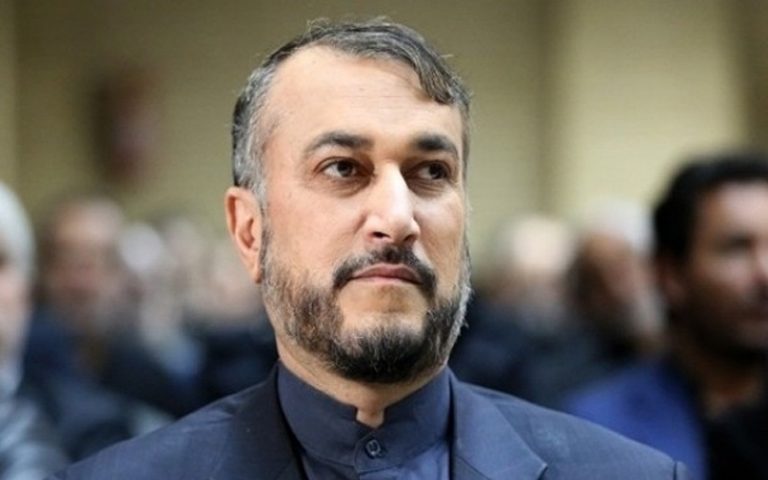
The Iranian regime’s incoming foreign minister, Hossein Amir Abdollahian has once again confessed his support of terrorism regarding the regime’s foreign policy.

In a session of the Majlis (parliament) last Sunday, Abdollahian, who has been nominated and destined for the Foreign Minister position in the administration of the regime’s new president, Ebrahim Raisi, professed his support of the ‘resistance front’, the name used by the mullahs’ clerical regime to refer to their many proxies’ terrorist groups, based across the Middle East region.

The regime is currently funding, training, and providing logistics support to more than a dozen terrorist groups in Iraq, Syria, Lebanon, and Yemen.

Abdollahian had made his comments in a speech during the meeting of the parliament, as officials were showing their support towards his appointment to his new role as Raisi’s top diplomat. His will to push terrorist policies comes as no surprise, considering his close relationship with the former leader of the IRGC’s Quds Force and the mastermind behind the regime’s terrorist activities, Qassem Soleimani, who was killed in January 2020 during a drone attack in Iraq.

He previously held the role of Deputy Foreign Minister for Arab and African Affairs under the previous administration, so he is no stranger to the regime’s policies.

Amir Abdollahian has a long history of enabling the regime’s terrorist policies in Iraq and other countries of the region. And he makes no secret of his ties to the regime’s terrorism apparatus.

Abdollahian announced, in an earlier meeting with the parliament’s culture commission, that he ‘cooperated with Soleimani in the foreign policy domain’ and that he will ‘continue Soleimani’s path’.

The regime’s diplomacy is closely controlled by the Revolutionary Guards (IRGC) and its foreign terror arm the Quds Force, a fact that regime officials have made no secret of.

The former Foreign Minister of the regime, Mohammad Javad Zarif highlighted in a recent interview that the regime’s foreign policy is heavily dominated by IRGC and that 98 percent of the diplomatic achievements, regarding the regime, were attained by the Quds Force and, specifically, Soleimani himself.

Hassan Rouhani, the regime’s former president spoke at a cabinet meeting on April 8, 2021, seemingly confirming that the regime’s diplomacy is based around terrorism. He said that from his 32-year experience in the Supreme National Security Council, ‘the frontline and diplomacy are two arms’ of the mullahs’ regime. During his speech, Rouhani went on to say, “If anyone believes that either the frontline of the negotiations must-win, then I must say that their words are incorrect.”

Many of the regime’s senior diplomats and embassy staff were members of the Quds Force and reported to Soleimani, including Assadollah Assadi, a Vienna-based diplomat who is currently serving 20 years in prison for a failed attempt to bomb a major rally of the Iranian resistance in France in 2018.

There Is No Solution for Iran’s Collapsed Economy

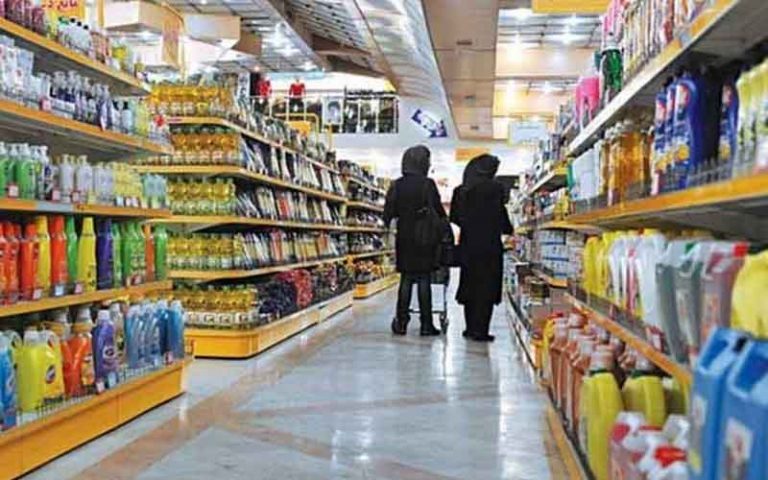
These days, Iran has been swept by the fifth coronavirus wave since the pandemic began in early 2020. While citizens need decent nutrition, the price of essential goods has once again increased. In such circumstances, Covid-19 patients, in particular, witness additional difficulties.

Local reports from the central province of Isfahan point to unusually high prices. “Today, I went shopping for some red meat, but I saw was bones being sold for 400,000 rials [$1.50] per kilo. This is while the market had a discount, and it was previously selling it for 720,000 rials [$2.66],” said a woman.

In a July 23 dispatch, Mehr news agency titled, “The chicken flew from people’s food basket.” “I saw a big notice on a chicken shop, declaring, ‘Poultry for 249,000 rials [$0.92] per kilo.’ I hastily entered the shop and asked, ‘Sorry, have you brought government-subsidized chicken?’ Shopkeeper impatiently answered, ‘Have you just been awakened? The period of government-subsidized chicken has been over,” Mehr reporter wrote.

“Once again, I asked the shopkeeper, ‘How much is poultry per kilo right now?’ ’400,000 rials [$1.50],’ he shortly answered. ‘At least, put down the notice of ‘Poultry for 249,000 rials per kilo’ and do not harass clients,’ I told him with annoyance,” the reporter added.

On August 15, state-run media reported a 20-percent increase in dairy prices. The semiofficial Beytoote website laid blame on the dairy association. “Twenty-percent increase in dairy prices on behalf of producers / The spokesperson of dairy industry association: We have not remained to wait for the government’s decision,” the website titled.

In his interview with Tasnim news agency, association spokesperson Mohammad Reza Bani-Taba pointed to the official increase in the price of raw milk. “There is no bill for increasing the dairy products. However, regarding an official increase in the raw milk price, we have to increase the price of our products,” Bani-Taba said.

“The association sent official letters to the President, Industry Minister, and Agriculture Minister. However, the raw mild price did not change… Government officials receive salaries to make the correct decisions in such circumstances, but they have left the dairy industry in a suspended situation. We cannot shut down dairy factories until officials make decisions,” he added.

Furthermore, the government faces massive budget deficits. Massoud Mir-Kazemi, the new chief of the Budget and Planning Organization, revealed damning details about the country’s bankrupted economy.

He revealed that the government’s debt to the banking system was 1.04 quadrillion rials in the beginning of former President Hassan Rouhani’s tenure in 2013. Currently, this debt is over 6.50 quadrillion rials, showing a four-fold increase in eight years.

To compensate for its massive deficits, the government resorted to two paths. First, increasing the price of essential goods such as the shocking 200-percent increase in gas prices in November 2019 ignited a nationwide protest in 200 cities across the country.

Second, the government ordered the Central Bank of Iran (CBI) to print unsupported banknotes, leading to unprecedented liquidity in Iran. For instance, despite the four-fold increase in the government’s debt to the banking system; however, the value of 6.20 quadrillion rials is too lower than 1.04 quadrillion rials in 2013.

This liquidity directly impacted people’s food baskets while their purchasing power is vanishing as their pockets are being filled with unsupported money. In this status quo, the catastrophic is too complicated than being resolved by claims and publicity stunts.

In this respect, Mir-Kazemi anticipates further economic failures under new President Ebrahim Raisi and mentions there is no possible solution for the government. “The situation is very tough, and we deliver the government in undesirable condition. This year’s budget has deficits. Why have the government’s ordinary expenditures reached 9 quadrillion rials [$33.333 billion]? These expenditures had a ten-fold growth. So, do we have a nice economic condition? What shall we do in the coming years?” Tasnim quoted him as saying on August 15.

Iranian Government Demands Access to Japanese Frozen Funds To Continue Nuclear Activities

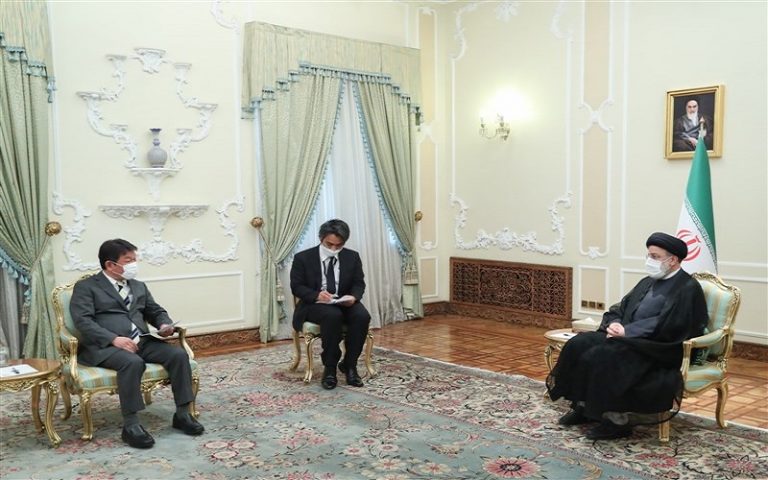
Iran’s President, Ebrahim Raisi has met with the Japanese Foreign Minister, Toshimitsu Motegi to demand the release of $3 billion, frozen in Japanese banks as a result of sanctions by the United States on Iran’s banking sector.

A number of infamous regime officials were present at the meeting which took place on Sunday, August 22, including the National Security Council secretary Ali Shamkhani, Majlis (parliament) speaker Mohammad Bagher Ghalibaf, and Mohammad Javad Zarif, the regime’s former Foreign Minister.

The demand comes after five rounds of talks between world powers and the Iranian regime in Vienna to curb Tehran’s dangerous nuclear program and revive the 2015 nuclear deal, formally known as the Joint Comprehensive Plan of Action (JCPOA).

As Raisi was declared as the next president of Iran, a sixth-round of talks was adjourned. According to state media sources, during the meeting with Motegi, Raisi questioned the justification for keeping the U.S. sanctions in place and stated that ‘Iran has no problem with the principle of negotiation’.

The meeting came just after the release of a new report by the International Atomic Energy Agency (IAEA) which laid out that the regime has already produced enriched uranium up to 20 percent purity, and that the production capacity has recently been lifted to 60 percent. These worrying figures point to a nuclear program aimed at creating nuclear weapons.

The regime has shown no sign of slowing down its nuclear enrichment to earn the international community’s trust. This is just the latest manifestation of the regime’s lack of respect for global peace and the breach of its commitments.

The regime’s former president, Hassan Rouhani spoke out in July saying that Iran’s Atomic Energy Organization already has the ability to enrich uranium between 20% and 60%, and if the reactors need it, the uranium can be enriched up to 90% purity.

Raisi’s new cabinet is filled with former members of the Islamic Revolutionary Guard Corps (IRGC), a terrorist organization in charge of running Iran’s economy and the nuclear weapons program.

The regime is blackmailing the international community to gain concession while experts are warning that even a return to the JCPOA will not block the regime’s path to a nuclear bomb.

The former U.S. Undersecretary of State for International Security, Robert Joseph stated that the regime has cheated in regards to every agreement it has made with international governing bodies and he questioned why agreements are still made with them, knowing their history.

Analysts believe that letting the regime access the frozen funds will only encourage them to work harder and faster on producing nuclear weapons.

The Iranian Resistance (NCRI) has stressed time and again, only a firm policy will curb the regime’s nuclear ambitions. The continuation of the decades-long appeasement policy will allow Tehran to keep and hide its dangerous nuclear weapons program.

Hezbollah’s Fuel From Iran Will Hurt the Lebanese People

Reuters reported on August 16 that Lebanese Hezbollah would begin importing fuel from the Iranian government. This has been opposed by many Lebanese politicians.

It was first in mid-July 2020 that Hassan Nasrallah, the secretary-general of Hezbollah in Lebanon, announced his readiness to buy and import fuel from Iran.

At the time, on July 10, Lebanese Energy Minister Raymond Ghajar announced that Beirut had no plans to do so.

Hassan Nasrallah had said at the time that he had begun talks with the Beirut government to consider the supply of oil and gasoline derivatives from Iran buying with the Lebanese lira, as it could ease pressure on Lebanon’s foreign exchange reserves.

Following these remarks, the Lebanese Minister of Energy added that at present he has no plans to negotiate with the Iranian government for fuel imports and that current negotiations with Iraq are underway.

Following Hassan Nasrallah’s remarks, the then US Secretary of State Mike Pompeo said that such a thing was unacceptable and that the US government would do everything to stop the sale of Iranian oil.

He added that they will not allow the Iranian government, as the biggest sponsor of terrorism in the world, to sell oil and give its money to Hezbollah.

After these remarks and after the crisis of gasoline shortage in Lebanon while protests escalated, Nasrallah again made the same statements about the import of gasoline from Iran.

On June 25, 2021, Nasrallah reiterated that “I want to stress that I promised and I’m still promising … if we have to go to Iran to get gasoline and fuel oil, we will, even if it causes a problem.”

He added that all technical facilities have been prepared for this possibility. Meanwhile, Lebanese Prime Minister Hassan Diab at the same time approved the import of fuel in pounds.

Nasrallah’s claim came as he announced that he would not import Iranian fuel through the Lebanese Central Bank to avoid US sanctions.

In other words, the process of importing gasoline from Iran by Hezbollah is non-transparent and includes money laundering laws.

At the same time Dorothy Shea, the US ambassador in Beirut, said in a television interview that imports from Iran were not a good solution to the fuel crisis in Lebanon.

She added: “What Iran is looking for is some kind of satellite state that they can exploit to pursue their agenda.”

Subsequently, on June 25, 2021, Lebanese Prime Minister Hassan Diab announced that he agreed to the plan to reduce fuel subsidies.

The Lebanese government allocated $250 million a month for the distribution of cheap fuel, which is problematic given the Lebanese government’s turbulent economic situation.

With the reduction of fuel subsidies by the Lebanese government, the price of fuel increased from 1,500 Lebanese pounds to 3,900 pounds.

Hassan Nasrallah reappeared on Wednesday, August 4, following the reduction of fuel subsidies by the government, and announced that if the government could not do anything, we would import fuel, and that there is some time needed and that the Hezbollah members are in Iran to import the fuel.

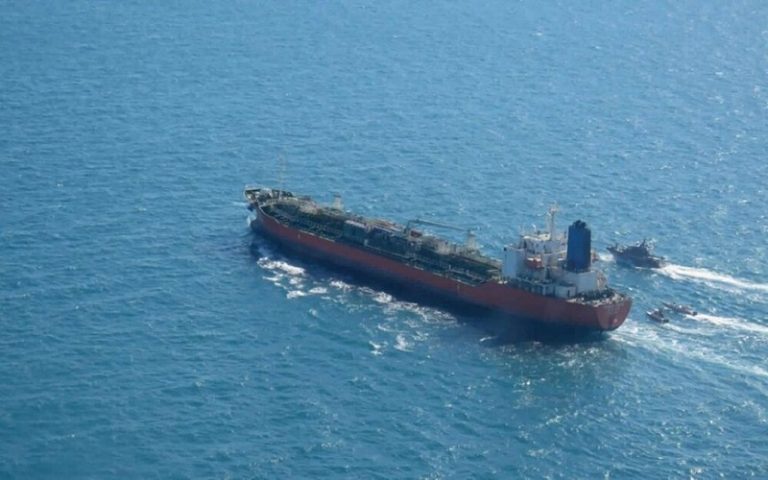
In the meantime, two oil tankers were carrying illegal fuel, and one of them was seized, during gasoline distribution, while a huge explosion took place and nearly 20 died and 79 were wounded.

Some eyewitnesses said the fire and explosion were intentional so that Hezbollah could carry out its intentions. Finally, on August 6, Hassan Nasrallah announced that he would begin importing gasoline and diesel from Iran.

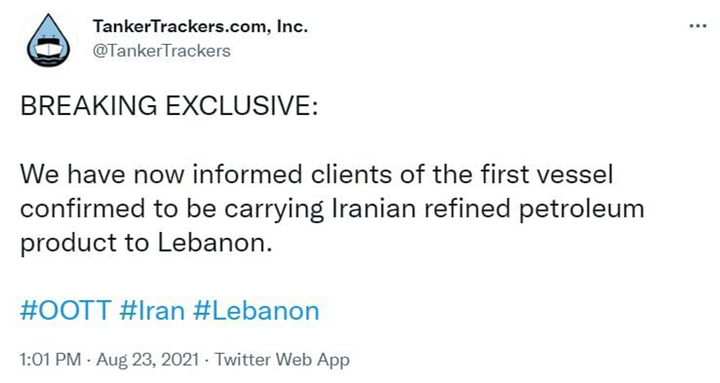
On August 19, Nasrallah announced that the first fuel tanker had left Iran for Lebanon. Some Iranian government intelligence and security sources also announced that the fuel sent to Lebanon had been purchased from the Iranian government by a Lebanese Shiite businessman.

Saad Hariri, the former Lebanese prime minister has said that importing fuel from Iran makes Lebanon dependent on a country that is under the heavy US and the international community, and that this will be a tragedy for Lebanon, as sanctions against Venezuela have intensified.

Hariri also reacted to Nasrallah’s remarks that the Iranian government’s fuel ships for Lebanon had been declared Lebanese territory, calling it a risky military equation, and asked if Lebanon had become a province of Iran.

Hariri revealed another story, adding that Hezbollah is aware that the Lebanese fuel crisis is due to its smuggling to serve Syria, so it is better to stop fuel smuggling to Syria instead of blaming the Lebanese people.

In addition to Hariri, Samir Geagea, militia commander who serves as the executive chairman of the Lebanese Forces since 1986 in protest of Hezbollah’s action while questioning the Lebanese President Michel Aoun Nasrallah’s ally, he asked Aoun that has he allowed Hezbollah to take over Lebanon’s economy after dominating security, military, and strategic affairs?

The current President of the Lebanese Kataeb Party Samy Gemayel also stated that Lebanon is not under siege now, but that this will happen very soon, and that Nasrallah will soon impose sanctions on them.

Given Hezbollah’s efforts to smuggle fuel with the help of the Iranian government, whose oil sales are subject to severe US sanctions, there is a threat that it will bring the Lebanese trade, which is facing its toughest economic challenge, under US sanctions.

On the other hand, the profits from fuel imports from Iran do not go to the pockets of the bankrupt Lebanese government, which may cure even a small pain, but go directly to the pockets of Hezbollah, which is used for the terrorist intentions of this group.

Iran: Need for Assertive Western Policies in Raisi Era

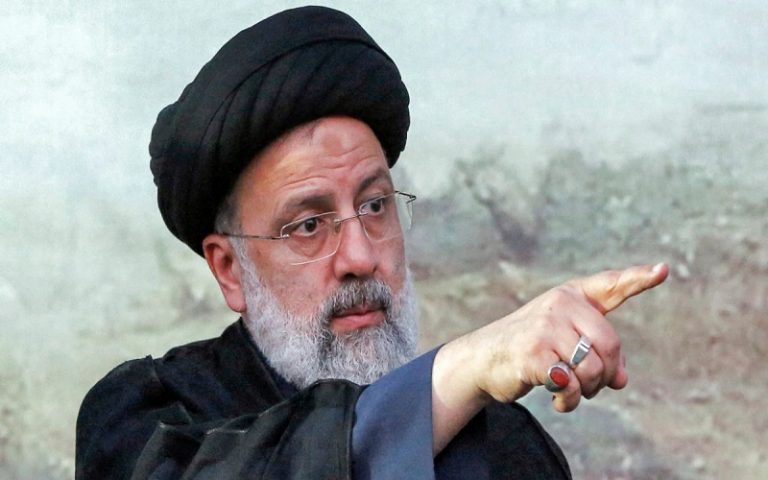
Ebrahim Raisi’s appointment to the role of President of the Iranian regime brought fears that his era will result in a surge in the regime’s terrorist activities and the continuation of human rights violations. Considering his choice for government head positions, this fear seems well-founded.

Raisi’s cabinet is poised to a collection of criminals and human rights abusers, who can be expected to move in lockstep toward greater repression of the domestic population and greater export of terrorism at the international community.

The international community needs to create more assertive policies to deal with the regime. Iranian citizens have already shown their disdain for their new President, by boycotting the sham elections long before he was appointed to the position, owing to Raisi’s history of suppressing dissent with violent methods. Iran’s National Council of Resistance of Iran (NCRI) previously reported that the voter turnout for the election was barely 10 percent.

Under orders from the regime’s Supreme Leader, Ali Khamenei, Raisi took up the position of judiciary chief in 2019. His appointment came as Khamenei feared a repeat of an anti-government uprising in 2017, and Raisi’s history of extreme brutality in regard to capital punishment made him the ideal candidate in Khamenei’s eyes. Raisi played a major role in the ‘death commission’ in 1988 which led to the massacre of 30,000 political prisoners.

Before and after Raisi’s inauguration, violent crackdowns of protests have been ceaseless, demonstrating that Raisi’s trends and his penchant for brutal punishments for dissent are likely to continue.

Such protests are indicative of tremendous bravery on the part of the Iranian people, especially given that they have little basis for confidence in the international response to Raisi’s presidency.

The attendance of European Union official, Enrique Mora at Raisi’s inauguration has been greatly criticized. It seems yet again that Western authorities are willing to ignore Raisi’s human rights abuses and continue to grant concessions to the regime.

If Western policy continues to emphasize friendly outreach to the Raisi administration after that time, it will effectively be granting the regime impunity not just in matters of accountability for past human rights abuses, but also in matters related to international terrorism, the spread of extremism, and the theft of resources from the Iranian people.

The majority of Raisi’s chosen government heads are members of the Islamic Revolutionary Guard Corps (IRGC), the regime’s militant forces who violently patrol demonstrations in Iran. Hossein Amir Abdollahian, Raisi’s choice to head the Foreign Ministry, was notably close to Qassem Soleimani, the former terrorist leader of the Quds Force who was killed in a drone strike in Iraq in January 2020.

The proposed head of the Interior Ministry for the regime, Ahmad Vahidi is a former commander in the Quds Force. He is still under warrant by Interpol for his involvement in a bombing in Argentina in 1994 which killed 85 people. He was also involved in a further bombing in Saudi Arabia in 1996.

Neither the European Union nor the United States can afford to stand by and let such men take power. Doing so would certainly endanger their own interests by reinforcing Tehran’s sense of impunity.

Scary Situation of Iran’s Nature

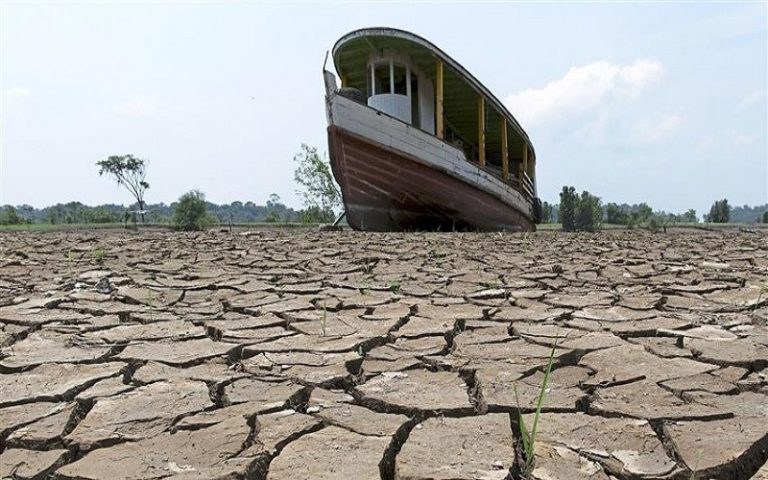
Iran’s government is claiming that the drought in the country is due to the decrease in rainfalls. But that is not true, according to Iran experts. The main reason for the depleted water resources is government mismanagement.

That is, if it rains a thousand millimeters in Tehran, the capital will still have little water because construction has increased, in a non-proper way, which is leading to climatic drought. And about the water drought which its main reason is the deep wells that the government is digging on any occasion is emptying the country’s groundwater resources, which is leading to subsidence.

Iran is one of those countries that is extracting more groundwater at 70% percent than other countries. But has become a country that has the worst subsidence all over the world. And adding to this despite the regime’s claims the country’s dams do have not the ability to store water.

After the 1979 revolution, the regime claimed to make the country’s agriculture independent from foreign resources. Not only this is not happening but the most the country’s main food supply is dependent on the import. Then they said to become an industrial power they must move to large industries such as steel. But despite constructing the steel factories near the ocean they have spread them around the country. A country that is suffering from water scarcity and its water resources should be used for people’s consumption.

Then they make excuses that there is a drought, the cause of these events is not the drought, but the cause is extremism in profiting, and even the current plans of the government are making the situation worse day by day.

Then the Ministry of Water and Electricity and Ministry of Energy with the help of MPs with their incoherent plans used primitive technologies to provide enough water to the people: Deep and semi-deep wells. The truth is that normal people and farmers who do have not a good education do not understand the destruction of such well to the nature around them and the future of their children.

This destruction is the government’s fault; the people did not know what a deep well is. Then they are claiming that the country’s agriculture system is using 90 percent of the water resources. Then how is possible with such a water consumption that the country’s food resources are mainly dependent on the import.

Now after forty years of destruction the country has no agriculture anymore, and most of the farmers are emigrating to the cities, cities that have become cancerous to the country. The demographic balance is disoriented.

Power plants are one of the main sectors of the industry, and these power plants that they have constructed are a kind of betrayal because for a power plant as many as 20 villages wells are constructed. It is a sin to build these hydro and thermal power plants when Iran has both sunlight and wind.

Cities must move to unconventional waters. The first unconventional source of water used in the world 60 years ago was wastewater treatment, rather than using other sources of water to meet the capital’s needs.

The second unconventional source is the issue of collecting rainwater. In Hamedan, with this heavy rainfall, its water needs can be easily met. A 10 by a 20-meter roof in this city can supply that house with water that year. This roof produces 60 cubic meters of water, which also requires a small tank. They are not mentioned such projects at all and only say that a lot of water is wasted.

Whoever is born in Iran in another 50 years will face a country without either surface water or groundwater. Of course, this may happen sooner.

It is not possible to rehabilitate wetlands, even if they say that a rehabilitated wetland is wrong. They are entering sugarcane water, which is full of sewage, into this wetland. Or, for example, it is said that the Gavkhoni swamp dried up the Zayandeh River. That too is not true. Mismanagement has dried up this swamp.

This also causes dust to rise from the swamp. And the government is sprinkling bitumen wherever the sand wanted to move. Then when bitumen is sprinkled somewhere, the whole area looks burned, the temperature coefficient increases and many living organisms die, even this substance is carcinogenic.

Iran has 2800 small and large wetlands. The total area of ​​the country’s wetlands is three million hectares, one and a half million hectares of which are registered as international wetlands in the Ramsar Convention. These three million hectares are equivalent to 30,000 square kilometers; For comparison, if we consider the area of ​​Tehran as 750 square kilometers, the area of ​​the country’s wetlands is 40 times that of Tehran. However, the reality today is that many wetlands have dried up or are about to dry up.

This is how the regime in Iran is betraying the country’s environment and nature.

Coronavirus in Iran – The Death Rate of People Who Have Been Vaccinated Is Dozen Times the World Standard

0

The Statistics and Information Center of the Ministry of Health of Iran’s regime has warned of an increase in coronavirus deaths of people who have been vaccinated. This warning indicates the complete failure of the vaccination program in the country.

The death rate of people who have been vaccinated, especially citizens over the age of 60, is dozens of times higher than the world standard. The Information Center of the Ministry of Health, after examining this situation in the Scientific Committee of the Coronavirus Headquarters, has emphasized:

“Irregular spacing between the first and second doses and disregard for the type of vaccine used for the people is a risk factor for death.”

The center’s analytical report states: “So far, more than 91,000 people who received the first dose of the vaccine have been infected with Covid-19 after two weeks and have been admitted to hospitals. The average age of these people is between 60 and 90 years.”

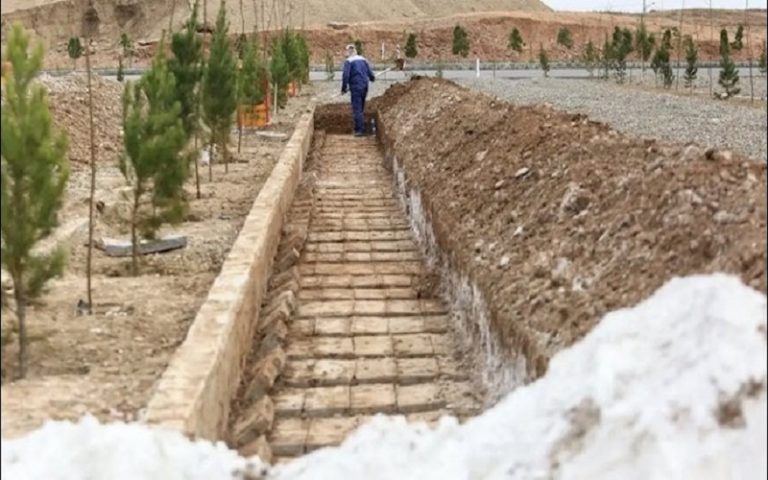
About 8,500 of those hospitalized have died. Most of those who died after receiving the first dose of the vaccine were in the 70s and 80s. According to the report, among those who received two doses of the vaccine and are said to have been fully vaccinated, about 23,000 people were infected again.

In the past few days, with a record of more than 600 deaths per day due to the coronavirus, the record of the highest number of deaths due to this disease was broken in Iran.

The announcement of the number of people killed by the coronavirus in Iran comes at a time when many countries around the world have been able to reduce the number of deaths by extensive vaccination.

The Ministry of Health of the regime has announced that 16,049045 million people have received the first dose of the coronavirus vaccine and 5,063519 million people have received the second dose of vaccine.

Iran’s custom has announced that 24.5 million doses of the coronavirus vaccine have been imported into Iran so far. According to these statistics, the largest imported vaccine is Sinopharm, which 17,910000 million doses is so far imported in 20 shipments to Iran.

Ali Sharifi Zarchi, head of the Statistics and Information Technology Management Center, presented a comprehensive and analytical report on the number of coronavirus hospitalizations and deaths in Iran after vaccination to the Ministry of Health and said that some indicators are much higher than the statistics announced by some countries.

According to the report, out of 2,749,356 people vaccinated, 16,784 were hospitalized two weeks after receiving the second dose of the vaccine, and the ratio of hospitalized people admitted with two doses of vaccine to the total number of vaccinated people was 0.0061%.

The report emphasizes that this index seems to be much higher than the statistics announced by some countries.

The report also noted that 2,490 people died after receiving the second dose of the vaccine, of which 1,411 tested positive, 682 were negative and 397 were unspecified.

According to the report, 2,072 people who were hospitalized at least two weeks after receiving the second dose of the vaccine died.

The report reiterates that international studies claim that the risk of disease exacerbation and death is very low two weeks after receiving the second dose of the vaccine.

According to the report, considering the population of 2,749,356 people who have been vaccinated for at least two weeks, the death rate of people who have been vaccinated for more than two weeks is 753 people per million. The declared index in some countries is less than 10 people per million population.

Iraj Haririchi, deputy director-general of the regime’s Ministry of Health, said it is estimated that about 220,000 people are infected with the coronavirus daily. He based this estimate on people who do not take the coronavirus test. According to official statistics, an average of 40,000 new cases of coronavirus infection is reported these days.

He stressed that the trend of infection and hospitalizations in 14 provinces has stabilized and is somewhat declining. He said, however, that the death toll would continue to rise for the next three weeks.

Systematic Immunity From Prosecution in Ebrahim Raisi’s Administration

The National Council of Resistance of Iran (NCRI) have reported that the administration of Ebrahim Raisi, the Iranian regime’s new President, now houses government heads who have ties to organizations that are notorious for their part in Iran’s human rights abuses and terrorism plots, notably the Islamic Revolutionary Guard Corps.

In an online international summit on Iranian affairs held in July, President-elect of the NCRI, Mrs. Maryam Rajavi foreshadowed, prior to his inauguration, that Raisi’s rise to power would increase the “hostility and enmity between the Iranian regime and society.”

She said, “Neither the installment of Raisi nor the collection of murderers and thieves in his cabinet can save the regime from its inevitable overthrow.”

Ebrahim Raisi’s appointment to the presidential position was selected in advance by Ali Khamenei, the regime’s Supreme Leader. Under the regime’s theocratic system, the loyalty to the supreme leader by any candidate is highly vetted during the selection process. Candidates are immediately disqualified if they desire to challenge Khamenei’s preferred choice at any point during this process.

The NCRI said, “Recognizing the lack of free choice in this election especially, the vast majority of the Iranian people chose to boycott the electoral process. The voter turnout was less than ten percent, and even regime authorities were forced to acknowledge that the rate of participation was the lowest of any presidential election.”

The Iranian Resistance were the ones who called attention to Raisi’s responsibility for the deaths of thousands of political prisoners during the 1988 massacre, referring to him as the ‘henchman of 1988’.

At the time, Raisi was working as the deputy public prosecutor in Tehran. Under a fatwa issued by the regime’s founder, Ruhollah Khomeini, Raisi was appointed to the ‘death commissions’ and tasked with implementing Khomeini orders to prosecute members of the People’s Mojahedin Organization of Iran (PMOI/MEK) and sentence them with the death penalty. Over the course of 3 months in the summer of 1988, 30,000 political prisoners were executed.

The NCRI said, “Therefore, it is not surprising that among Raisi’s cabinet appointments there are individuals who are similarly subject to sanctions by both the US and the European Union, as well as those whose prior roles involved work for sanctioned entities. Raisi’s choice to head the Interior Ministry, Ahmad Vahidi, is even wanted by Interpol for his role in the 1994 bombing in Argentina.”

Amnesty International has said that the disregard and unwillingness to hold Raisi and other Iranian officials like him accountable for their crimes against humanity and allow them to be prosecuted by the international community shows just how entrenched the regime is with impunity.

The Iranian people refuse to turn a blind eye to the regime’s immunity from prosecution, as demonstrated by the protests that began the day following the selection of Raisi as Iran’s new president, and have continued to increase exponentially since.

The NCRI said, “Of course, if the international community should stand behind those people, their triumph over the regime would surely prove to be not only “inevitable” but imminent.”