Home Blog Page 279

Iran’s Inefficient Government

After World War II many countries around the world started development and growth of their economic power, but Iran has fallen behind many other countries.

International institutions such as the World Bank addressed this issue in the early 1990s and finally made it clear that ‘governance’ is a key issue in the development strategy of countries with poor performance.

They then indexed this new category in the development economics literature, which ‘includes six components: corruption control, government effectiveness, political stability, quality of laws and regulations, rule of law, the right to comment and be accountable, which is considered as a model for development and ‘good governance.’

But the Iranian government does not abide by any of these indexes. Even while government experts analyzed these indexes about Iran, they were scared about the results.

“An examination of the data and statistics of various institutions shows that Iran is not in a good position in terms of governance. This is evident in all the indicators that are built around the category of governance. Iran’s best ranking in 2018 is related to ‘government effectiveness’, in which it is ranked 131st among 209 countries.

“But in other indicators, it is among the last 50 countries among more than 200 countries. The position of the country among the countries of the region (25 countries) is not very suitable, so that in all indicators except the government effectiveness index, it is considered as one of the last 10 countries.

“In addition to the World Bank, Iran is not in a favorable position in the eyes of other international institutions that have described good governance.” (Iran’s Economic Affairs Research Institute / Ministry of Economy, May 2020)

In the above findings, the Minister of Communications, in his final days in office confirmed that ‘good governance’ in Iran is only tantamount to the ‘survival’ of the people and said: “Like it or not, every day one of the thousands of faces of the pain of poverty and deprivation parades before our eyes. The pain of ‘survival’ that can neither be ignored nor reacted to.” (State-run Khabar Online, May 11, 2021)

In the index, Iran was ranked 131st in terms of ‘government effectiveness’ which is considered good for the regime’s officials.

But what are their opinions about the inflation which is tied with the people’s livelihood baskets?

“The most important challenge we have in the country’s economy is the challenge of inflation. This chronic inflation, which has plagued us for more than four decades, reflects the inefficiencies and structural problems that exist in our economy.

“The result of all these inefficiencies in the economy will be an increase in inflation, because eventually the government will have to solve these problems indirectly, without the people realizing it, by creating money.

“That is, the banking system has covered these imbalances by creating money. But the banking system itself has suffered a greater imbalance that has used central bank resources.” (State-run daily Tejarat, May 12, 2021)

One of the members of the Expediency Council about the suffering of the country’s economy and the inefficiency of the government said: “There is no doubt that Iran’s economy is in turmoil. Management is the main challenge of the country’s economy and we have been plagued by mismanagement in all the past years.” (Tejarat, May 12, 2021)

About the high costs and its pressure on the people, he added: “The prices have become so terrible that the sections of the society, especially the minimum wage earners, are shouting what can I do, and the increase in salaries and wages cannot meet these costs, which result in empty tables and the shame of the breadwinner of the family.” (Tejarat, May 12, 2021)

And again, about the government’s inefficiency and irresponsibility, he added: “The fat and lazy government manages the affairs of the country. The presence of about 3.5 million government employees shows how much we rely on government desks and chairs to create jobs.

“This approach causes a lot of costs in the form of salaries and wages to be imposed on the country’s economy, in such a way that a large part of government revenue is spent on government salaries and benefits.” (Tejarat, May 12, 2021)

Iran’s State Media: Which JCPOA Is To Be Revived in the Vienna Talks?

In Iran, the two political currents, if we could call them so, are fighting with each other about the fate of Iran’s 2015 nuclear deal with global powers, known formally by the acronym JCPOA.

The so-called reformist faction, which is now represented by the regime’s president Hassan Rouhani, is struggling to revive the JCPOA. And its rival faction the so-called principlists, which is represented by the regime’s supreme leader Ali Khamenei, is trying to sabotage the reformists’ efforts in the negotiations with the world powers.

Despite all these shows, the regime’s main wish which is under the authority of the supreme leader is to revive the JCPOA, Iran analysts say. The rest of the story seems to be more like a political theatre and is used by Khamenei’s loyalist to revive the spirits of the Basijis, the regime’s forces, and its mercenaries in the region.

The Mehr news agency in an article attacking the government and its efforts to revive the JCPOA on May 14 wrote:

“As Iran’s presidential election approaches, some are seeking an agreement with the West to revive the JCPOA. But there are serious questions that need to be answered. Because the evidence shows that the red lines announced by the leadership in these negotiations have been violated again, and it seems that another pure damage is on the way.”

The article confessing about the failure of the JCPOA and its damages to the regime wrote: “Today, it is clear to any fair observer that the JCPOA was nothing but a loss to Iran. But why did the JCPOA fail to meet expectations as claimed by the JCPOA? The main problems of the JCPOA can be summarized in the following cases:

  1. Lack of necessary guarantees to fulfill the obligations of the Western parties

Contrary to the claims of the Iranian negotiating team, the JCPOA lacked a serious legal mechanism to compel the Western parties to fulfill their obligations. The US presence in this agreement was based on an executive order from the President of this country, which with the change of government in the US, Trump simply violated it and left it! In addition to the United States, European countries have not actually complied with their obligations.

  1. Lack of proper and fair mechanism for resolving disputes

The dispute resolution mechanism in the JCPOA (trigger mechanism) was designed in such a way that practically any protest that Iran made in violation of the Western Covenant could lead to the return of UN Security Council resolutions against Iran! This was one of the main reasons for the government’s appeasement of the violation of numerous Western treaties.

  1. Suspension of sanctions instead of lifting them

Although after the signing of the JCPOA, the President of our country officially announced that all sanctions have been ‘lifted’ and not ‘suspended’, the reality was that these sanctions were suspended for 120 days by the executive order of the US President and its re-suspension required a new order. Thus, despite the suspension of some sanctions because the shadow of sanctions has always been on the Iranian economy, the risk of cooperation with Iran for foreign parties did not decrease and the effect of sanctions remained in place.

  1. Maintaining the structure of sanctions

But the bottom line is that although the Iranian government claimed that the US sanction’s structure was broken, the reality was that the sanctions’ structure was completely safe, and the return of sanctions depended on a signature or even no signature. Therefore, the sanctions had no practical result for Iran and were only suspended on paper.

Interestingly, all the JCPOA’s weaknesses are those that have been repeatedly pointed out as the red lines of negotiations by the system’s leadership, but the Iranian negotiating team acted hastily and inflicted this great damage on the country.”

The article frustrated and fearing the result of the JCPOA’s negotiations asked, “Which JCPOA is to be revived in the Vienna talks?!”

It added: “Now the question is which JCPOA is going to be revived? Is it the same JCPOA in which there is no guarantee that the Western parties will comply in practice with their obligations? Will it be the same JCPOA in which the structure of US sanctions is maintained, and the suspension of sanctions (not their lifting) be conditional on the signature of the US President for 120-day periods?! It is natural that returning to such an agreement will be a repetition of the same sheer damage that the current situation of the country is the result of the same agreement.”


The conclusion of these short summary by the state-run Mehr news agency is very simple. Despite all the factional dispute shows and the regime’s claim about an opening and progress of the negotiations and the lifting of the sanctions, this time the regime is not the winner of the JCPOA negotiations and must pay double the price to satisfy the world powers, which are demanding even more and are adding the regime’s regional meddling, its missile program and its human rights case into the new agreement, which according to the regime’s media is known as JCPOA+ with more damages to the regime.

Iran’s Nurses Struggling To Cope With COVID-19 and Make a Living Forced To Migrate

The phenomenon of migration of Iranian nurses to other countries already existed, but with the outbreak of the coronavirus pandemic, the gap between the employment status and welfare of nurses in Iran and abroad deepened and the rate of migration of nurses abroad increased.

Since the start of the coronavirus crisis last year, nurses have shown that they are at the forefront of public health in the fight against this great pandemic – a fight which would not have been possible without the presence of nurses.

During this period, nurses showed many sacrifices in different countries of the world, including Iran, and as health heroes, they were able to establish their position in defending the health of society and show their important role in combating diseases; however, unfortunately, some of them lost their lives in this way.

With the outbreak of the coronavirus pandemic, various countries, including in the West and the Middle East, were in dire need of nurses and provided many facilities for nurses.

This was one of the main reasons of the migration of Iran’s nurses to other countries. There is a huge difference of quality in facilities and advantages between Iran with those countries.

Although there are no exact statistics on this, it is said that about a thousand nurses emigrate from Iran every year with the motivation of finding better job opportunities and more welfare.

Nurses have been educated for many years and have gained valuable experience and losing them causes serious damage to the health system, which is very difficult to compensate. Iran trains about 10,000 nurses annually, and due to the retirement of many nurses and the growing need of the health system for nurses, the crisis of shortage of nurses is intensifying day by day, and this shortage has a great impact on the quality of nursing services.

Lack of nursing staff on the one hand and the occupation of most hospital beds by the COVID-19 patients on the other hand has caused physical and mental exhaustion of nurses.

Iran’s officials of the Program and Budget Organization and the President made several promises to pay special attention to nurses and solve their problems, and even the regime’s Supreme Leader emphasized on addressing the accumulated demands of nurses, but in practice there was no concrete action in this regard.

The Coronavirus bonus which was promised to the nurses alongside their regular wages was just for the government’s propaganda and was very little and it can even be said that the amounts paid were an insult to the nurses. Reducing working hours was another promise that was made, but not kept, to many of the nurses who worked in hospitals dealing with Covid patients, which caused great dissatisfaction.

A recruitment test was to be held and a significant number of nurses were to be recruited, but the fate of this recruitment test is still unknown and has stopped in Iran’s corrupted bureaucracy cycle.

The country’s medical universities employ many 89-day contract nurses, and it was recently said that they are employed on a one-year basis, but the government has a free hand to expel them anytime it wants.

And so far, the law on nursing tariffs, which was promised many times, is still being passed between the parliament and the government and has not been implemented.

More than 50,000 nurses have become infected with the coronavirus. So, the priority should vaccinate nurses, i.e., those who are at the forefront of providing health services to patients.

While it has been a long time since vaccination began, the government’s negligence and mismanagement in this area has meant that many nurses have not yet received the coronavirus vaccine.

Iran’s Corruption Crisis

There is no doubt that Iran suffers greatly from institutionalized financial corruption, as evidenced by the fact that Transparency International’s corruption perceptions index ranks Iran

149 out of 180 countries, but still officials can shock Iranians and the world at large with the related information.

Former minister Mohammad Gharazi said last weekend that Tehran has had “$4 trillion in revenue” since 1979, but that 2-3 trillion was “destroyed by rent-seeking activities”. Just days before that, attorney general Ali Alghazi Mehr advised that a criminal case was being filed against the former president of the Central Bank Valiollah Seif for his role in a major embezzlement case involving $30.2 billion and 60 tons of gold.

Alghazi Mehr said: “Between 2016 and 2018, not only the country’s currency laws were breached, but also the legal responsibilities pertaining to the intervention of the Money and Credit Council on issues related to currency and the sale of gold coins to prevent the formation of brokerage markets were not respected.”

Last month, judiciary spokesperson Gholamhossein Esmaili said that over 200 judiciary staff members were arrested on corruption charges, with the former executive deputy of the judiciary chief Akbar Tabari held on charges relating to billions of dollars of embezzled money.

Regarding the two others charged alongside him, Tabari said during his trial: “I and [Hassan] Najafi and [Farhad] Mashayekh are like three brothers. If I need 8 trillion rials, these brothers will provide. If I want the Lavasan factory, they will register it under my name! This is friendship. If you don’t have these kinds of friends, you have nothing to say to me. If they want the same from me, I will do it for them.”

Here are some other known corruption cases in Iran that prove just how widespread the issue is:

  • 180 trillion rials: Babak Zanjani, state-affiliated businessman
  • 80 trillion rials: Bonyad-e Shahid foundation
  • 5 trillion rials: Saeid Mortazavi, former attorney general
  • 30 trillion rials: former labour ministry
  • 23 trillion rials: Mohsen Rafighdoost, former Revolutionary Guards commander

The Iranian opposition, People’s Mojahedin Organization of Iran, in this regard wrote: “The flipside of this mega-corruption is the tragic situation of the Iranian people, who have to find shelter in graves, food in [the] garbage, and sell their body organs to earn their keep. With the revelation of every one of these cases, the people become even more outraged and determined to overthrow this regime and bring decency back to their country.”

The consequneces of these unbridled corruption can be see in the dire condition of the people’s lives.

The Friday Prayer’s leader Razavi Ardakani of Shiraz about the people’s situation, while expressing his fear about protests said:

“They said, No, the people will not come (to vote), so, what is happening that they will not come? The pressures of inflation pushed many away from the revolution, these imprudences, so this is the livelihood basket of the people, and that what is important, is the lielihood basket of the people. The worker which his salary is not enough, or the one who does not get paid at all, you (the government) must be aware of the situation of the people.

“Not controlling the prices will stress the people, they may even say bad things, now in Shiraz you cannot find any chicken.” (State-TV Fars Channel, May 13, 2021)

Qasem Soleimani Dashtaki, the governor in Khuzestan admitted on Wednesday, May 12, that the unemployment rate in this province is higher than 45 to 50 percent.

He said: “Usually the announced unemployment rate is not the real unemployment rate. The unemployment rate in Khuzestan is announced at 14.5 percent, but if you look to the province, you will see that this rate is definitely higher. According to the criteria, if someone works two hours a week, it is not included in the unemployment rate statistics, but this does not make sense at all, and in many areas of Khuzestan province, the unemployment rate is higher than 45 to 50 percent.”

Iran’s Presidential Election, a Step Beyond Electoral Engineering

One of the most important issues now in Iran’s political field is the upcoming presidential election. Iran experts say that more than ever, Iran’s clerical rulers fear the results and consequences of the elections.

The reason is that the regime in the last two to three years has experienced very hard blows through the people’s protests. One of its consequences, as officials have confessed, is the non-participation of the people in the elections and the people’s distrust of the regime which can lead to its overthrow.

Now the people have found the courage which is increasing day by day to oppose the regime in public and call this election a sham-election which is not free. The situation for the regime is so murky that even many of its officials stand opposed to it too.

So, to create a balance Iran’s Supreme leader Ali Khamenei was forced to came to the stage and announce that, “Do not always say that elections should be free; We had 34 elections since the beginning of the revolution, which one was not free?”

In reality, however, the post of President is in conflict with the post of the Supreme Leader, and to neutralize this position and having the upper hand like in the past 40 years, Khamenei once again commissioned the super reactionary Guardian Council, to take control over the presidential candidates, and remove those from the list who are not synchronized with the regime’s principles, which the most important is to be loyal to the supreme leader.

On May 8, 2021 the Guardian Council announced:

“If the Guardian Council finds that even after the qualification something happened before the election, which is the reason for the disqualification, it is the Guardian Council’s legal right to reconsider that person, so it does not matter, and it is possible that someone in the previous period after the qualification, and in the debate and non-debate, as well as during the propaganda, did things that are now in this period, when his case is reviewed, see those things, were things that are unqualified, whether related to the past or to this period, so it is the Guardian Council’s oversight right to reconsider the competence of that person.” (Entekhab, May 8, 2021)

The easy translation of these sentence is that the blade of the Guardian Council is all the time on the neck of the candidates.

One of the state-run outlets mocked this situation and wrote: “With this explanation, the election debates will become a TV show, because any talk may lead to disqualification.” (Shargh, May 8, 2021)

Then a government lawyer attacked the unlimited and unrestrained power of this Council and said:

“When the Guardian Council such a free hand, and has taken over the election, and it has become the law at all, the best thing to do to speed up the election and save the nation all the time and money, at the election day, do not put any ballot box anywhere except at the Guardian Council’s place.

“All twelve respectable men of the Guardian Council cast their ballots in the same ballot box. The person who gets the most votes in that ballot box becomes the president. In less than 15 minutes, everything starts and ends without wasting any time or money, and easily it become what you want it to be. And the people will not get bother either.” (Setareh-e-Sobh, May 8, 2021)

Although this may sound ironic, it is the truth. For more than four decades, this mechanism in Iran has determined the fate of the election. Because in Iran, elections in the common and well-known sense like in democratic systems have never been valid. The ‘election’ is a cover for the engineering of the power structure controlled by the supreme leader.

But the final and real thought of the regime is accumulated in these sentences expressed by cleric Mohammad-Taqi Mesbah-Yazdi who died earlier this year:

“If there has been talk of elections in the Islamic Republic so far, it is because the Supreme Leader has considered it useful to hold elections now and to get the opinion of the people. The supreme leader has the right and can choose any other type of government whenever he wants and deems expedient, in which he may not refer to the people’s vote at all. The legitimacy of the government is not only subject to the vote and consent of the nation, but also the vote of the nation has no effect on its credibility.” (Partoo weekly, December 28, 2005)

Iran: Supreme Leader’s Initiatives for Presidential Election

Today, the Islamic Republic system in Iran faces critical and backbreaking challenges that it has never before experienced. The government wrestles with unprecedented economic dilemmas, and the coronavirus outbreak claims more lives each day in addition to its financial, social, and political consequences.

These crises along with numerous catastrophes in almost all fields have severely intensified the gap between the state and society while officials and state-run media frequently warn about the upcoming protests. In such circumstances, the ayatollahs intend to hold another Presidential election on June 18.

“The people’s frustration has deeper roots in this status quo. However, political movements analyze and make decisions regardless of these roots, and this distance is getting deeper between politicians and people. This distance would be deeper with political gestures,” wrote the state-run Ebtekar daily on April 6.

In other words, the people have grasped that current politicians cannot change their living conditions and resolve their complicated difficulties. Instead, they are adding insult to society’s injuries and thereby pushing citizens to think about solutions beyond the Islamic Republic system.

The ayatollahs’ 42-year reign has shown that they could not and cannot afford to bring prosperity and welfare to Iran’s 83-million population. In this regard, there is an ongoing struggle between citizens, particularly the young generation, and rulers for fundamental rights like freedom of speech, equality, justice, and a fair and democratic election.

In Iran, the Supreme Leader has the final word. In 2009, former President Mohammad Khatami described the President in Iran as a waiter reminding the current Supreme Leader Ali Khamenei’s efforts to expand the president’s power when Khamenei himself was the president.

Nonetheless, to prevent potential protests, Khamenei intend to remove ‘reformists,’ ‘moderates,’ or anything else they call themselves from power. During their protests in January 2018, November 2019, and January 2020, citizens openly chanted the slogan, “Reformists, Principalists, the game is over” showing their disappointment over the current political divisions.

“The election must symbolize the national unity, not duality, division, and bipolarity,” Khamenei said in his recent remarks on March 21 revealing his intention to nip any competition in the bud. Following his remarks, Khamenei’s faction launched a comprehensive campaign to stifle the rivals, and in some cases, the Supreme Leader personally ran this campaign.

Majlis Paves the Path for Khamenei’s Desired Figure

On December 20, 2020, the official IRNA news agency reported, “Members of the Parliament [Majlis] rejected a proposal for banning military individuals from running for the [Presidential] election.”

“The constitution has allowed all armed forces members to register for the Presidential election without resignation,” IRNA quoted the Speaker Mohammad Bagher Ghalibaf as saying. “The object of interference in political issues and candidacy for the election are two different topics.”

Notably, before the death of Qassem Soleimani, the Islamic Revolutionary Guard Corps Quds Force (IRGC-QF) chief, in a US drone attack in Iraq, Khamenei had dreamed to appoint him as a the most loyal president to himself, Iran analysts say. However, the U.S. January 3, 2020, drone strike changed the puzzle completely forcing Khamenei to think about other options.

Observers recently speak about Hossein Dehghan, the Supreme Leader’s military advisor, Ghalibaf, Saeed Jalili, the former Supreme National Security Council (SNSC) secretary, and Saeed Mohammad, the former IRGC’s Khatam al-Anbiya Construction Headquarters chief, Rostam Ghasemi, another former Khatam al-Anbiya chief, and Mohsen Rezaei, the former IRGC commander-in-chief as potential future presidents.

All these military commanders, of course, had taken out their fatigues long while ago fearing a public backlash. However, the Khamenei-controlled Majlis has left the gate open for more military individuals, particularly IRGC commanders, to participate in the June 18 Presidential election.

Khamenei Personally Ousts Potential Rivals

Hassan Khomeini Announces Dissuasion from Candidacy in June Election

Furthermore, the Supreme Leader has personally convinced one potential candidate not to engage in the Presidential competition. On April 12, Tasnim news agency affiliated with the IRGC-QF reported, “Seyyed Hassan Khomeini would not be a candidate for the 2021 election.”

In recent months, ‘reformists’ had raised the name of the Islamic Republic founder’s grandson Hassan Khomeini as their main candidate. They believed that he could unify ‘reformist front’ due to his title. However, Khamenei personally spoke with him urging him not to run for the election.

“The [Islamic] Revolution’s Supreme Leader considered that [Khomeini’s] candidacy in the election was not appropriate. He expressed that he counts Hassan as his son asking him not to enter this field in such circumstances,” said Yasser Khomeini, Hassan’s brother.

Zarif’s Audiotape Removed Him from Election in Advance

On April 5, the leaked audiotape of Foreign Minister Mohammad Javad Zarif’s interview with state-affiliated journalist Saeed Leylaz shocked both the people inside and his counterparties abroad. In his interview, the Foreign Minister had openly declared his opposition to the Islamic Republic’s regional path.

He also admitted that Khamenei was the main orchestrator for nuclear talks laying all the blames on him. Already, Khamenei was beholden behind the curtains leaving the way open to criticize and breaches nuclear obligations. However, Zarif highlighted the role of the Supreme Leader and the IRGC eluding himself from nuclear talks’ consequences.

Just a few hours before leaking the tape, Zarif had sarcastically announced his dissuasion from the Presidential election in a letter to Khamenei. He had warned about pressure led by Khamenei’s faction, saying, “I’m not concerned about getting low votes… I do not intend to run for Presidency, but I may revise my decision if the pressure increased.”

In response, Khamenei severely chastised Zarif and all but barred him from running in the Presidential competition. “These days, we heard some remarks on behalf of some officials, which are surprising and unfortunate. I heard that enemy’s media had aired these remarks… Some of these remarks are the repetition of our enemies’ words,” he said.

“For years, the Americans have been extremely unhappy about the Islamic Republic’s influence in the region. They were upset from the Quds Forces’ activities, and they killed Soleimani for this reason… Dividing diplomacy form the country’s other policies is a great mistake, which should not be made by an Islamic Republic official,” Khamenei added addressing Zarif’s remarks about Soleimani’s destructive role in foreign policies and “spending diplomacy on the field.”

Khamenei-Controlled Guardian Council Purges Other Candidates

Meanwhile, the Guardian Council completed this path and almost purged less-known candidates paving the path for Khamenei’s desirable figure. In its recent directive about candidates’ conditions, the council has announced that Presidential candidates must be neither less than 40 nor above 75 years old, meaning 39-year-old Mohammad-Javad Azari Jahromi, the current Minister of Information and Communications Technology, and 80-year-old Mohammad Gharazi, the former Minister of Petroleum, cannot run for the Presidency.

Also, the council has emphasized that candidates should enjoy a sufficient managerial background, and they should not have criminal convictions. Therefore, Saeed Mohammad—for the lack of managerial records—and Mostafa Tajzadeh—for his criminal conviction in 2009—were purged.

Who Is Khamenei’s Required President?

Already, observers thought Saeed Mohammad is Khamenei’s required candidate and potential president due to the Supreme Leader’s previous comments about the establishment of a “young and hezbollahi government.” Khamenei, of course, declared his intention more bluntly by pointing to Qassem Soleimani’s method and iconic role.

However, following Mohammad’s resignation from the IRGC Khatam al-Anbiya Headquarters, the IRGC deputy for political affairs Yadollah Javani revealed that Mohammad had actually been fired due to his corruption cases. To save face, Mohammad rejected Javani’s remarks bringing the rivalries to new levels.

Eventually, in an interview with the IRGC-controlled Fars news agency, the Supreme Leader’s Representative for the IRGC Abdollah Haji Sadeqi approved Javani’s position. “Javani has raised the opinion of the IRGC supreme commandership—an indirect mention to Khamenei and not even the IRGC commander-in-chief Hossein Salami,” said Haji Sadeqi.

On the other hand, Khamenei’s loyalists in the Majlis and colleges launched two separate campaigns inviting Judiciary Chief Ebrahim Raisi to run for the Presidency. “In a letter to the Ayatollah Raisi, more than 220 MPs invited the Judiciary Chief to register for the Presidential election due to the country’s dire economic, political, social, and cultural conditions and his executive records for taking office,” Fars reported on April 26.

MPs’ letter sent two messages to both Khamenei’s supporters and opponents. They obviously acknowledged his supporters that Khamenei’s required candidate is Ebrahim Raisi, not Ghalibaf, Mohammad, Rostami, or Jalili. MPs also clarified that Khamenei would no longer step back from Raisi as the president.

A day later, Fars once again reported, “More than 2,000 professors, student activists, and graduates—affiliated with the IRGC and Basij paramilitary forces—joined the campaign for the invitation of Raisi to run for the 2021 Presidential election.”

Furthermore, other principalists’ candidates like Speaker Ghalibaf have announced that they would withdraw from the Presidential competition if Raisi announced his candidacy. In the previous Presidential election, Ghalibaf withdrew in favor of Raisi.

Why Has Raisi Not Announced He Is Running for Election Yet?

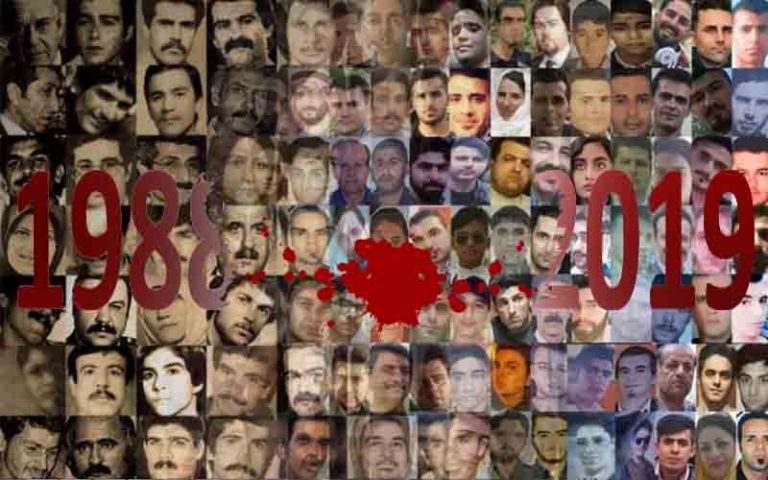
Raisi is known as one of the most notorious judges in Iran for his role in the mass killing of thousands of political prisoners in 1988. In May 2017, he tried his chance but failed despite Khamenei and the IRGC’s support. He is also a potential candidate for replacing Khamenei as Supreme Leader.

In this respect, the issue is not too easy. Raisi started his provincial trips some while ago, which is considered as an unannounced action for a Presidential candidacy. However, Raisi still refuses to announce his candidacy formally.

Observers believe that he is concerned about another public apathy as the government experienced in the February 2020 Parliamentary elections. In this context, Raisi prefers to hold the Judiciary Chief post rather than betting on a dead horse and tarnishing his reputation on the cusp of the death of Khamenei and taking the Supreme Leader’s office.

In other words, Raisi would not run in the election without necessary guarantees by Khamenei and IRGC ensuring a significant victory for him. However, the upcoming developments inside Iran and abroad may motivate Raisi and may persuade Khamenei to look for another figure. It all depends on the time.

European Intelligence Shows Iran’s Pursuit of Nukes

Iran has repeatedly tried to develop business contacts in the developed world with the intention of getting equipment and knowledge that could be used to further their nuclear program or even develop weapons of mass destruction, according to intelligence reports from Germany, Sweden, and the Netherlands, which all highlighted incidents from 2020.

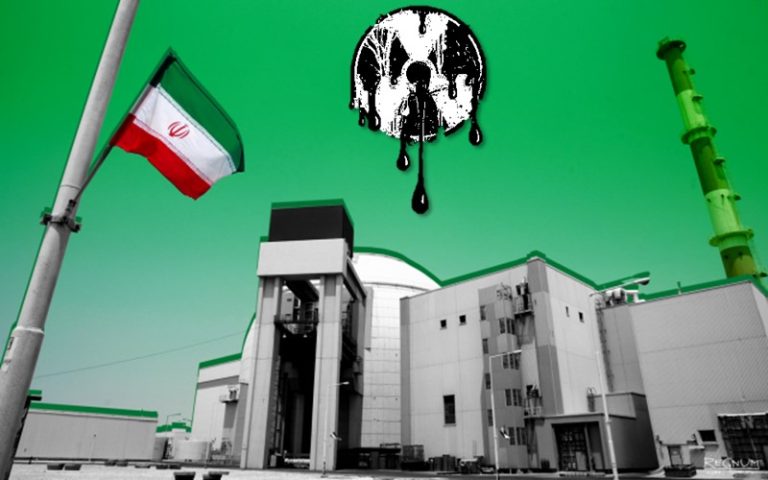
Yes, despite the Joint Comprehensive Plan of Action (JCPOA), which was designed to stop Iran from continuing its nuclear program, Tehran has barrelled ahead, proving what the Resistance said from the start, that the JCPOA was nowhere near comprehensive enough to deal with the Tehran’s malign behaviour.

The German report said that Iran is “making efforts to expand their conventional arsenal of weapons through the production or constant modernization of weapons of mass destruction”, while the  Swedish report accuses Tehran of industrial espionage against “Swedish hi-tech industry and Swedish products, which can be used in nuclear weapons programs”.

The Iranian Resistance wrote: “This surely comes as no surprise to the early critics of the deal, who anticipated that it would prompt Iranian authorities to scale back certain nuclear activities that were subject to international scrutiny while stepping up those that would allow the regime to secretly advance its capabilities in other areas.”

But the situation may be worse than expected if we look at comments by the head of the Atomic Energy Organization of Iran Ali Akbar Salehi, who said in January 2019 that Tehran lied about deactivating the Arak heavy water facility and ensured that the government would be able to quickly ramp up uranium enrichment if needed, which they subsequently did. The problem is compounded by the fact that the International Atomic Energy Agency has not been able to fully monitor the nuclear activity taking place.

So, why, oh why, are the Europeans so keen to restore the deal by getting the US to re-join and drop sanctions on Iran?

The Resistance wrote: “There can be no justification for returning to the JCPOA as written. The US, Britain, France, and Germany must all recognize that the prior enforcement mechanisms were not sufficient for dealing with a regime that has no interest in cooperating with its interlocutors or voluntarily restraining its own behaviour. At every turn, the leadership of the Iranian regime must be compelled to change that behaviour, whether by complying with specified enrichment limits or by accepting snap inspections of all suspected nuclear sites or by halting its procurement efforts in the West.”

On May 12, Reuters wrote that the Iranian regime has enriched uranium to up to 63% purity, according to the IAEA, which is clear breach of its JCPOA obligations.

“Fluctuations” at Iran’s Natanz plant pushed the purity to which it enriched uranium to 63%, higher than the announced 60% that complicated talks to revive its nuclear deal with world powers, a report by the U.N. nuclear watchdog said on Tuesday.” (Reuters, May 12)

Warning the government Mojtaba Zolnour, Chairman of the Parliamentary Security Commission said that the extension of the Agency’s inspection is subject to the opinion of the Parliament or the Supreme National Security Council. Which is a clear sign that the Iranian regime is on the path to cancel and prevent the IAEA’s inspection, to continue its illegal nuclear program without any barriers.

“Araqchi’s statement was wrong, the extension of the inspection and the agreement with the International Atomic Energy Agency is not in the hands of the Ministry of Foreign Affairs and the Atomic Energy Organization, this should be done with the opinion of the parliament or within the framework of the law strategic action to lift sanctions, and it is done with the discretion of the Supreme National Security Council.” (Mojtaba Zolnour, May 12, 2021)

Iran Protests Continue on Sunday

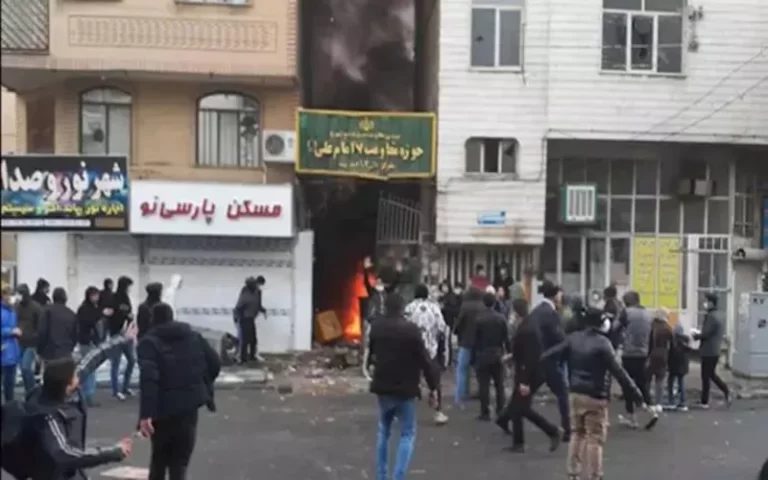
Protests by people from all social classes, all employment sectors, and all age ranges are continuing to be seen across Iran, as the public are outraged by both the authorieties’ general failure to improve the lot of the people and its issues surrounding the Covid-19 pandemic.

On Sunday, May 9, alone, there were at least three major protests, all featuring very simple demands that should not take a lot of effort to meet.

Retirees of the Social Security Organization held nationwide protests in a dozen cities to demand that their pensions be adjusted in line with inflation. They’ve been holding protests – sometimes twice weekly – for a few months now over officials’ corruption and failure to address their needs.

They chanted:

  • “Imprisoned worker should be freed”
  • “We won’t vote any more, we’ve heard too many lies”
  • “We suffer from injustice and Covid-19, no one cares about us”
  • “Retirees, stand up again injustice and oppression”

While newly-graduated “green record” teachers rallied outside the parliament to protest their continued unemployment and the false promises of officials in this matter. To have a “green record” means that the teachers achieved a high level of qualification and academic rank.

Students also protested in over a dozen cities because the government is insisting on students taking in-person exams, as opposed to online ones, during the pandemic. The authorities have failed to prevent these protests even though they sent threatening text messages to students and parents.

Ever since the pandemic came to Iran in January 2020,  officials have used it to suppress the people’s protests through a deliberate failure to suppress the virus, which explains why Supreme Leader Ali Khamenei called the coronavirus a “blessing”. Given that the pandemic came so shortly after the November 2019 protests that shook the regime to its core, it’s no surprise that the mullahs wanted to use any opportunity to stop people from gathering.

Despite all the mullahs’ efforts, protests have increased over the past four months, both in size and scale. More and more sectors are coming out on a weekly basis from defrauded investors to workers to parents. There is no sign of this slowing down at any time in the future.

The Iranian Resistance wrote: “Khamenei and his regime are witnessing these intensifying protests. But they can neither completely oppress them, as this will intensify protests due to the society’s explosiveness; nor the regime can refuse to oppress these protests, as they would spread rapidly. The regime’s deadlock in dealing with these protests has caused protests to continue and intensify.”

Update:

On Tuesday, May 11, a group of teachers in Fars province gathered in front of the General Directorate of Education in Fars to protest the non-achieved demands of educators. And in-line with them, the teachers in Zarrinshahr, Isfahan, protested in front of the General Directorate of Education for the demands of the educators. These teachers want the full implementation of the ranking scheme.

And Izeh students gathered in front of the city’s education department to protest the holding of face-to-face exams. Students in Shiraz protested the holding of year-end exams in the wake of the coronavirus pandemic, too. These protests are continuing for several days.

Rouhani’s COVID Lie

The coronavirus pandemic in Iran rages on, killing far more people than necessary, and all because the mullahs failed to take the appropriate measures at any stage. Yet still, the mullahs, including President Hassan Rouhani, continue to lie about the pandemic to justify their inaction regarding lockdowns and vaccinations.

It’s not that Rouhani and the rest of the officials are unaware of the national demand for free and effective vaccines, which have already been rolled about to vast swathes of the adult population in many countries, but they have certainly created a rod for their own backs about it over the past few months.

They’d already refused to buy any vaccines in January, but Supreme Leader Ali Khamenei banned the Pfizer and Moderna vaccines, which meant that shipments sent over by a charity were wasted. He claimed that the pharmaceutical countries wanted to test the drugs on Iranians, even though both were already being administered to the general public in the US and UK, with President Joe Biden and Queen Elizabeth having already been vaccinated. Then, Rouhani spoke about a domestic vaccine that would be available at some point in the next two years and was laughed off by medical experts.

So, what now? Well, the government seems to be more aware that a failure to vaccinate the population could increase the people’s anger and lead to protests that would sweep them from power, so they’ve backtracked a little and Rouhani even said that “the first vaccine is the best” as if there was a choice of vaccines for the public.

One might question how much he believes in what he says when neighbouring countries began their vaccination process at the start of 2021 when Rouhani questioned vaccine effectiveness, and the government has still failed to import World Health Organisation-approved vaccines. One might even wonder if the vaccines will reach Iranians when even the state-run Arman daily reports that the officials are allowing “mafias” to import the vaccines in a likely embezzlement scam.

Food and Drug Organization spokesperson Kianoush Jahanpour said on May 2: “Four-dollar vaccines are sold at $50, and $10 vaccines are imported at $25-70… Many companies that import vaccines do not work in the field of vaccines at all.”

The state-run Aftab-e Yazd daily wrote that the vaccines are being “monopolized” and that the country faces a “phenomenon called ‘vaccine smuggling’”.

And even worse, now you can find the vaccine on the black market. The state-rund daily Donya-e-Eghtesad on May 11 wrote: “The vaccine is available on the black market, but it is not clear whether this vaccine is real or not, the customer must trust and pay a thousand euros for the Russian vaccine.
According to this report and quoted by the pharmacists of the Nasser Khosrow street, it is said that the Chinese vaccine will be available in 10 days.

“Iran has 8,574 kilometers of border with 7 countries, and this has caused everything that is offered to the European market, the United States or even the Far East to be available in the Iranian market 48 hours later.

“According to field observations, the price of two doses of Russian vaccine in Iran is one thousand euros and they do not accept its equivalent in Rials. There is no guarantee as to whether this vaccine is genuine or not.”

The Iranian Resistance wrote: “The reality is that people are losing their lives during the Covid-19 fourth wave, and there are no vaccines. The private sector, rather the Revolutionary Guards (IRGC) front companies and state-linked mafias, are about to import Covid-19 vaccines, sell them in the free market. In other words, trade vaccine with Iranian people’s blood.”

Iran Regime’s Blackmail for JCPOA Negotiations

These days around the Iranian nuclear program, all eyes are on Vienna, a city where direct or indirect negotiations are being held between Iran and the United States, along with major world powers. The Iranian government is seeking to revive the 2015 nuclear agreement (JCPOA) at any price.

Iran’s hardliners are pretending that the negotiations are not by the orders of the regime’s supreme leader Ali Khamenei. But Iran experts say Khamenei himself is directing the entire nuclear projects, including all events and negotiations around this case.

Because for his regime this is one of the two wings of the continuation of its existence, beside its support of global terrorism which is aligned with its internal repression.

This became clear when the regime’s supreme leader stamped this fact, after the revelation of the regime’s foreign minister Mohammad Javad Zarif tape and warned him and the entire government: “Foreign policy is not set by the foreign ministry anywhere in the world. All over the world, it is up to the superiors and high-ranking officials to make the decisions. Of course, the foreign ministry is also involved. But it is just the executor.”

Defending the regime’s global terrorism and the killed Quds Force commander Qassem Soleimani, which is the main tool for its harmful actions overboard, he added: “The Quds Force is the biggest factor in preventing passive diplomacy in West Asia. Man feels sorry when he hears these (attacking the foreign minister Javad Zarif).”

He continued: “Some of these speeches are repetitions of American speeches. Americans have been deeply saddened by the Islamic Republic’s influence for years. They were angry about Martyr Soleimani because of this and because of this he was martyred.”

The question here is why we are repeating this facts and speeches again. The truth is that the Iranian regime since the US President Joe Biden’s presidency has committed more than 200 hundred attacks against the US troops mainly in Iraq and Afghanistan with the help of its proxy forces.

And it seems that these attacks are intensifying after the new round of the JCPOA negotiations. And as we know, over the last 40 years this regime has solved every of its crises with its terror lever, to impose its demands and goals.

Below is a partial list of the regime’s latest attacks against the US troops and bases in Iraq fulfilled by its proxy groups, reported by the regime’s media. The amazing thing is that many times even further the Iraqi media and other international media, the regime’s media have reported these attacks.

State-run daily Khabar Fori, May 8: “Some news sources reported on Saturday morning that a rocket attack has hit the US base in Ain al-Assad in Iraq’s Anbar province. The base is home to US terrorist forces, and initial reports indicate that a missile warning siren sounded at the base. News sources reported that the C-RAM and Patriot missile defense systems recently installed at the base failed to intercept and destroy the rockets.”

State-run website Karg News Agency, May 5: “Following the rocket attack on the Ain al-Assad base in western Iraq, US forces took unprecedented security measures at the base. Ain al-Assad air base in Iraq, where US forces are based, was targeted by a missile yesterday.”

IRNA news agency, May 4: “Iraqi sources reported that the Iraqi Ain al-Assad base was targeted by several rockets an hour ago. Yesterday, Balad base was attacked with 10 rockets. An hour ago, an explosion took place in the American military equipment loading area on the Kuwaiti border, which, according to published images, caused extensive damage to the occupiers’ equipment.”

IRNA, May 4: “Iraqi news sources reported an attack on a US military logistics convoy on the road leading to Iraq’s occupied Ain al-Assad base.
“According to IRNA on Thursday night, this attack with a developed bomb was against a convoy carrying US missiles and military equipment. Saberin News wrote that the group of Ashab al-Kahf claimed responsibility for the attack. Attacks on US military convoys in Iraq have intensified in recent weeks, with some Iraqi anti-occupation groups announcing they will continue their attacks as long as their country is under US occupation.”

ISNA news agency, May 4: “The Iraqi army’s security unit affiliated with the Iraqi army by issuing a statement that four Katyusha rockets hit the Balad air base and announced the operation of identifying its terrorist elements.”

ISNA news agency, May 3: “Iraqi security sources reported on Sunday night that two rockets had been fired at a US military base near Baghdad International Airport.”

Mehr news agency, May 2: “News sources reported Sunday evening that a rocket had hit a US military base near Baghdad airport. According to the report, the ‘Victoria’ military base near Baghdad airport, where the American occupying forces are present, was hit by several rockets. At least three rockets are said to have hit the Victoria military base.”

Fars news agency, April 28: “An unnamed Iraqi group claimed responsibility for a drone strike on Balad Air Base, 64 km north of Baghdad. According to the Saberin News Telegram Channel, the statement said: ‘In the name of the Lord of the Mojahedin and with the blessing of the birth of our Master Imam Hassan Mojtaba, peace be upon him, the American military branch stationed at Balad Air Force Base was recently targeted by a drone.’”

Mashregh News, April 23: “News sources announced that at least 3 rocket missiles hit American Victoria base near Baghdad airport in the Iraqi capital.”

Iran Press news agency, April 18: “Some Iraqi sources reported that two people were wounded in a rocket attack on Balad Air Base, a US military base in Iraq’s Salah al-Din province. In the past few days, more than 20 US logistics convoys have been attacked in various parts of Iraq, including the US base near Erbil Airport and the Ain al-Assad base in Anbar province. US convoys and military bases in Iraq have been targeted several times in recent months.”

Mehr news agency, April 16: “News sources reported that the Ain al-Assad air base in Iraq’s Anbar province was targeted.
The Saber News Channel, which broadcasts military news about the US occupation of Iraq, reported that the base had been targeted by three UAVs.”

State-run website Khabar Fori, April 15: “According to Iraqi sources, the ‘Ain al-Assad’ base, the base of the American occupying forces in the Iraqi province of Al-Anbar, has been targeted by rockets.”

State-run news agency IRNA, April 9: “According to IRNA, following the increase in threats regarding the targeting of American bases in Iraq, in addition to the full readiness of the occupiers; The Iraqi security forces have also increased their level of monitoring and preparedness.

“The Nas news agency close to the Iraqi government reported: following the efforts of the Iraqi security forces with field monitoring and intensification of intelligence efforts, one of the patrols at 20:00 on Thursday night in the ‘Al-Jazeera’ area of ​​Al-Anbar province saw a suspicious vehicle that it was a short distance from the road east of the Ain al-Assad base.

“According to the Iraqi security headquarters, the security patrol searched the vehicle and found a launcher and 24 missiles, then an engineering unit was called to the scene to neutralize and deactivate the missiles.”

Fars new agency, April 7: “A US military logistics convoy was targeted in western Iraq. The Saberin News channel reported Wednesday that the convoy was targeted in the area between Salah al-Din and Al-Anbar provinces. This is the fourth US military logistics convoy to be targeted.”

Nasir News, April 4: “Attack on a US military support convoy in Diwaniyah, Iraq. The attack on the US support convoy in Diwaniyah province was claimed by the armed group ‘Ashab al-Kahf’, but no group has claimed responsibility for the rocket attack on Balad base as of this writing.”

IRNA news agency, March 18: “A newly formed Iraqi group that announced its existence last night (Wednesday) claimed responsibility for two attacks on military support convoys of the occupying US army and the ‘Ain al-Assad’ base. The Iraqi group, dubbed the ‘Khyber Brigade’, today (Thursday) issued a short statement and video of its attacks, claiming responsibility for the recent attacks on a convoy and US military base on Iraqi soil.”