


 Haaretz: To facilitate regime change from within Iran, it is critical to remove the terrorist designation from the MEK, and to protect and resettle its members. Haaretz
By Raymond Tanter
 To facilitate regime change from within Iran requires a dissident organization with the same sort of leadership skills that helped create a coalition to overthrow the shah of Iran. Only one viable group that rejects clerical rule in Iran remains from the days of the Islamic Revolution – the Iraq-based Mujahideen-e-Khalq, the largest group within the National Council of Resistance of Iran (the Paris-based parliament-in-exile ). Together, only the MEK and the NCRI have the expertise and means to lead political change in Iran. Consider the role the MEK has played in bringing about inspections and sanctions, as well as what it offers for the present and future Iran.
Earlier this week, David Cohen, the U.S. Treasury undersecretary for terrorism and financial intelligence, was in Israel, where he discussed additional sanctions against Iran with the heads of both the Mossad and IDF Intelligence. Today, IAEA chief Yukiya Amano meets in Vienna with Iranian representatives to negotiate access for inspectors to a suspect nuclear site.
While the connection between inspections and sanctions may seem obvious, it is useful to inquire how this came about. In a 2006 study, the Center for Strategic and International Studies, a Washington, D.C. think tank, found that the NCRI’s exposure of Iran’s secret nuclear program was the trigger for getting the IAEA into Iran.
In August 2002, the NCRI had reported the existence of a secret nuclear facility near Natanz. Another independent think tank, the Institute for Science and International Security, confirmed the revelation, identified the site as a uranium enrichment facility, and that December, released imagery of Natanz. These two prominent organizations credited NCRI for its revelation, as did President Bush.
Considering the continued blacklisting of the MEK (and NCRI ), it’s worthwhile to examine three essential aspects of the organization: its ideology, support within Iran, and how the group relates to Israel.
In my research, I have interviewed most of the MEK’S leaders, in both Iraq and France, as well as analyzed their foundational statements and documents, and found their positions to be consistent with democratic principles.
Tehran seeks to delegitimize and link Israel and the MEK, partly because both are committed to the rule of law rather than reign by unelected clerics. I found that leaders and rank-and-file of the MEK support a two-state solution to the Palestinian problem and Israel’s right to exist. In contrast, other dissidents have called for the annihilation of Israel, as well as preservation of the nuclear program.
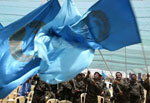
Abroad, no other dissident organization can mobilize similar numbers of expatriates at its rallies. On June 23, MEK supporters will hold their 9th annual rally in Villepinte, France. The event regularly draws upward of 80,000 supporters, including many Arabs, Christians, and Jews.
Back in Iran, the disproportionate number of summer 2009 protesters arrested, sentenced to death, and hanged because of their association with the MEK also indicates the organization’s significant presence on the street there. And, the vast majority of an estimated 30,000 political prisoners massacred in summer 1988 belonged to the MEK. Risking one’s life to divulge highly classified intelligence is a clear indication that even in the most sensitive field of national security, there are MEK supporters.
I conducted a content analysis of references to all formal Iranian opposition groups in regime media during 2005, in both Farsi and English. The team I headed found that state-run media paid 350 percent more attention to the MEK than all other organizations combined.
And yet, since 1997, the MEK has been on the list of foreign terror organizations compiled by the State Department. The designation almost paralyzes a group that operates openly, and makes it illegal for U.S. citizens to provide it with material support. The more recent roots of this ongoing aberration go back to the summer of 1997, when a “moderate” cleric, Mohammad Khatami, was elected as Iran’s new president. The Clinton administration saw inclusion of the MEK on the terrorist list as a goodwill gesture to the new regime, with which it was hoping to open a dialogue.
On June 1, 2012, the U.S. Court of Appeals in Washington informed the State Department that it had until October 1 to make a decision on the status of the MEK; otherwise the court would order its revocation from the list. The Department can be expected to allow that full period to pass to delay delisting out of a desire to keep alive the moribund nuclear talks with Iran, which threatens to end talks if the MEK is delisted.
To facilitate regime change from within Iran, it is critical to remove the terrorist designation from the MEK, and to protect and resettle its members who are under constant attacks and threats from Iran and its proxies in Iraq. The Iranian people, and Jerusalem and Washington all have an interest in empowering the Iranian opposition. The current policy does just the opposite; it empowers the regime in Iran.
Prof. Raymond Tanter served on the senior staff of the National Security Council in the Reagan administration, and has been a visiting professor at the Hebrew University of Jerusalem. His most recent book is “Terror Tagging of an Iranian Dissident Organization” (Amazon Kindle ).


