


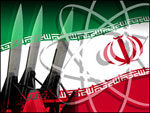
 AP: Judging by its expanding nuclear program, harsh sanctions against Iran have done little but impose hardship on its people, while diplomacy has also failed to slow the Islamic Republic’s atomic progress.
The Associated Press
By By GEORGE JAHN and BRIAN MURPHY
VIENNA (AP) — Judging by its expanding nuclear program, harsh sanctions against Iran have done little but impose hardship on its people, while diplomacy has also failed to slow the Islamic Republic’s atomic progress. And while more talks are planned for later this month, there is a growing sense that the nuclear standoff between Iran and the international community is reaching a tipping point.
Iran can theoretically back down. But because it insists that all of its nuclear work is peaceful and protected by international law it is unlikely to go further than repeating its top leader’s religious edicts against nuclear weapons in pushing for an end to sanctions. That in turn will lead to another negotiating failure — and mounting pressure for military intervention to prevent Tehran from becoming a threshold nuclear weapons power.
Each side wants what the other is bringing to the table at the planned Feb. 25 talks in Kazakhstan. The problem is that both want the other to blink first.
For the P5 +1 — the five permanent U.N. Security Council members plus Germany — the onus is on Iran. They want Tehran to stop enriching uranium to 20 percent — a grade that is only a technical step away from the level used to arm nuclear warheads. Then, they want it to transfer its 20-percent stockpile out of the country. They also demand that Iran shut down Fordo — the bomb-resistant underground bunker where Iran is enriching uranium to 20 percent. Only then are they ready to discuss sanctions relief on Iranian oil and financial transactions.
But Iran insists it is enriching only to make reactor fuel and for scientific and medical programs — a right that all nations have. It denies any interest in nuclear weapons, considers Security Council demands that it stop enrichment invalid, and U.N. and other sanctions illegal. Tehran wants a promise that non-U.N. sanctions at least will be lifted if it makes even the smallest commitments on uranium enrichment.
Demands and counter-demands have shifted since the talks began in 2003 between Iran and Britain, France and Germany, later expanded to include the United States, Russia and China. But one constant remains: failure not only to reach a breakthrough but even to make substantive progress.
Neither side is known to be bringing new proposals beyond what was in play the last time they met, in June in Moscow. Success seems even more elusive thanks to Iran’s recent announcement that it would speed up the pace of its uranium enrichment, and with planned new U.S. sanctions to take effect Wednesday.
“The situation has changed for the worse for both sides since last summer,” says Mark Fitzpatrick, a non-proliferation expert and former senior official at the U.S. State Department. With further enriching, Iran already has enough material for several nuclear weapons, and Fitzpatrick says that since the Moscow talks, Iran has produced enough additional low-enriched uranium to produce an additional weapon with further enrichment. As for Tehran, “the sanctions bite has gotten worse” since the two sides last met.
Even ahead of the new U.S. penalties, Iran’s revenues from oil and gas exports are now down by 45 percent from normal levels. That, and severe restrictions on its ability to access international banking networks led the rial, Iran’s currency, to lose 45 percent of its value last year.
But Iran shows no sign of budging, and Israel’s threat to hit Tehran’s nuclear targets if negotiations fail stands, as does the possibility that such a move would draw the United States into the conflict. Iran could enrich uranium to arm one weapon within half a year even though analysts say it would take years longer for it to actually create a full working nuclear weapon.
That is a longer time line than Israel accepts. But independently of Israel, President Barack Obama may not have more than a year or two to decide whether Iran has embarked on making nuclear weapons or whether it has only reached the ability to do so. If it’s the latter, he has to judge whether Iran is content to stay on the nuclear threshold and if America can tolerate that status.
For diplomacy to succeed, “both sides need to move with greater urgency and flexibility toward a lasting solution,” says Daryl Kimball, executive director of the Arms Control Association. “Iran apparently does not yet have the necessary ingredients for an effective nuclear arsenal, but its capabilities are improving. “
An Iran with the capability to make the bomb might choose not to do so. Iran could be shaping its nuclear ambitions after Japan, which has the full scope of nuclear technology — including the presumed ability to produce warhead-grade material — but has stopped short of actually producing a weapon. It creates, in effect, a de facto nuclear power with all the parts but just not pieced together.
In that light, Supreme Leader Ayatollah Ali Khamenei’s recent repetition of his fatwa, a proclamation that nuclear weapons are banned by Islam, could be another way of stating Iran’s nuclear goals — ready to assemble weapons but doing so only if threatened.
Israeli Prime Minister Benjamin Netanyahu has vowed that he would not allow the Islamic Republic to reach that level of weapons capability. But he is unlikely to attack without U.S. military backing — and he and Obama may have different interpretations of when such action may be needed.
“Our policy toward Iran’s nuclear program has been defined by Obama’s red lines, not Netanyahu’s, meaning that the U.S. isn’t likely to use military force unless and until it’s clear that Iran is taking active steps to weaponize its program,” says Karim Sadjadpour, an Iran specialist at the Carnegie Endowment for International Peace.
EDITOR’S NOTE: Jahn, the AP’s Vienna bureau chief, has reported on Iran’s nuclear program since 2003. Murphy, the AP’s bureau chief in Dubai, has reported on Iran for more than 12 years. He reported from Dubai.
Associated Press international political writer Steven R. Hurst contributed from Washington.


