


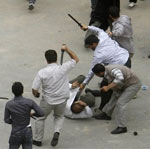
 AP: The Obama administration warned Friday that nations such as Iran, Russia and Venezuela are turning up pressure on human rights and other activists, decrying what it described as a global crackdown on the “lifeblood of democratic societies.” The Associated Press
WASHINGTON (AP)— The Obama administration warned Friday that nations such as Iran, Russia and Venezuela are turning up pressure on human rights and other activists, decrying what it described as a global crackdown on the “lifeblood of democratic societies.”
In its annual human rights report, the State Department criticized a host of new restrictions on advocacy groups including laws banning free speech, assembly and religion. Even worse, it noted that human rights, political and labor leaders in more countries were facing harassment, arrest and even assassination.
“Civil society is the lifeblood of democratic societies,” the report said. “Countries succeed or fail based on the choices of their people and leaders — whether they sit in a government ministry, a corporate boardroom, an independent union or a cramped NGO office. When individuals have the ability to come together, air their views and put forward their own proposals, they challenge and support their governments in reaching higher standards of progress and prosperity.”
At a briefing, Secretary of State John Kerry told reporters he considered canceling the release of the report because of the intensity of the manhunt for the suspect in the Boston marathon bombing but said he decided to release it because “people have the right to run in a marathon without violence.”
“And people have a right to enjoy a holiday without terror,” Kerry added.
The report singled out for criticism a series of new Russian laws that target groups receiving international funding and restrict “unauthorized protests” and Internet freedom.
Bangladesh was cited for suppressing labor rights while Egypt was criticized for continuing to put pressure on domestic and foreign non-governmental organizations after raiding the offices of pro-democracy groups in 2011. China imposed new registration requirements to prevent groups from emerging that might challenge government authority.
Other trends cited in the report included:
—Uneven progress in the Middle East as protests turned to politics, with increased violence against women and religious minorities. The worst cases were civil war-wracked Syria, where 70,000 people have been killed over the past two years, and Iran, which executed 523 people last year and whose government attacks journalists, students, lawyers, artists, women and ethnic activists.
—An emergent democratic transition in Myanmar, also known as Burma, even if many legacies of the military’s authoritarianism remain. These include its repressive laws, pervasive security apparatus, corrupt judicial system and limits on freedom of religion. Inter-ethnic violence persists.
—The increased availability of information, even in closed societies such as North Korea, where people risked punishment to get illegal radios, cellphones and other communications equipment. In Philippines, social media activists helped suspend a restrictive law on online libel. But globally, the number of imprisoned journalists reached a record 232 last year, led by Turkey with 49. Another 133 were killed in the deadliest year for reporters since 1997.
—Anti-Semitism throughout the Middle East, Europe and Latin America, from Egyptian President Mohammed Morsi’s “amen” after an imam called for the destruction of the Jews to the gains made by overtly racist political parties in Hungary and Greece. Many of these parties in Europe also launched political attacks on Gypsies and Muslim immigrants. Even state-controlled media in Venezuela included anti-Semitic statements.
—Attempts to criminalize homosexuality, including a draft law in Uganda that prescribes death for repeat “offenses.”
The report, which analyzes human rights around the globe, looked for the first time at the world’s newest country: South Sudan. It documented security force abuses, a lack of access to justice and civilians displaced by fighting between Sudanese and South Sudanese forces, rebel militia and ethnic communities. The government rarely punished officials who committed atrocities, the report said.


