


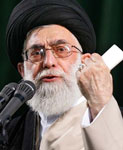
 Bloomberg: The best way to understand Iran’s elections this week is to think of Supreme Leader Ayatollah Ali Khamenei as the regime’s supreme investment manager. Bloomberg
By Meir Javedanfar
The best way to understand Iran’s elections this week is to think of Supreme Leader Ayatollah Ali Khamenei as the regime’s supreme investment manager.
Like Warren Buffett, or any other top fund manager, Khamenei is answerable to his shareholders when making a big investment pick. Both men enjoy enormous personal authority, but if they keep hurting the interests of their shareholders by getting the big choices wrong, that authority will erode.
Khamenei’s shareholders consist mainly of the Islamic Revolutionary Guard Corps and the Principalists, a broad coalition of conservative politicians. Where Buffett is judged by the companies and stocks in which he invests, Khamenei is judged by the politicians he picks or supports for positions of authority, and how those people further the economic and political interests of the supreme leader’s supporters. And the most important pick Khamenei has to make this year is Iran’s next president.
Khamenei’s last presidential investment, Mahmoud Ahmadinejad, didn’t work out so well. Instead of uniting Iran’s conservative elite, Ahmadinejad’s antics and leadership style created infighting and division. He ravaged the regime’s standing abroad with inflammatory speeches, such as his denial of the Holocaust. At home, his populist economic policies caused extensive damage, which today can be witnessed in Iran’s high level of inflation — which the nation’s official statistics agency put at 30 percent in May — and 12 percent unemployment, according to International Monetary Fund data.
Appalling Record
Coupled with international sanctions triggered by Iran’s alleged nuclear-weapons program, this appalling economic record has hurt not only the Iranian people, but also the business interests of the revolutionary guard.
Today, the guard has major business interests in the construction, oil-and-gas, and automotive industries, as well as in the manufacture and importing of electronic goods. To give just one example, the U.S. administration last year named National Iranian Oil Co., Iran’s state oil company, as an “agent or affiliate” of the revolutionary guard.
As powerful as the guard is, however, its companies rely on the Iranian population to buy their products. The less money consumers have, and the more inflation erodes their purchasing power, the less they can spend on goods that the revolutionary guard makes and imports.
Compounding the stakes for Khamenei is that, despite Ahmadinejad’s damaging antics and policies during his first term as president, the supreme leader backed him again for a second term in 2009. Khamenei asked his stakeholders to support that decision, which they did.
This makes it even more important that Khamenei invests his political capital and reputation in the right candidate this time. The next president needs to strengthen the regime’s cohesion, its domestic- and foreign-policy performance, and the economy. If Khamenei makes another poor choice, his credibility and even authority may suffer as important regime stakeholders begin to doubt his ability to secure their interests.
Khamenei’s top priority right now is to promote cohesion in the regime’s increasingly divided ranks, a major concern for the Principalists. Infighting has increased at an unprecedented rate during Ahmadinejad’s second term, a phenomenon that is more and more difficult to conceal.
Family Feud
Even Khamenei’s family has been affected. The supreme leader’s ultraconservative older brother, Sayyed Mohammad Khamenei recently attacked former President Ali Akbar Rafsanjani, who was planning to run for the office again, but was disqualified by the Guardian Council. Khamenei’s younger brother Hojatoleslam Hadi Khamenei then publicly defended Rafsanjani by stating that those who attack the former president “want to destroy the Islamic Republic.”
Infighting is one of the main reasons why the supreme leader had Rafsanjani’s candidacy disqualified. Economics played an even bigger role. Rafsanjani and his backers want to open Iran’s economy to new investors, both domestic and foreign, to promote growth. This would create competition for the revolutionary guard, hurting its business interests. Forced to choose between the guard and Rafsanjani, Khamenei had little choice — he couldn’t afford to risk alienating the revolutionary guard, a vital pillar of support for his rule.
Presidential candidates, such as chief nuclear negotiator Saeed Jalili and Tehran Mayor Mohammad Baqer Qalibaf look like better investment options for the supreme leader. Both are close to the revolutionary guard and to the conservative circles that surround Khamenei.
The major difference between these two conservative candidates is that Qalibaf has more genuine grass-roots support, especially in Tehran, where he has spent eight years as mayor and is fairly popular. That also gave him valuable experience in managing domestic affairs, giving him an edge over some of the other candidates. This support base makes it more likely that, as president, Qalibaf would be willing to criticize or oppose the supreme leader’s policies, whereas Jalili has proved himself to be a yes-man. Unlike Ahmadinejad, however, Qalibaf would probably air his differences in private.
The widespread use of election fraud in 2009, when the Iranian regime went so far as to fake ballot papers for Ahmadinejad in Jerusalem — 48 voters produced 79 ballots — shows that the supreme leader doesn’t care much about whom the majority of Iranian voters would like to see as their leader. The whole system has been designed to narrow choices and tilt the process to ensure that a candidate approved by the supreme leader wins.
Turnout Risk
Still, a low voter turnout this time could also damage Khamenei’s image as the supreme investor, exposing low levels of public faith in his leadership. To address this challenge, it seems that Khamenei hopes the three election-campaign debates — between the eight candidates the Guardian Council permitted to stand (out of 686 hopefuls) — will create the impression that the elections will be fair.
In 1989, Warren Buffett wrote in a letter to shareholders that: “It’s far better to buy a wonderful company at a fair price than a fair company at a wonderful price.” That’s good advice for Iran’s Khamenei, too. He needs to back a convincing candidate for the presidency this week, even if that means paying a higher price in terms of choosing someone who won’t always toe the line. The Iranian regime’s shareholders are watching and judging. After a bad investment in Ahmadinejad, Iran’s supreme investment manager needs to show his worth.
(Meir Javedanfar is an Iranian-Israeli Middle East analyst. He teaches the contemporary Iranian politics at the Interdisciplinary Center in Herzliya, Israel.)


