


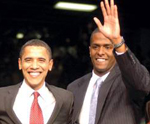
 The Hill: The bill [Nuclear Weapon Free Iran Act] gives Western negotiators even greater leverage to convince the Iranians to make further concessions and ultimately reach a final agreement. This bill serves as an important diplomatic tool for Secretary Kerry and his international counterparts.
The Hill
By State Rep. Bakari Sellers (D-S.C.)
As a State Representative from South Carolina, I’ve been watching with great concern as the Iranian regime becomes frighteningly close to developing a nuclear weapons capability. Recently I have lead bipartisan efforts to divest state assets from Iran and worked with various municipalities to do the same. However, I know that my constituents, as well as most Americans, continue to have two major foreign policy concerns: we do not want to be involved in another military engagement, and we do not want to see Iran develop a nuclear weapon. President Obama and his administration are doing all they can to prevent both of these scenarios by engaging in the diplomatic process with Iran to achieve a final, peaceful agreement.
Last November, Secretary of State John Kerry and his international negotiating partners came to a historic agreement with Iran. I am fully supportive of the efforts of President Obama and Secretary Kerry, together with our allies, to reach a diplomatic solution with Iran. Tough sanctions passed by Congress, coupled with a strong diplomatic push by the Obama administration, created an environment that convinced the Iranian regime to come to the negotiating table.
Congressional sanctions have put significant pressure on Iran’s economy over the past few years. Unemployment is rampant, the value of Iran’s currency has plummeted, and oil exports have fallen over 50 percent. Without this economic pressure, the obstinate regime in Tehran would never have agreed to make any concessions to the West. Sanctions created leverage for the Obama administration and Secretary Kerry to reach a diplomatic agreement.
Sens. Robert Menendez (D-N.J.) and Mark Kirk (R-Ill.) recently introduced the Nuclear Weapon Free Iran Act. The bill, which has overwhelming bipartisan support in the Senate, would implement new sanctions on Iran only if it violates the terms of the interim agreement or fails to reach a final agreement with Western powers. The bill gives Western negotiators even greater leverage to convince the Iranians to make further concessions and ultimately reach a final agreement. This bill serves as an important diplomatic tool for Secretary Kerry and his international counterparts.
In order for the U.S. to reach the best possible solution, the administration must have every tool available to help it achieve its goals. The Menendez-Kirk bill gives President Obama all the flexibility he needs to come to a final agreement: the bill does not violate the terms of the interim agreement and actually gives President Obama generous waiver authority to postpone the sanctions for up to a year if he feels they will harm the diplomatic process. The bill provides Iran with a necessary “stick” to prevent it from negotiating in bad faith. The regime is feeling the pressure of the sanctions and wants to avoid increased pressure.
Those who oppose this bill argue that the U.S. must now give its negotiators time and space to come to a final agreement with Iran without the threat of new sanctions. But Iran has proven time and time again that it cannot be trusted. Given Iran’s track record, the U.S. should not trust Iran to follow through on its commitments and must continue to exert pressure on the regime. If we put blind faith in the Iranians to uphold their end of the bargain, the negotiations are doomed to fail.
We all want to see a diplomatic resolution to the West’s decades’ long conflict with Iran. But in order to avoid a military confrontation, we must use all available diplomatic tools to come to an agreement. President Obama and John Kerry have made tremendous progress in recent months, but Congress must now do its part to provide them with as many tools as possible to reach a peaceful solution. Financial sanctions combined with diplomatic outreach have convinced Iran to come to the negotiating table. Now is not the time to let up on this pressure.
Sellers is from Denmark, S.C. and represents House District 90, serving since 2006. He is a member of the South Carolina House Judiciary Committee and a candidate for Lt. Governor.


