


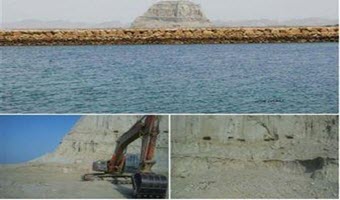
London, 15 Sep – In the Jask seaport next to the Persian Gulf in southern Iran, Iran’s Revolutionary Guards (IRGC) Navy has initiated the demolition of an ancient castle that belonged to the Persian Empire of the Sassanid era, according to a report on the website of the National Council of Resistance of Iran (NCRI).
On 11 September, the state-run ISNA news agency quoted local official Ibrahim Bousik as saying that the IRGC “has advanced 10 percent” in the demolition of the site.
This castle is called “Castle of Kouh Mobarak” and belongs to the Sassanid Empire (Sasanian Empire) that ruled Iran from 224 to 651 AD.
The demolition has met strong opposition by the local people. Following numerous referrals and correspondence in this regard, they formed a human chain around the construction machinery on 10 September and stopped the work. However, the IRGC attacked them and started the demolition of the castle, according to the NCRI.
The castle includes a famous building called Sassanid Rooms which is two rooms carved out of stone that are situated at the cape of Kouh Mobarak. This site is one of the most precious ancient sites of Hormozgan Province which lies on the southern shores of Iran.
In the old ages, Jask seaport was one of the centers for the religion of Mitra, and the Anaheata shrine remains in Jask.
Haidar Haidarinejad, a researcher on the history of Jask region, says that next to Kouh Mobarak there is a cemetery that experts believe is 3000 years old.
“Just like the terrorist and savage ISIS group in Iraq and Syria, the Iranian regime’s fundamentalist IRGC is destroying this ancient site dating back three millennia”, the NCRI said.
On August 20, state media acknowledged that an ancient site, dating back 2500 years, called Hezareh (Millennium) Castle of Minab at the shores of the Persian Gulf is being destroyed because of irresponsible archeological work by state institutions that are looking for antiques at the site.
An official in this province disclosed that all of the land around this historic site has been given to the IRGC.
The confiscation of land, as well as trade and financial institutions, by Iran’s Supreme Leader Ali Khamenei and the Revolutionary Guards under his command has taken on astonishing dimensions in recent years, the NCRI said, adding that it is estimated that anywhere from 50% to 67% of Iran’s GNP is now under the thumb of Khamenei and the IRGC.
The locals living around the ancient site of Kouh Mobarak have stated that they would continue with their resistance.


