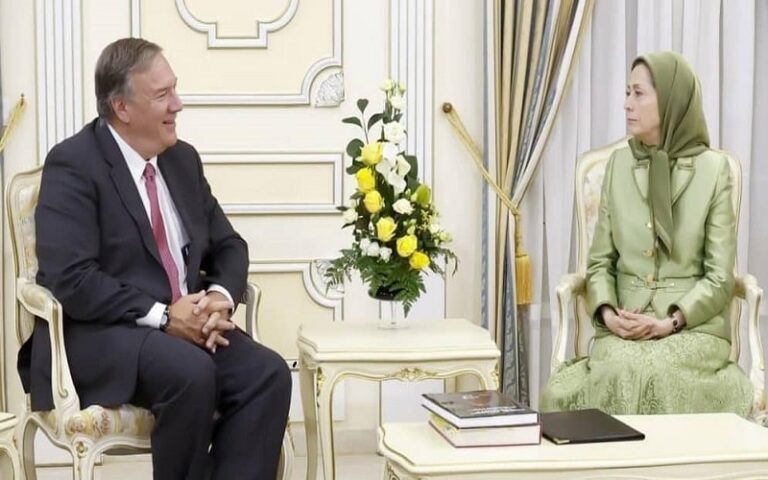
In a gathering of the National Council of Resistance of Iran (NCRI) on October 6, former Secretary of State Mike Pompeo delivered a speech commemorating the anniversary of the Iranian uprising and expressing solidarity with the brave Iranians who have fought against the oppressive regime. Pompeo praised the resilience and sacrifice of the Iranian people, acknowledging the atrocities committed by the regime to suppress their voices.
“We are here to mark a special anniversary, and I of course want to acknowledge the bravery and sacrifice of so many brave Iranians over the past year. The brutal regime has committed a great many atrocities to silence their voices,” he said.
Pompeo emphasized the importance of supporting the opposition movement within Iran and recognized the significant progress made over the past year.
“We will never forget the responsibility we have to support what you are doing inside of that country,” Secretary Pompeo said. “I last spoke to you back in July, just three months ago, and yet much has happened since then. It’s a short time, but yet one year after the beginning of the uprising, the regime is in a complete deadlock. It has no way out of the crisis, the conflict between the people and the government, which in fact in those 90 days has only intensified.”
Pompeo stressed that despite the regime’s attempts to quell civil unrest through executions, repression, imprisonment, and torture, the people’s determination has only grown stronger.
“The civil unrest has become more powerful. The regime responded with more executions, more repression, more imprisonment, more torture, exactly what one would expect from a scared set of leaders. This has indeed deepened the divide between the regime and its people, just as we know it would,” he said. “I believe with all my heart for the Iranian people and the resistance informed and encouraged by the folks in this room today is stronger than they are.”
The former Secretary of State highlighted the shared objective of establishing a democratic and free republic in Iran, free from dictatorship.
“We, each of us, everyone around the world must recognize what these uprisings are aimed at. They’re aimed at a democratic, free republic of Iran that is devoid of any form of dictatorship. That’s our objective. Everyone here shares that goal,” he said.
He asserted that the regime is destined to fail and that lasting change can only be achieved by those who have dedicated themselves to the cause over many years.
“First, no matter what the regime does, it is doomed to fail. Second, even as important, change in Iran can only be achieved by those who have been working toward it for decades, those who have paid the price for it and contain the organizational structure to accomplish that objective,” he said.
Pompeo praised the People’s Mojahedin Organization of Iran (PMOI/MEK) for its growing capabilities and its role in impeding the regime’s brutal tactics.
“The organized resistance led by the MEK, every day is increasing its capability. It is delivering an even bigger push. Your work has made it far more difficult for the IRGC to inflict its brutal terror and mayhem on the people of Iran,” Pompeo said.
He acknowledged the organization’s efforts in organizing rallies near the United Nations.
“You all, the MEK, and your supporters have organized rallies abroad, too. One such rally, numbering in the thousands, happened on September 19th. It took place just across the street from the United Nations, protesting Raisi’s visit and in support of President Rajavi and her Ten-Point Plan for the future of Iran,” he said.
Pompeo stressed that appeasement has been a major obstacle to ending Iran’s state-sponsored terrorism.
“That appeasement has been and remains the biggest outside obstacle to ending Iran’s state-sponsored terror, its rogue regional behavior, and its support for the Iranian people’s desire to struggle to bring about change in Iran,” he said. “Appeasement will not work.”
Pompeo expressed concern over the Biden administration’s decision to provide six billion dollars in appeasement to Iran.
“Six billion dollars of appeasement. More evidence that the Biden administration’s recent decision to pay to get Americans home to their families, something that I worked so hard to do for so long,” he said. “We know this. There is zero chance this money is going to benefit the Iranian people. None. You all know this. And they’ll use this money to go after Iranian dissidents both outside of the country and inside of the country. Six billion dollars to fund its brutal oppression of the organized resistance inside of Iran.”
Furthermore, Pompeo revealed that individuals within the United States government took directives from the Iranian regime’s former Foreign Minister Zarif and his associates.
“We now know that operating inside the United States government were people working on behalf of the United States ostensibly, but who were taking guidance from Foreign Minister Zarif and his henchmen inside of Iran,” he said. “This policy to which we have returned, not just to America, but to large European powers as well, it’s totally counterproductive. Iran’s newfound wealth, we’ll see it in the months and years ahead, it’ll fund terror abroad and oppress people at home.”
Pompeo stressed that it is time for the West to listen to the real voice of the Iranian people.
“Listen to the voices of the Iranian people. In over 280 cities across all 31 provinces of Iran, they have rejected the ruling theocracy and made clear that the mullahs are not a permanent feature of this nation,” he said. “Chants, chants like you all have said here today of down with the oppressor, be it the Shah or the Ayatollah, we do not need dictators.”
In conclusion, Pompeo emphasized the importance of supporting the resistance movement both inside and outside of Iran:
“As we seek to support the resistance movement inside Iran and out, we must consider what the future should hold for Iran, what it should look like, and what is it we want. Everyone here wants freedom for the Iranian people. Let’s talk about how we can achieve it, how we can build something that can not only replace the regime but do so in a way that is lasting and secures freedom for everyone inside of that beautiful nation.
“As I’ve said before, Iran will never return to the dictatorship of the Shah, nor will it settle for the current theocracy in Iran. The remnants of the past monarchy have failed to gain any traction during the uprising over the past year. The Shah’s supporters were exposed when they heavily relied on collaboration with the IRGC. What Iran needs is something that looks and feels like the people in this room. People who simply want freedom for all. A governance model that is reflective of the people’s will. We don’t need dictatorships. We need freedom.
“It’s our moment. It’s the time. I’m confident. Our ask should be simple. We should ask every leader to support the brave Iranians who are inside of the country and who stand daily at great risk to themselves and their families against this theocracy. We’ve seen what happens in one year, a year of powerful, unyielding protests. These protests ride on the backs of those who have gone before them, forty years of organized opposition to Iran.”
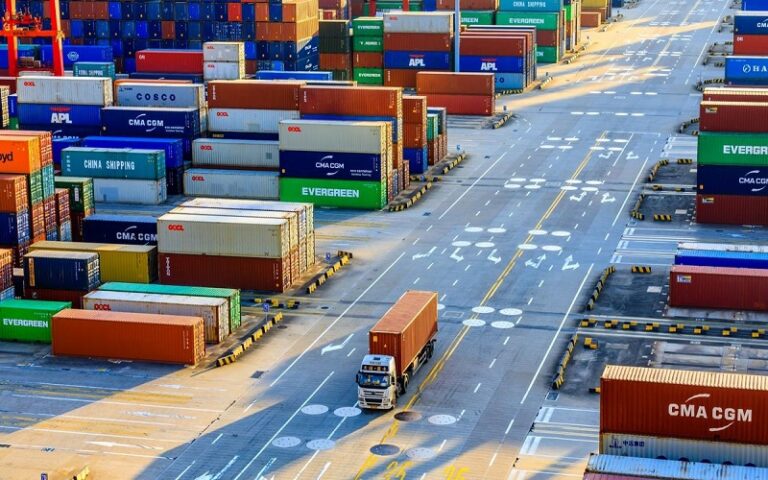
According to the data published by the Iranian regime’s customs, non-oil exports to Japan, which had reached around $1 billion in the mid-2000s and 2010s, have plummeted to about $5 million in the first six months of this year.
The state-run “90eghtesadi” website reported that considering Iran’s non-oil exports to Japan in the previous year amounted to only $12.6 million in total, this figure is “approaching zero.”
The website reported that after the signing of the nuclear agreement (JCPOA) between Iran and the West, Iran’s exports to Japan reached $1.1 billion in 2016, and in 2017 and 2018, they amounted to $422 million and $241 million, respectively.
90eghtesadi stated that this decline indicates that Japan is “adhering most” to the U.S. sanctions against Iran. However, Iran’s inclusion in the FATF blacklist also has an impact in this regard.
According to multiple published reports, Iran’s trade balance has become negative in recent years, with the value of imports surpassing non-oil exports. Customs statistics for the first five months of this year showed that the country’s non-oil exports were nearly $5 billion less than its imports.
Furthermore, from March to July 2023, Iran’s non-oil commodity exports, excluding crude oil, furnace oil, and white oil, as well as luggage trade, decreased by 7.97% and reached $15.906 billion.
Meanwhile, customs statistics from China, Iran’s largest trading partner, indicated that China’s non-oil imports from Iran fell by 43% in the first seven months of this year compared to the same period last year, reaching $2.5 billion. In contrast, China’s exports to Iran have reached a peak of $6 billion, with a growth rate of 17%.
The Iranian regime’s customs has ceased publishing official statistics on its website for the past three years and only provides a general report on non-oil trade for distribution to government media. In this way, the Iranian regime intends to present an inaccurate picture of the economy.
In the same context, the Financial Times reported on September 10 that following the easing of restrictions on the registration of Iranian companies in the United Arab Emirates and the facilitation of visa issuance, bilateral trade between the two countries has experienced significant growth, increasing from $11 billion in 2021 to $24 billion in 2022.
The point here is that according to the statistics from the Chamber of Commerce, this growth is solely due to Iran’s increased imports from the UAE. In the past year, the UAE’s exports to Iran were $18.4 billion, while UAE’s imports from Iran were only $5.7 billion.
Iranian customs statistics also show that in the first five months of this year, Iran had $2.3 billion in exports to the UAE and $7.3 billion in imports from the country.
Consequently, the trade balance heavily favors the UAE, whereas before the U.S. withdrawal from the Iran nuclear deal and the imposition of sanctions against the regime, there was a trade balance between the two countries.
Iran’s inability to revive its export volume to the UAE, despite the improved political climate in 2020 and the Biden administration’s willingness to overlook the regime’s bypassing of sanctions, indicates that Iranian traders still face significant obstacles to export growth to the UAE.
A similar situation exists with India, which was once Iran’s third-largest oil importer and a major exporter of goods to Iran. Indian Ministry of Commerce statistics show that in the first half of this year, India’s exports to Iran were around $420 million, while its imports from Iran were $276 million.
Regarding Turkey, the latest report from the Statistical Center of this country shows that in the first seven months of this year, Turkey had $1.36 billion in imports and $1.66 billion in exports to Iran.
It is not only the imbalance in foreign trade that threatens Iran’s foreign commerce but also the dependence on a few countries for a significant portion of imports and exports, which puts the security of Iran’s foreign trade at risk.
For example, customs statistics from March 21 to July 23 show that during this period, Iran’s non-oil exports were $19.3 billion, of which $14.5 billion, equivalent to 75%, went to just five countries: China, Iraq, the UAE, Turkey, and India. Iran’s imports during the same period were $24.2 billion, of which $18.6 billion, equivalent to 77%, came from only five countries: the UAE, China, Turkey, Germany, and India.
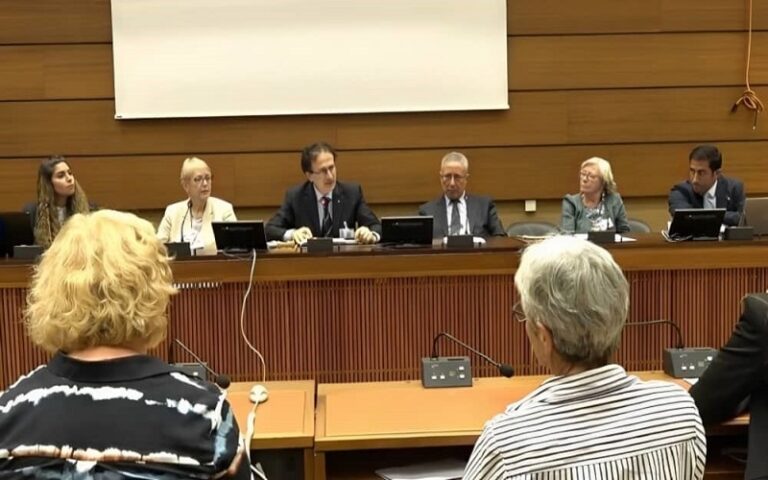
On October 5, coinciding with the fifty-fourth session of the United Nations Human Rights Council in Geneva, an important conference was held to address the severe human rights situation in Iran under the rule of the clerical dictatorship. The conference gathered international figures and human rights advocates who pressed for action on two critical issues: the extension of the United Nations Fact-Finding Mission to investigate the suppression of women-led demonstrations in 2022 and the launch of an investigation into the 1988 mass execution of political detainees in Iran.
The Grave Human Rights Situation in Iran
Antonio Stango, the President of the Italian Federation for Human Rights (FIDU) and the conference moderator, shed light on the alarming human rights situation in Iran. With his extensive experience in monitoring human rights violations globally, Mr. Stango expressed deep concern over the widespread repression within the country. He emphasized the extensive crackdown on dissent, including numerous executions and mass imprisonment of individuals participating in peaceful demonstrations. Mr. Stango referred to the events of the past year as a wave of protests akin to a revolution, underscoring the urgent need for international attention and action.
Impunity and Repression in Iran
Sonja Biserko, the President of the Helsinki Committee for Human Rights in Serbia and a former member of the UN Commission of Inquiry on Human Rights Violations in North Korea, highlighted the persistent issue of impunity in Iran. She drew attention to international reports that underscored the lack of accountability for human rights abuses committed by Iran’s security forces. Mrs. Biserko specifically emphasized the need for justice regarding the 1988 mass execution of political prisoners, where thousands lost their lives in a matter of weeks. She stressed the importance of renewing the UN Human Rights Council’s fact-finding mission to investigate the ongoing protests and called for a comprehensive investigation into the 1988 massacre. Mrs. Biserko emphasized the role of international criminal law, access to justice, and accountability in achieving peace and justice for all.
Iran’s Pattern of Denial and Repression
Tahar Boumedra, the Director of the Justice for Victims of the 1988 Massacre in Iran (JVMI) and a former Chief of UNAMI Human Rights Office, highlighted Iran’s pattern of denial and repression in response to human rights concerns. He cited the recent passing of a new hijab and chastity bill in Iran, which further restricted individual freedoms, particularly for women. Mr. Boumedra mentioned the tragic case of Mahsa Amini, a young woman who died in police custody, sparking nationwide protests. He emphasized that Iran remains bound by the International Covenant on Civil and Political Rights, ICCPR, which it signed and ratified in 1975. Mr. Boumedra called for accountability regarding the 1988 extrajudicial executions and cited the recommendations of distinguished former international judges who supported holding the perpetrators accountable. He urged the UN Human Rights Council to renew the mandates of the fact-finding mission and expand its investigation to include the 1988 massacre.
The Role of Switzerland and Urgent Global Action
Laurence Fehlmann Rielle, a Member of the National Council of Switzerland, expressed deep concern over the continued repression and lack of freedom in Iran, particularly affecting women. She highlighted the uprising following the murder of Mahsa Amini, which challenged the regime’s propaganda of resolute power. Mrs. Rielle stressed the urgency of global action to fight for the abolition of the death penalty and called on the international community to exert genuine pressure on Iran. She emphasized Switzerland’s commitment to abolishing the death penalty and urged the country to play a more robust role. Mrs. Rielle also called for a comprehensive international investigation into recent events in Iran and commended the courage of Iranian women in their pursuit of human rights and democracy.
The Urgent Need for Accountability
Kirsty Brimelow, a renowned human rights advocate and former chair of the Criminal Bar Association and the Bar Human Rights Committee of England and Wales, emphasized the urgent need for accountability regarding the 1988 massacre in Iran. She decried the extrajudicial nature of the killings, labeling them as crimes against humanity. Mrs. Brimelow pointed out that many perpetrators still hold high-ranking positions in Iran, while witnesses are disappearing and mass graves are being destroyed. She said families of the victims demand accountability and closure, urging international action. She called on the UN to establish an international tribunal for a formal investigation, emphasizing the importance of collecting evidence for potential prosecutions.
The speakers emphasized the persistent issue of impunity, the pattern of denial and repression by the Iranian regime, and the urgent need for global action. The speakers stressed the importance of accountability, access to justice, and the role of the international community in addressing the human rights situation in Iran.
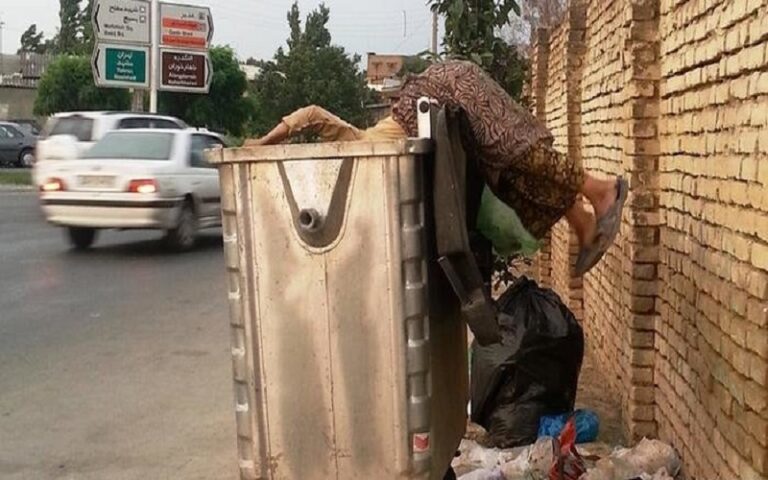
As the cost of living in Iran continues to surge, an increasing number of Iranians are facing the daunting challenge of making ends meet. Basic necessities such as food, housing, and healthcare have become increasingly elusive for a significant portion of the population.
Farshad Momeni, an economist within Iran’s regime, recently made a stark observation during a roundtable discussion with Hossein Raghfar, another economist, in September. He drew upon the economic ideas of John Maynard Keynes, particularly Keynes’ book ‘The Economic Consequences of the Peace,’ to emphasize the gravity of the situation: “When inflation surpasses conventional limits and persists, it threatens the very foundation of society. Therefore, it is imperative that those in power understand they are, in essence, digging their own graves. Large segments of the population are enduring suffering, poverty, and misery, and as a result, the social fabric is under severe strain.”
Before delving deeper into the issue, Momeni refers to the book ‘Transition to Egalitarian Development’ by Keith Griffin and Jeffrey James, highlighting that “a structural problem demands a structural solution.” He is specifically addressing the rampant double-digit inflation that has taken hold of Iran’s economy. He asserts, “When inflation persists in a country for over 50 years, it indicates a structural problem. Purely economic manipulations cannot remedy this situation. To address it effectively, there must first be a political will, which is unattainable in a system where the government and its power structure exhibit unfairness.”
In simple terms, Iran’s economic problems, which have persisted for over four decades, cannot be resolved through economic measures alone. These crises are deeply rooted in the flawed foundation of the Velayat al-Faqih system, and a comprehensive, structural solution is required.
Momeni refrains from defining the term ‘structural solution’ explicitly, suggesting that it falls outside his purview and is a sensitive topic. Instead, he contends that the government and its power structure lack the political will to address this critical issue.
This statement implicitly acknowledges that resolving Iran’s economic and social woes hinges on challenging the very political structure of Velayat-e Faghih—a sentiment expressed by the People’s Mojahedin Organization of Iran (PMOI/MEK) since the inception of this regime. Despite changing governments, from the so-called reformist faction to the principlists, the core structure of this system, characterized by corruption and systematic looting, remains unchanged. Momeni makes this point clear:
“For more than 30 years, successive governments in Iran have displayed starkly different appearances and slogans from their predecessors. Yet, they have all implemented the same economic policy package. This is not haphazard; it is a calculated move. Iran’s economy is ensnared in a triple alliance dominated by shortsightedness and mafia-style dealings. Rentier, unproductive, and mercenary sectors readily sacrifice long-term national interests for short-term gains, while nationalist neoclassicals provide justifications for these mafia-like relationships. Consequently, it is evident that if a reckoning were to occur, the fallacies propagated in the name of marketism in Iran, which serve to legitimize these corrupt relationships, would crumble.”
The root cause of these issues, as pointed out by the regime’s supreme leader Ali Khamenei, is the “seven-headed dragon of corruption.”
Furthermore, Momeni sheds light on the role of counterfeit money in Iran’s economy, relying on official reports: “For the past two decades, fake currency has accounted for between 75% and 85% of Iran’s economy. The most alarming aspect is the enormous scale of this counterfeit money, with 75% of deposits belonging to just 1% of depositors. This glaring and unjustified wealth disparity is a testament to the deeply abnormal distribution of wealth.”
Recognizing the “most terrible, most violent, and most blatant justified inequality” within Iranian society, he expresses his apprehension about the potential consequences: “In a situation where unjustified inequalities surpass conventional limits, no one is safe—neither the rulers, the wealthy, nor the marginalized.”
Perhaps one of the most enlightening moments of the roundtable is Momeni’s advice to those in power: “Take heed of what Keynes emphasizes, for he is the savior of the capitalist system. He is simply warning that those who have vested interests in inflationary policies are essentially preparing an all-encompassing grave to bury a civilization.”
It is evident that such well-intentioned advice alone will not resolve the regime’s myriad problems. The tremors of multiple nationwide uprisings foreshadow a seismic shift in Iranian society. The main power brokers have, in many ways, sealed their own fates long ago.
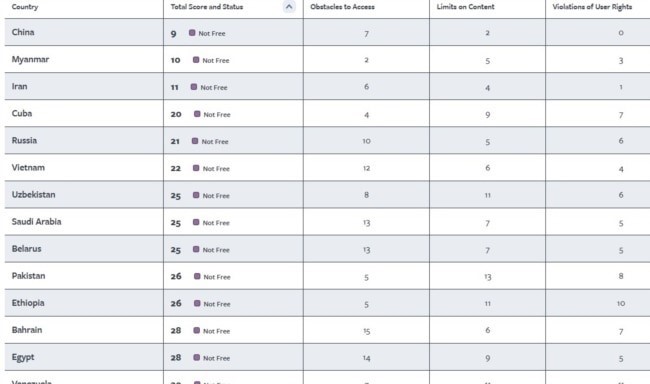
In a report, the non-governmental organization Freedom House announced that Iran had the worst decline in internet freedom worldwide in 2023, with a score of negative five out of 100 on the scale. The report indicates that digital repression in the country has intensified.
According to the report, following the murder of Mahsa (Zhina) Amini in the custody of the “Morality Police,” the Iranian regime experienced the greatest regression in internet freedom evaluation worldwide. This regression was attributed to the internet shutdown, blocking of WhatsApp and Instagram, increased surveillance, and monitoring to suppress anti-government protests.
Furthermore, Iran, along with Myanmar, was identified as a country where authorities have imposed the death penalty for citizens expressing their opinions online. The report also mentioned the execution of two Iranians for blasphemy following the publication of materials on Telegram channels.
The report highlights the cases of Yousef Mehrdad and Sadrollah Fazeli Zare, two active social media users who were executed on May 8th on charges of “insulting Islamic sanctities” and insulting the “Prophet of Islam”. Human rights sources emphasized that these individuals were merely criticizing religious superstitions.
The state-run Mizan News Agency, affiliated with the regime’s judiciary, reported the execution of these two individuals, stating that Yousef Mehrdad was arrested in Ardebil and Sadrollah Fazeli Zare was arrested in Yasuj, both after the formation of a case in the Revolutionary Court in Arak in 2020. Yousef Mehrdad was the father of three young children, and Sadrollah Fazeli was the caretaker of his elderly mother.
According to the report, in terms of the decline in internet freedom in 2023, following Iran, the Philippines had a score of negative four, and Belarus, Costa Rica, and Nicaragua each had a score of negative three.
Based on this report, in 55 out of the 70 countries surveyed, individuals faced legal prosecution for expressing their opinions online, and in 41 countries, people were physically attacked or killed for expressing their opinions in the online space.
Furthermore, governments of 41 countries blocked websites that should be allowed to operate under the standards of freedom of expression outlined in international human rights law.
The report concluded that the decline in internet freedom worldwide has continued for the thirteenth consecutive year, with 27 countries experiencing a worsening situation and only 22 countries showing improvement.
In the previous year’s Freedom House report, it was stated that Iran, after China and Myanmar, imposed the most restrictions on the internet.
While Iran’s economy is declining and the lives of a large part of the population is spiraling into poverty, the regime continues to invest vast sums into internet censorship and surveillance. After the 2019 nationwide uprising, the regime spent a huge budget in creating a complex infrastructure for cutting off internet access during protests. At the same time, the regime is trying to replace popular messaging applications with local insecure apps that allow authorities to peer into the communications of users. All of these endeavors are being paid for from the pockets of the Iranian people.
Iran’s score in internet freedom in 2023 (on a scale of 100 points) is negative 5 (per Freedom House).
Socioeconomic protests in Iran continue by various sections and classes, including strikes by workers in Abadan Petrochemical and Razi Petrochemical, temporary contract employees of the Ministry of Oil, and farmers in Parsabad.
According to social media reports, the employees and workers of Abadan Petrochemical went on strike on October 4, protesting officials’ failure to pay their delayed salaries and benefits.
On October 1st, they also gathered in front of the central office of Abadan Petrochemical Company, demanding “clarification from the CEO regarding bankruptcy” of this industrial unit.
According to a report by Aftab News on Monday, September 30th, Abadan Petrochemical Company has declared bankruptcy with a reported debt of “29,460 billion rials,” (approximately $60 million) which is approximately “three times its capital.”
Similarly, contract workers of Razi Petrochemical in the “Imam Khomeini Special Economic Zone” have been on strike since September 29th.
They are protesting their delayed payments and significant discrimination in the allocation of welfare benefits among official and contractual workers by the company.
Not only have the officials of Razi Company failed to addressed the demands of the striking workers, but they also employ various methods to put pressure on workers. For instance, they refrain from providing meals to the striking workers.
Temporary contract employees of the Ministry of Oil gathered in front of the Ahvaz Oil-Rich Regions Company and Iranian Offshore Oil Company and demanded a change in their contract status to “fixed-term.”
These protesters also demanded “empowerment and employment capability against non-essential organizational positions,” full implementation of the January 2023 Administrative and Employment Resolution of the Oil Industry regarding “special and specialized bonuses,” as well as the payment of “workers’ annual bonuses” and “buying back unused leave according to labor law.”
“Calculating overtime and productivity bonuses according to fixed-term personnel” and “granting educational bonuses to employees’ children” are among the other demands of this group of Ministry of Oil employees.
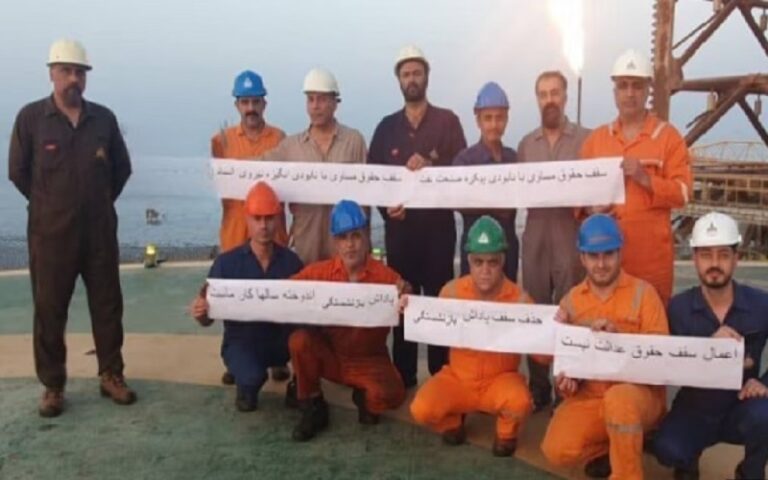
In recent days, some employees of Iranian Offshore Oil Company and Pars Oil and Gas Company have also held protest gatherings on oil platforms.
According to the Afkare Naft news website, they considered the determination of a “salary ceiling” as “equivalent to the destruction of the oil industry structure and the demotivation of human resources,” and demanded the “elimination of retirement bonus ceiling.”
According to another report, some farmers in Parsabad, Ardabil province, gathered in front of the Moghan Cultivation and Industry Company.
These farmers, while holding receipts for wheat seed payments, stated that despite receiving the funds, the company has not yet delivered the seeds to them.
The socioeconomic crisis in Iran continues, and a member of the regime’s Majlis (parliament) has admitted that the protests have not subsided. These protests are taking place against the backdrop of a tumultuous year of nationwide uprisings, with Iranians in hundreds of cities calling for the overthrow of the mullahs’ rule due to four decades of corruption, repression, and mismanagement.
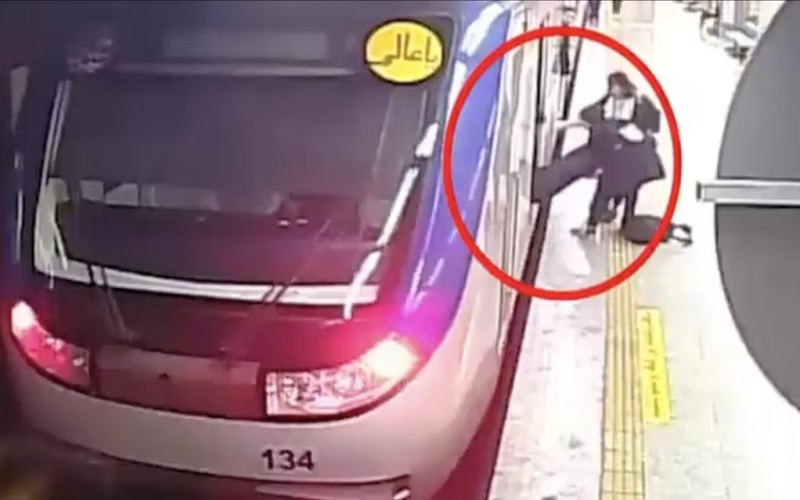
On October 1st, a16-year-old schoolgirl was transferred outside the car while unconscious, moments after entering the subway with her friends. A video released by the Tehran Subway company shows that shortly after Armita Geravand entered the subway car, was transferred outside by several individuals while unconscious. However, news circulating on social media suggests that security agents pushed her because she was not wearing a hijab, resulting in her head hitting a metal bar and becoming unconscious. After the incident, she was transferred to Fajr Hospital, and no one is allowed to approach her.
Armita was transferred outside by several individuals while unconscious..
On October 2, the CEO of the Tehran subway, simultaneously with the release of a video, said, “Around 7 a.m. on Monday, a 16-year-old schoolgirl entered the train on Line 4 at Shahid Square and became unconscious due to a drop in pressure. This person was transferred outside the train by her friends and another passenger, who was probably a doctor.”
He added, “Immediately, the subway’s operational agents initiated initial medical treatments on her and requested assistance from the emergency services. The emergency team arrived at the scene immediately and, after initial interventions and stabilizing her condition, transferred her to the hospital.”
He claimed that this student had no verbal or physical altercation with passengers or Subway staff.
However, the release of this video raised further ambiguities, as some users on social networks questioned why the video of the moment of entry and before that was not released. Some also questioned the authenticity of the video because no timestamp was visible. The ambiguities increased when the news of the arrest of Maryam Lotfi, a journalist from the state-run Shargh newspaper, was published. According to the newspaper’s officials, she had gone to Fajr Hospital to prepare a report on the incident but was detained by security forces. Although she was released on Tuesday night, the report she was working on was not published.
ماجرای دختر نوجوانی که در متروی تهران بیهوش شد
مدیر عامل شرکت مترو تهران در گفتوگو با ایرنا: مقارن ساعت ۷ صبح روز یکشنبه نهم مهر ماه یک دختر دانش اموز ۱۶ساله در خط ۴مترو میدان شهدا وارد قطار شده که به دلیل افت فشار بیهوش شد pic.twitter.com/twMbCjTKK8
Some journalists on Twitter said that she was detained while she was talking to the mother of this student. This incident led to the parents of this student being put in front of the cameras of government media on Wednesday.
The mother and father of this girl, whose name had not been released until Wednesday morning, appeared in front of the camera of the official news agency, IRNA, and said, “I don’t think what people are saying is true.”
The Iranian regime has a long history of obtaining forced confessions and broadcasting them on national television. The parents were visibly shaken in the video.
The mother, however, expressed doubt and said, “I think in that place [subway], my daughter had a drop in her blood pressure. I think they said her blood pressure dropped. Then her head hit the edge of the subway.”
The parents of the girl stated that they reviewed the subway videos and do not believe what people are saying to be true.
The mother mentioned that she saw images of how her daughter fell.
The Tehran Subway has not released any videos showing the moment of the incident or before.
With the identification of the girl, the Tehran Subway released another video from a different angle of the incident that day. However, this video does not show the inside of the subway car. It was taken from cameras on the opposite platform and shows several student girls waiting for the train on the subway seats. The trains on both sides arrive simultaneously, the footage cuts, and then shows the images of the students being taken out and Armita being pulled out the day before. The camera on the side where the students boarded the train has not shown the time of their boarding so far.
Some describe the girl’s consciousness as low, and it is said that the surroundings of the hospital are completely secure.
Security and state-run medias have also extended their reactions. The Tehran Municipality newspaper, Hamshahri, wrote: “If you have boarded the subway and are a daily passenger of this vehicle, you will witness that law enforcement officers in the subway only verbally express a sentence of hijab observance without any verbal or physical confrontation with norm-breakers.”
In response to this issue, Annalena Baerbock, the German Foreign Minister, said: “A young woman in Iran is fighting for her life once again. Only because her hair was visible on the subway. This is intolerable. The parents of Armita Garawand should not be in front of the camera, but they have the right to be by their daughter’s bedside.”
Schon wieder kämpft eine junge Frau in #Iran um ihr Leben. Allein, weil sie in der U-Bahn ihre Haare gezeigt hat. Es ist unerträglich. Die Eltern von #ArmitaGarawand gehören nicht vor Kameras gezogen, sondern haben das Recht, am Krankenbett ihrer Tochter zu sein.
— Außenministerin Annalena Baerbock (@ABaerbock) October 4, 2023
Last year, 22-year-old Mahsa Amini was also in a similar situation after an encounter with the security forces known as “Gasht-e Ershad” or “Morality Police” over the hijab. She died as a result of the assault by the security forces. Her death sparked widespread street protests in Iran and abroad, leading to international condemnation of the Iranian regime. In last year’s protests, more than 750 people were killed, and the Iranian regime executed seven individuals for participating in the demonstrations. Tens of thousands of people were also imprisoned on the same charge.
Iranian media reported a collective resignation of professors at Sharif University of Technology on the eve of the anniversary of the attack by security forces on the university. According to the state-run Shargh newspaper, members of the faculty council of Sharif University, including the council’s secretary, resigned collectively.
Reports indicate that this collective action, which led to the “dissolution” of the council, took place on the eve of the anniversary of the attack on Sharif University on October 2, 2022.
In this regard, Vahid Karimipour, a professor at the Faculty of Physics and the secretary of the faculty council, announced his decision in a letter, citing “summons by an external entity” as the reason for his resignation.
In his letter, he stated, “This council was formed with the aim of optimizing the use of faculty opinions and assisting university management in better administration of university affairs.” He added, “From the beginning, all members of this council believed that they could fulfill this duty through constructive negotiations with university management and within the university.”
Karimipour further emphasized that he “did not expect that carrying out this university duty would result in an invitation from an external [security] entity for negotiations regarding university issues.” He stated, “Naturally, while welcoming such negotiations in his office, he considers attending an institution outside the university as contrary to respecting the position of all university professors in general.”
After Vahid Karimipour’s resignation from the position of secretary and membership in the faculty council of Sharif University, Saeed Shahrokhyan, a professor at the Faculty of Chemistry, and Farzin Jafarzadeh, a professor at the Faculty of Civil Engineering, also resigned from their membership in the council. They also cited reasons such as “lack of atmosphere and suitable conditions for carrying out the duties of the faculty council” and “the need for peace and sufficient focus on educational and research activities” for their resignations.
The resignations of the members of the faculty council of Sharif University continued on September 30, and Sohrab Rahvar, a professor at the Faculty of Physics, and Ali Abedian, a professor at the Faculty of Aerospace Engineering of the university, also resigned from the “Sharif University Faculty Council.”
Last year, during the nationwide protests that escalated after the killing of Mahsa Amini while in the custody of the “Morality Police,” a peaceful gathering of students at Sharif University of Technology on Monday, October 2, 2020, was confronted by security forces, Basij, and plainclothes agents. At least 40 people were detained in the attack on Sharif University. Attacks and shootings at the dormitories of Sharif University and the university parking lot were also reported, and some students on the campus were besieged by security forces.
After the attack on this university, student guild councils across the country announced in a statement that security forces had detained and transferred a group of students to an unknown location.
A few hours after the attack on Sharif University, the Islamic Student Association of the university called for protests and strikes by all students and university members in the country.
On October 3, 2022, the “Aftab News” website reported on the events at Sharif University, stating that the “Minister of Science” was present at the university, and there was a “heated exchange” and “threatening tone” between the minister and the students.
“Aftab News” described the attack by stating that published images and videos of the incidents at Sharif University showed that some motorcyclists had entered the university and attempted to detain students, and “gunfire was also heard.”
In recent weeks, with the start of the academic year in Iran, a fresh wave of restrictions has begun in universities, ranging from preventing the entry of certain students to the installation of face recognition cameras and the expansion of gender segregation in university environments.
Prior to the start of the academic year and on the eve of the anniversary of Mahsa Amini’s death, various reports of the expulsion of critical professors were published, citing reasons such as “termination of cooperation,” “cancellation of contracts,” or disqualification by “security authorities.”
These seven professors were elected as members of the “Faculty Guild Council” of Sharif University with a vote of 160 professors in the November of last year.
The tragic event known as “Bloody Friday in Zahedan” refers to the devastating massacre of the Baluch people by the Iranian regime security forces on September 30, 2022. It bears a haunting resemblance to the infamous “Black Friday” of September 8, 1978, when the shah dictatorship sought to suppress anti-regime protests on the build-up to the 1979 revolution. Astonishingly, 44 years later, the ruling clerics repeated this fatal mistake, committing a crime on Zahedan’s Bloody Friday.
The regime’s supreme Leader Ali Khamenei mistakenly believed that he could quell the nationwide uprising by brutally targeting the most deprived and impoverished segments of society, who had nothing to lose but their already miserable lives.
On that fateful day, thousands of Baluch citizens, demanding justice and equality, were mercilessly shot by security forces, paramilitary units, and snipers positioned on rooftops. Countless videos capturing this atrocious crime were recorded and widely shared on social media. Through these harrowing visuals, the people of Iran witnessed Baluch worshipers and innocent passersby drenched in their own blood, desperately calling for help amidst the chaos and horror.
This flagrant crime against humanity claimed the lives of 120 Baluchi citizens, while more than 300 others were left injured, including four women and 17 children.
Similarly, on November 4, 2022, in Khash, the people experienced another bloodbath. Security forces ruthlessly killed 18 individuals, including two children.
The wounds inflicted by Zahedan’s Bloody Friday and the tragedy in Khash continue to deeply affect Baluchestan and its people. The children of Baluchestan, victims of long-standing deprivation and corruption under the ruling clerics, remain unaware of why their family members were brutally killed after the Friday prayer sermon on September 30, 2022. Mothers in this troubled region still mourn the loss of their loved ones. Many families have lost their breadwinners, and numerous wounded individuals have been disabled indefinitely.
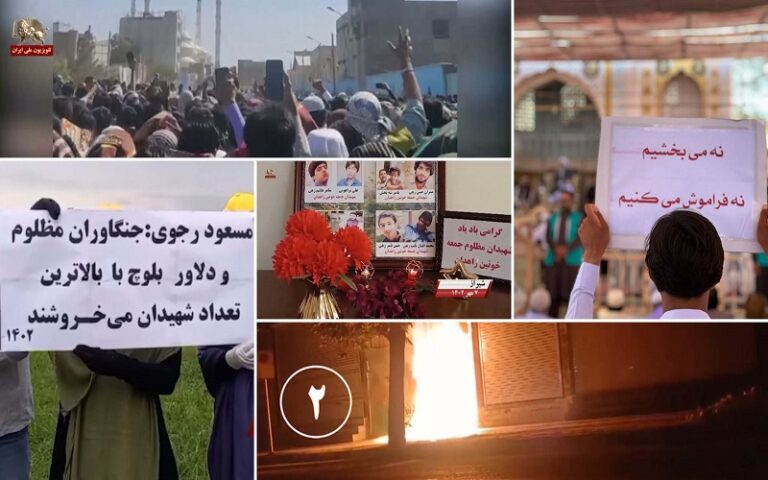
On the first anniversary of Zahedan’s Bloody Friday massacre, people in various cities throughout Sistan and Baluchestan province defiantly organized protest rallies against the regime. Despite the regime’s deployment of extensive security measures and a heavy presence of security forces, particularly in Zahedan, these rallies boldly took place. The regime had even dispatched anti-riot forces and deployed heavy weaponry in an attempt to suppress any form of protest.
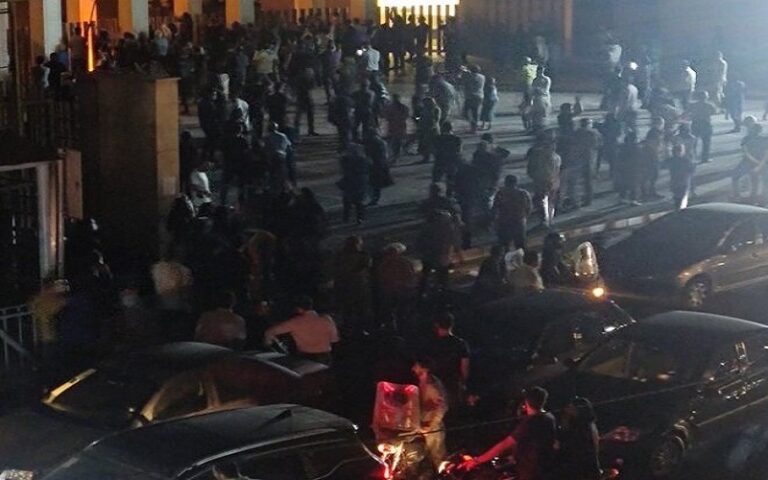
On September 29, 2023, in Zahedan, a sizable crowd gathered near the Makki Mosque to honor the victims of the tragic massacre. They resolutely chanted anti-regime slogans, defying the oppressive atmosphere that surrounded them.
Protesters were chanting:
“I will avenge my murdered brother!”
“Death to the tyrant, be it the shah or the mullahs!”
“Death to Khamenei!”
“Death to the Basij!”
In response to the protests, the regime opted for a repressive approach. NetBlocks, an organization that monitors global internet connectivity, reported that the regime imposed restrictions on internet access in Zahedan and other areas of Sistan and Baluchestan. This deliberate action aimed to limit the flow of information and further suppress dissent.
⚠️ Confirmed: Metrics show a significant to disruption to internet connectivity in Zahedan, Sistan and Baluchistan in #Iran, on the first anniversary of the "Bloody Friday" massacre; authorities have systematically shut down telecoms to suppress weekly anti-government protests 📉 pic.twitter.com/h5HBrShCo8
In Zahedan, the tense situation escalated as security forces launched a violent assault on the protesters, using firearms and tear gas. Numerous videos captured the disturbing scenes of security forces firing upon the demonstrators.
However, the courageous people of Zahedan showed incredible resilience, confronting the security forces with nothing but their bare hands and managing to force them into retreat. Initial reports indicate that a significant number of individuals, including several children, sustained injuries as a result of the security forces’ actions.
In the aftermath of Bloody Friday, the Baluch people have continued to demonstrate their unwavering spirit by organizing regular protest rallies every Friday. The regime’s attempts to intimidate and suppress the people’s yearning for freedom have proven increasingly futile, as their determination remains unshaken.
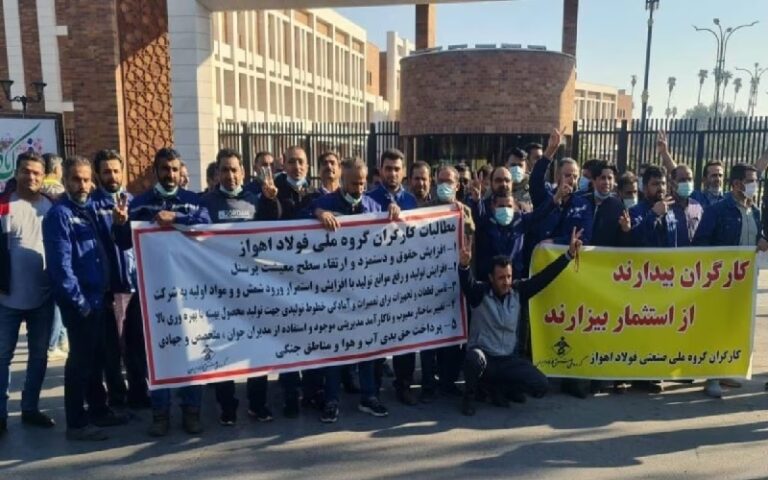
Seventeen workers of Iran National Steel Industrial Group have been sentenced to flogging and imprisonment by the judicial system of the Iranian regime due to their protests against economic conditions. According to the state-run ILNA news agency on September 27, the revolutionary court in Ahvaz issued these sentences based on a report from the State Security Forces and a complaint filed by “Shafagh Rahian Axin Industrial and Commercial Company S.R.O.,” the employer of Iran’s Steel Company, and the company’s security.
ILNA published the names of these protesting workers and stated that they were charged with “disturbing public order through creating turmoil and commotion” during last year’s protests.
The court found them guilty and sentenced each of them to “paying a fine of 25 million rials (approximately $50) to the government treasury instead of three months of disciplinary imprisonment, and receiving 74 lashes.”
These workers had protested against the management of the company and their own legal situation in 2022. Iran’s Steel Company is one of the economic entities owned by Amir Mansour Aria Investment Group. After the judicial investigation of a 30 trillion rials (approximately $60 million) embezzlement case, the temporary management of the company was handed over to the judiciary and later to the Central Bank.
The conviction of these workers comes at a time when workers across the country have repeatedly protested against their living conditions and the management of relevant companies.
The workers of Iran’s Steel Company have also engaged in numerous protest gatherings and strikes in the past, and they have often been targeted by security forces.
In December 2020, Davoud Rafiei, a worker who protested against his dismissal from Pars Khodro Company, received 74 lashes on the charge of “insulting” the Minister of Labor.
In another case in June of the same year, Rouhollah Barzin, a bakery worker in the city of Choram, received 55 lashes for publishing critical content on social media.
Rasoul Taleb Moghadam, a member of the Bus company’s labor union who had been sentenced to two years in prison in June 2020, received 74 lashes and was sent to prison.
Prior to that, in January 2015, 17 protesting workers in West Azerbaijan were sentenced to 30 to 100 lashes on various charges.
The judicial authorities of the regime have defended the issuance of flogging sentences against workers in some of these cases, which has faced strong protests from trade unions and workers’ supporters.
Furthermore, in recent years, the judicial system of the Iranian regime has arrested a large number of labor activists and imprisoned them on political charges.