Iran: 24 Executions in Two DaysAccording to published data, ninety-five people including two women were executed during this same week. Between November 22 and December 8, more than two hundred executions were recorded, with the sole purpose of suppressing society and blocking popular uprisings. The full text of the statement for the ninety-eighth week of the “No to Execution Tuesdays” campaign is provided below: The continuation of the “No to Execution Tuesdays” campaign in its ninety-eighth week across fifty-five different prisons This week, one of the most dedicated justice-seeking lawyers, Khosro Alikordi—an active supporter of the “No to Execution Tuesdays” campaign, the attorney of detainees from the nationwide 2022 protests, and a source of refuge for bereaved families—died under suspicious circumstances. We sincerely offer condolences for this great loss to freedom-seeking lawyers, to all who seek justice, and to his family, friends, and colleagues. Today, the issue of executions in Iran is not a form of punishment but an organized crime and a systematic violation of the right to life. Official notification of the death sentence for Karim Khoshjasteh; growing concerns about the judicial process and transparency of the case In recent days, the political prisoner Karim Khoshjasteh, held in Lakan Prison in the city of Rasht, was officially informed of his death sentence. According to published data, ninety-five people including two women were executed during this same week. Between November 22 and December 8, more than two hundred executions were recorded, with the sole purpose of suppressing society and blocking popular uprisings. On Tuesday, December 9, 2025, the “No to Execution Tuesdays” campaign entered its ninety-eighth week, with prisoners in fifty-five prisons across the country continuing their hunger strike.
98th Week of the “No To Execution Tuesdays” Campaign in 55 Prisons Across Iran
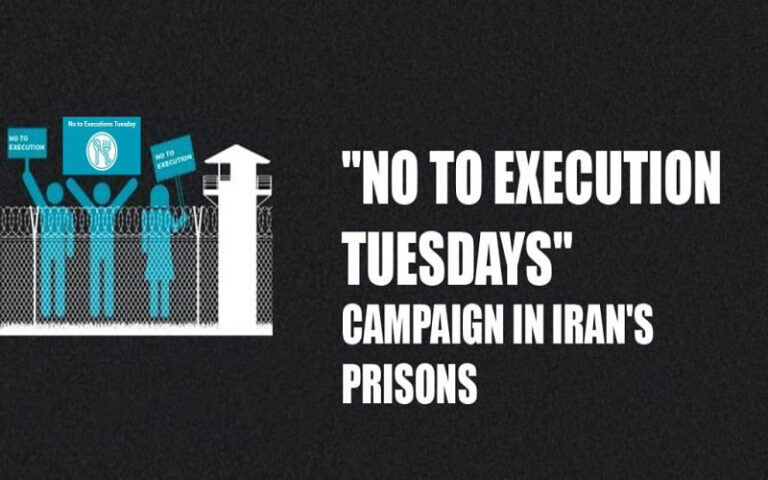
The 98th week of the “No to Execution Tuesdays” campaign has continued in fifty-five prisons across Iran with a hunger strike by participating prisoners.
The 98th week of the “No to Execution Tuesdays” campaign has continued in fifty-five prisons across the country with a hunger strike by prisoners. The prisoners participating in the hunger strike honored the memory of the justice-seeking attorney Khosro Alikordi and offered condolences to his family, friends, and colleagues. He had represented those arrested during the nationwide 2022 protests.
Stocks of Hundreds of Medicines in Iran Have Fallen Below Three Months
Iranian pharmaceutical officials, warning of an escalating medicine shortage crisis, have stated that stocks of hundreds of medicines in the country have fallen to below one to three months. At the same time, the director-general of drugs and controlled substances at the regime’s Food and Drug Organization announced that the country’s pharmaceutical system is in “the worst possible condition” in terms of foreign currency and rial funding.
Akbar Abdollahi-Asl, speaking on the sidelines of a meeting held on Sunday, December 7, with the Association of Pharmaceutical Distribution Companies, said that out of roughly three thousand medicines on the country’s official list, 195 have less than one month of stock, 360 have less than two months, and 270 have less than three months.
Drug and Medical Equipment Prices Jump 70% in IranHe said this situation could be dangerous, meaning that nearly 800 medicines awaiting the allocation of foreign currency and rial funding are at risk of shortage in the coming months. He added that among essential hospital medicines, at least 21 items are experiencing shortages, and 56 additional essential non-hospital medicines are also on the shortage list. The director-general added that strategic medicine reserves are typically maintained during stable periods to prepare for unstable times, but at present, the country’s pharmaceutical system is “in the worst possible condition in terms of currency and rial resources.” This is not the first time reports have emerged about medicine shortages, liquidity crises, and the failure to secure the foreign currency required for drug imports in Iran. In one of the latest examples, on December 6, Amin Afshar, head of the Iranian Hemophilia Society, said: “Imports of some vital medicines for hemophilia and coagulation disorder patients have stopped, and for certain items we have now reached the end of emergency reserves.” On November 26, Mehdi Pirsalehi, head of the Food and Drug Organization, also announced that due to currency shortages and disruptions in foreign exchange resources, the supply chain for medicine and infant formula has entered a crisis.
Severe liquidity crisis
Alongside the currency crisis, pharmaceutical industry representatives at the December 7 meeting described a severe liquidity shortage as another factor threatening medicine supply. Ebrahim Hashemi, chairman of the Board of the Association of Drug and Supplement Distribution Companies, said the entire medicine supply chain is under “extremely difficult financial conditions,” and that outstanding payments owed to distribution companies by the pharmaceutical market had reached about 1.57 quadrillion rials (approximately USD 1.308 billion) by late November. Hashemi added that pharmacies and distribution companies have not received a significant portion of their payments from insurance organizations and government entities: “More than 310 trillion rials (approximately USD 258.3 million) of these claims relate to medical universities, and the total government debt—including social security, the Red Crescent, and insurance entities—has reached about 470 trillion rials (approximately USD 391.66 million).” He warned that if these resources are not provided, the production and import of essential medicines will face serious difficulties.The loss of strategic medicine reserves
Shahram Kalantari, head of the regime’s Pharmacists Association, said about 70% of medicine distribution in the country is carried out by the private sector, but insurance organizations collectively owe nearly 400 trillion rials (approximately USD 333.3 million) to private pharmacies. He added that every currency fluctuation imposes about 400 to 500 trillion rials (approximately USD 333.3 to 416.6 million) in losses on these pharmacies, and therefore their purchasing power and ability to restock medicines are rapidly diminishing. According to him, in recent months the shelves and storage rooms of pharmacies have become “emptier,” and strategic medicine reserves are effectively being depleted. These warnings come amid months of reports pointing to increased pressure on patients due to medicine shortages and soaring drug prices. On November 16, Ahmad Aryaeinejad, a member of the Health Commission of Iran’s regime parliament, said that due to the high cost of medicine and doctor visits, many low-income individuals are forgoing medical care and medication, and are forced either to live with their illnesses or turn to herbal remedies.Iran: 24 Executions in Two Days
Human-rights media outlets reported the execution of at least twenty-four prisoners in Iranian prisons over a two-day period. These numbers show that in just two days, an average of at least twelve people per day—and one person every two hours—were executed across Iran.
These individuals were hanged on Saturday, December 6, and Sunday, December 7, in various prisons across Iran, including the cities of Arak, Aligudarz, Bandar Abbas, Borujerd, Saveh, Semnan, Sanandaj, Qom, Qazvin, Karaj, Kermanshah, Khorramabad, Dezful, Rasht, Gorgan, Hamedan, and Neyshabur.
97th Week of Iran’s ‘No To Execution Tuesdays’ Campaign in Fifty-Five PrisonsThe news of these executions was published by several human-rights sources, including HRANA, the Iran Human Rights Society, and Hirkani. Inside Iran, state-run news agencies reported only one of the cases. Twenty-three of the prisoners were executed on charges of “murder” or “possession or transport of narcotics,” and one person was executed in connection with an economic case involving the company “Rezaayat Khodro Taravat Novin.” Given that many executions in Iranian prisons are carried out secretly and reported to human-rights organizations with delay, the current figures represent only a minimum estimate of the reality. Under these circumstances, and due to systemic secrecy within the judicial apparatus of Iran’s regime, many execution cases are typically identified and recorded only days, weeks, or even months later. Earlier, the National Council of Resistance of Iran (NCRI) had announced that Iran’s regime hanged at least 355 people in prisons across the country during November, two of which were carried out in public. NCRI added: “The number of executions this month was more than double the 155 in 2024, three times the 115 in 2023, six times the 57 in 2022, and eleven times the 30 in 2021.” The human-rights website Iran Human Rights Monitor also reported that in 2025, Iran’s regime executed 1,176 people. The rise in the issuance, confirmation, and implementation of execution sentences in recent months has triggered widespread protests both inside and outside the country. On November 21, the United Kingdom’s Foreign Office issued a statement calling for the immediate halt of executions in Iran. On November 19, the Third Committee of the United Nations General Assembly adopted a resolution condemning human-rights violations in Iran, with seventy-nine votes in favor and twenty-eight against. This year’s text placed greater emphasis on executions, women’s rights, the suppression of protesters, and cross-border repression.
Message by Imprisoned Iranian Student Ehsan Faridi: Freedom cannot be imposed from outside
Ehsan Faridi, a twenty-two-year-old student of Manufacturing Engineering at the Technical Faculty of the University of Tabriz — who has been sentenced to death on charges of “waging war against God” and “corruption on earth” — called on students to stand firm and resist in a statement issued from Tabriz Central Prison on the occasion of Student Day. He emphasized that freedom arises only from the inner will and conviction of Iran’s young generation, not from foreign interference or external imposition.
Imprisoned Students Iranian Students: Break The Silence, Rise For FreedomIn this statement, which was released today, December 7, coinciding with Student Day, Faridi honored the memory of the victims of December 7, 1953 — the day three students were killed by security forces under the monarchy during protests at the University of Tehran — and wrote: “In the name of justice and freedom. On the occasion of December 7, Student Day — the day when, following the disgraceful coup of August 19, 1953, the booted soldiers of Mohammad Reza Pahlavi suppressed and killed students to please their masters and extinguish the last glimmer of hope for freedom — I send greetings to all the brave students and professors of my homeland; those who, under the heavy shadow of repression and injustice, chose to raise their voices and kept the torch of awareness burning.” Criticizing what he called the “ominous triangle of reaction, despotism, and colonialism,” which he said usurps the people’s rights through deceptive slogans, he added: “But we know well that freedom cannot be imposed from outside; it will arise only from the faith and will of these very students and the people of our land.”
Iran’s Student Movement Cannot Be Silenced: Voices Rise Again on Student DayAddressing his peers, Faridi stressed: “Our measure is neither titles nor degrees; only our steadfastness will show how we emerge from this test. You are the living hope of this land. You will build Iran’s future; you who believe in freedom, who do not bargain away the truth, and who in the hardest moments choose to stand rather than surrender to forgetfulness or compromise.” This imprisoned student, whose death sentence has been upheld by the regime’s Supreme Court, concluded his statement by writing: “If we have managed to endure the bitter days of prison, it has been because of you; because of your solidarity… Stay strong, for tomorrow’s Iran will not be born from decrees and walls, but from your belief in human dignity. You will write the future; you who, even in captivity, are freer than those who have imprisoned the freedom of the people.”
Iran’s Student Movement Cannot Be Silenced: Voices Rise Again on Student Day
Coinciding with Student Day on December 7, student and labor activists in Iran emphasized that the student movement cannot be silenced and stressed the need to continue and intensify political struggles aimed at overthrowing the mullahs’ regime.
A group of students from Tehran University of Medical Sciences wrote in a statement published on Telegram channels: “The arrest of our classmates, including Pouya Ghobadi and Vahid Bani-Amrian, and the placing of Ehsan Faridi under a death sentence, is a symbol of the alarming situation that has disrupted the natural functioning of the university.”
UN Rapporteur Warns About Execution of Six Iranian Political PrisonersThey said: “We do not accept Pezeshkian (the president of Iran’s regime) on our campus. What does he want to come here to talk about? Student Day belongs to us, the students… Pezeshkian has no place at the university and has no right to use the university platform for his usual lies.” The Islamic Students Association of Khajeh Nasir Toosi University reported last month that between September 2022 and September 2024, more than 5,000 disciplinary cases were opened in Iranian universities, of which around 500 resulted in final verdicts including suspension, loss of academic terms, educational exile, and expulsion. Since its establishment in Iran, the Iranian regime has consistently arrested, tortured, or expelled students and professors who criticized the government. Security and judicial crackdowns, along with disciplinary punishments against students, have intensified across universities in Iran since the nationwide protests following the death of Zhina (Mahsa) Amini in the custody of the morality police in September 2022 and the expansion of student protests thereafter.
Iranian Political Prisoner Sentenced to Death as Regime Authorities Force His Family Into SilenceSince then, numerous reports have documented coercive actions against students, including expulsions, suspensions, and academic bans. According to reports, more than 12,000 students were arrested, suspended, expelled, subjected to educational exile, or stripped of their dormitory accommodation during the nationwide protests. After the mullahs took power in Iran following the 1979 revolution, universities effectively became venues for political, ideological, and even personal purges by ruling authorities and regime loyalists against dissenting professors, students, and even university staff. The regime sought to use organizations such as the Student Basij, Academic Jihad, the Office for Strengthening Unity, and the Supreme Council of the Cultural Revolution to systematically and deliberately purge and expel many independent or dissenting students and professors from universities, and to prevent any opposing voice from entering academic spaces. The student movement, along with workers, teachers, nurses, retirees, women, and others, has its own demands, many of which fundamentally overlap. The connection among these demanding and protesting groups is the Achilles’ heel not only of the Iranian regime but of all authoritarian and dictatorial systems.
“The student movement cannot be silenced”
The Retirees’ Union, a labor-based organization, wrote in a statement on Saturday, December 6, commemorating Student Day — marked annually by students since 1953 — that: “After the 1979 revolution, despite the systematic repression of the Cultural Revolution, the expulsions, the purges, and the attempts to control the university environment, the student movement has repeatedly shown that it cannot be silenced — not by closures, not by censorship, and not by creating an atmosphere of intimidation.” The Retirees’ Union referred to the July 9, 1999, student protests, the 2009 protests, the student presence in the 2017 and 2019 uprisings, their “leading role” in the 2022 nationwide uprising, and dozens of other civil and labor actions, calling them “proof that this tradition of struggle is alive.” This labor group added that despite the regime’s various measures to permanently halt the “heartbeat of the student movement,” students’ resistance “showed once more — precisely on the day when they thought the university no longer had the strength to protest — that the student movement is not only alive but, in these critical moments of Iran’s history, is once again demonstrating its capacity for renewal in the face of the current tyranny.” The Retirees’ Union emphasized that students, alongside workers, women, teachers, retirees, and other social groups, are an inseparable part of the people’s struggle for a free, just, and humane society. The Iranian regime attempts to sideline this leading segment of society by expelling dissenting students from universities and imprisoning them. Yet Iranian students, despite facing imprisonment, torture, and even execution sentences, have not abandoned their protests and have demonstrated their defiance at every opportunity.Every Year, Tens of Thousands of Hectares of Land in Iran Become Degraded
The head of Iran’s Soil and Water Research Institute warned that Iran’s soil has reached a “warning point,” and tens of thousands of hectares of the country’s land are eroding each year. He said that despite public awareness of the crisis, no serious action has been taken, and the country needs urgent investment to prevent the recurrence of environmental disasters.
Hadi Asadi-Rahmani, the head of Iran’s Soil and Water Research Institute, said that the soil degradation crisis in Iran has reached a point where “lamentation” is no longer enough.
According to him, everyone knows that soil protection is vital, but “despite this awareness, no practical action has been taken and the destruction continues.”
Iran’s Water Crisis is Getting WorseHe noted that only 24 million hectares of Iran’s land area are arable, explaining that the share of arable land per person is about two thousand square meters, but “the soil becomes poorer every year.” Iraj Soleimanzadeh, the representative of West Azerbaijan Province in the Supreme Council of Provinces, warned on October 14 about the consequences of excessive extraction of groundwater and repeated droughts. He said that land subsidence in the plains of the province, especially the Salmas Plain, has reached 17 centimeters. Soleimanzadeh described the main cause of the crisis as “management mistakes” and the construction of 32 dams in the eastern river basin of Lake Urmia, which has disrupted the natural flow of water toward West Azerbaijan. Asadi-Rahmani said that a large portion of Iran’s agricultural production takes place on third- and fourth-grade lands, and now “75% of the country’s soils have less than one percent organic carbon,” a condition that indicates severe soil degradation. According to him, Iran is following the same path in soil protection as it did with its water resources. He warned that about 30 thousand hectares of the country’s land are affected by erosion and degradation annually, and this trend will continue in the absence of corrective policies. Ali Beitollahi, head of the Engineering Seismology and Risk Department at the Road, Housing and Urban Development Research Center (a government-run institution), warned on August 22 that due to the drastic decline of groundwater resources, Iran is now among the top three countries in the world in terms of the number of land subsidence zones. He stated that the main cause of subsidence in Iran is the lowering of groundwater levels, adding: “Around Tehran, there were places where the water table was twenty to thirty meters deep; now we dig down even one hundred twenty meters, but there is no water anymore. The water has been extracted and not replaced. This is what they call a negative water balance.”
The soil’s need for retirement
Asadi-Rahmani, referring to the United States’ experience in the 1930s, said: “The excessive expansion of mechanized agriculture in that country led to dust storms and the destruction of millions of hectares of land; a crisis that was later contained by the passage of the Soil Conservation Act and the planting of millions of trees.” He said that the United States today has more than 42 million hectares under conservation agriculture, whereas in Iran the figure is only about 600 thousand hectares. Asadi-Rahmani also referred to the U.S. “soil retirement” program, in which millions of hectares of farmland were removed from production, leading to the restoration of aquifers and the revitalization of agriculture. Safdar Niazi-Shahraki, the deputy for water and soil at the Ministry of Agriculture Jihad, said in September 2024: “Soil erosion in Iran is roughly two to 2.5 times that of Asia and five to six times the global average.” According to him, the average soil erosion in the country is estimated at “about 16.5 tons per hectare.”Price Of U.S. Dollar In Iran Set A New Record
Continuing the upward trend in currency and gold prices in Iran, the price of each U.S. dollar surpassed 1.22 million rials, and the price of the new-design gold coin known as the “Emami” exceeded 1.29 billion rials.
The price of each dollar in Iran’s free market
In recent weeks, an upward wave has swept through Iran’s currency and gold markets, repeatedly setting new records and creating a new path of price increases. On December 1, the prices of various gold items in domestic markets set new records, and the price of the “Emami” gold coin exceeded 1.26 billion rials.Washington Post: Actions of Tehran’s Leaders Are Clear Example of What Not to Do in Running an Economy
Five-thousand-toman gasoline
The rise in currency and gold prices comes as a third-tier gasoline price of 50,000 rials was scheduled to be introduced starting December 6. Fatemeh Mohajerani, the government spokesperson, wrote on her personal account on X on the evening of December 5: “The exact date for implementing the gasoline price reform plan has not yet been finalized.” Many citizens have described the introduction of three different gasoline price tiers as contradicting the election promises of Masoud Pezeshkian, the president of Iran’s regime, and as a factor that increases economic pressure on the population. In recent months, runaway inflation and the rise of foreign exchange rates have added to concerns about the worsening economic situation in Iran. This trend intensified following the return of United Nations sanctions and the insistence of Iran’s regime officials on continuing the nuclear program. In the past year, food prices in Iran have increased by more than 66% on average. During this period, bread and grains increased by 100%, fruits and nuts by 108%, vegetables by 69%, beverages by 68.3%, fish and shellfish by 52.3%, and milk, cheese, and eggs by 48.6%.Worsening economic conditions amid the ongoing nuclear deadlock
The economic crisis in Iran has intensified while the prospects for nuclear negotiations remain highly uncertain. In response to Pezeshkian’s request for Saudi Arabia to mediate between Tehran and Washington, the U.S. government once again emphasized its three conditions for negotiations with Iran’s regime. Steve Witkoff, Donald Trump’s special envoy for Middle East affairs, had previously demanded that Iran’s regime fully abandon its nuclear and uranium enrichment program, dismantle its proxy forces, and accept limits on its missile program. Some media outlets in Iran have reported that, in addition to diminishing hopes for reviving nuclear talks and political openings, discussions about the 2026 budget deficit and the gasoline price increase have also contributed to the turmoil in Iran’s currency and gold markets.Lebanese FM Says Disarming Hezbollah Depends on Tehran’s Approval
Youssef Rajji, the Lebanese foreign minister, stressing that disarming Hezbollah is a “national necessity,” stated that the group cannot hand over its weapons without the approval of Iran’s regime.
Rajji, in an interview with Al Arabiya on Saturday, December 6, referred to the role of Iran’s regime in Lebanon’s disarmament issue and said the group’s main concern today is buying time and preserving its position within Lebanon so it can regain its power.
He added that Hezbollah, as its officials have declared, is rebuilding itself in various ways, including with money, so that whenever an opportunity arises, it can regain its previous influence and position in Lebanon.
Tehran Has Sent One Billion Dollars to Hezbollah This YearThe Lebanese foreign minister emphasized that for this reason, Hezbollah’s activities are no longer focused on border areas and fighting Israel. In September, a high-level U.S. delegation including Tom Barrack and Morgan Ortagus met Lebanese officials in Beirut. In their discussions, members of the delegation stated that Iran’s regime is the main obstacle to the process of disarming Hezbollah. On August 7, the Lebanese government approved the main framework of a U.S. plan for disarming armed groups. However, Hezbollah—considered the most important proxy of Iran’s regime and severely weakened by repeated Israeli attacks—has refused to accept disarmament. Rajji continued in the interview, saying he had seriously raised issues related to Hezbollah’s disarmament with Abbas Araghchi, the foreign minister of Iran’s regime, on the sidelines of regional meetings. On December 4, Araghchi sent a written message to his Lebanese counterpart, inviting him to visit Iran for consultations on “expanding bilateral relations and reviewing regional and international developments.” The Lebanese foreign minister added that he will respond to the invitation through “a diplomatic note.” Ynet recently reported that Rajji had expressed readiness to meet Araghchi in a “neutral country” to discuss bilateral disagreements. Lebanese officials have repeatedly emphasized in recent months that Tehran must refrain from interfering in Lebanon’s internal affairs.
Hezbollah Secretly Rebuilding Itself with Help from Iran’s RegimeIn one example, on December 4 the Lebanese Army denied reports by media outlets affiliated with Iran’s regime claiming that large numbers of its soldiers were simultaneously members of Hezbollah. Recent remarks by Ali Akbar Velayati, an adviser to Ali Khamenei, the leader of Iran’s regime, stating that “the existence of Hezbollah is more essential for Lebanon than daily bread,” also sparked strong reactions from Rajji and Lebanese Prime Minister Nawaf Salam.
“Hezbollah challenges the Lebanese state”
In his interview with Al Arabiya, the Lebanese foreign minister described the disarmament of Hezbollah and dismantling its military structure as a “Lebanese demand,” regardless of international requests. Rajji expressed regret that Hezbollah remains unconvinced that handing over its weapons would benefit both Lebanon and the group itself as a “political party.” According to him, the credibility of the Lebanese government now depends on its ability to exercise authority over the entire country and to restrict weapons to state-authorized forces. Naim Qassem, Hezbollah’s deputy secretary-general, once again opposed the full disarmament of the group in a speech on December 5. As international pressure on the Lebanese government to disarm Hezbollah increases, the Tehran-backed group has threatened that if the government insists and acts toward this goal, there may be a risk of “internal conflict.” However, findings from a new Gallup survey show that the majority of Lebanese people want only the Lebanese Army to have the right to possess weapons. The Lebanese foreign minister also warned that Hezbollah challenges and provokes the government on a daily basis. Rajji stressed that the international community will take Lebanon seriously only if the government can demonstrate control over the country by monopolizing weapons and asserting the authority of its legal forces. He added that the success of any diplomatic solution with Israel begins with the disarmament of Hezbollah.School Closures Sweep Iran as Air Pollution, COVID-19, and Influenza Surge
Local officials in several provinces of Iran, including Tehran Province, have announced school closures due to air pollution and the spread of COVID-19 and influenza.
Hassan Abbasnejad, secretary of Tehran Province’s emergency air-pollution task force, announced on Friday, December 5, that due to the emergency air-pollution conditions, elementary schools in Tehran city and province—except for Firouzkouh, Malard, Robat Karim, and Qarchak—will be closed on Saturday and Sunday, December 6 and 7, and students will receive their lessons “online.”
He also stated that truck traffic in the capital is banned around the clock, except for vehicles transporting perishable goods or fuel.
357 Dead From Air Pollution In Tehran In One Week
School closures in other provinces
According to Iranian media, schools in Alborz Province will be closed on Saturday, December 6, due to air pollution; schools and universities in Chaharmahal-and-Bakhtiari Province will be closed on Saturday due to influenza; all schools, universities, and educational centers in Kurdestan Province will be closed on Saturday because of the spread of influenza; and kindergartens, preschools, and schools in Hormozgan Province—including Kish Island—will be closed on Saturday and Sunday due to influenza. Conditions in several other provinces and cities—such as Isfahan Province—are similar, and schools have been closed. In some cities, such as Isfahan, the cause of closures has been announced as “a combination of influenza and air pollution.” Earlier, Iranian health authorities had stated that COVID-19 has also spread alongside influenza. Ghobad Moradi, head of the Center for Communicable Disease Management in Iran’s Ministry of Health, announced on November 19 the spread of COVID-19, saying: “Although COVID-19’s share is low, continuous monitoring of it and other causes continues, because any respiratory agent can mutate and cause more severe disease.” Influenza season in Iran begins in November and continues until March. This is not the first time schools in Iran have been closed due to various reasons, including air pollution, energy crises, or COVID-19 outbreaks.Academic decline among students due to repeated closures
Previously, Ali Farhadi, spokesperson for the Ministry of Education, had warned that repeated school closures in Iran have negatively affected the quality of students’ learning. On March 22, Farhadi stated in an interview with the state-run news agency that one day of school closure costs about 10 trillion rials (approximately 8.7 million dollars), and virtual education cannot be an effective substitute for in-person learning.Iran’s Statistical Center Reports Rise in School Dropout RatesIn recent years, experts have repeatedly warned about the academic decline among Iranian students. Masoud Kabiri, a faculty member at the Education Research Institute, warned in January 2025 that two out of every five Iranian students lack effective learning, and that 70% of boys in rural schools fail to reach the minimum expected learning standards. Rezvan Hakimzadeh, deputy for elementary education at the Ministry of Education, stated in November 2024 that 40% of students suffer from learning poverty, adding that this significantly reduces their chances of academic and professional success in the future. She described learning poverty as a condition in which some students, despite being present in school, fail to properly acquire basic literacy skills such as reading, writing, arithmetic, and speaking. Gholamali Afrooz, a professor at the University of Tehran, also stated in November 2024 that only 70% of Iranian students who enter elementary school go on to complete high school.
UK Parliament Warns About Iran’s Transnational Repression
The British Parliament, in a newly published report, wrote that concerns about the Iranian regime’s foreign policy are not limited to its nuclear program or its support for armed groups and “terrorist” organizations in the Middle East, but also include targeting critics, journalists, and dissidents abroad.
The UK House of Commons, in the report released on Friday, December 5, wrote that the Quds Force of the Islamic Revolutionary Guard Corps (IRGC) has played a central role in expanding the Iranian regime’s influence in the Middle East and in directing broader global operations.
UK Probes Iranian Regime’s Hidden Network Amid Growing Fears of Tehran’s Hybrid WarfareThe report added that individuals targeted by the Iranian regime in the UK include dissidents, journalists, government critics, Israelis, Jews, and sectors such as government institutions, the travel industry, and universities. The House of Commons emphasized that actions by agents linked to Iran’s regime are part of a broader pattern of transnational repression. Transnational repression typically includes harassment or intimidation of individuals abroad, with the goal of silencing them, coercing them, or extracting information. This is not the first time the British Parliament has warned about the Iranian regime’s transnational repression. On July 30, the Joint Committee on Human Rights of the UK Parliament issued a report calling for stronger measures to counter the growing transnational repression carried out by foreign governments on British soil. On July 7, The Telegraph reported that the findings of a confidential report by the UK Parliament’s Intelligence and Security Committee confirmed that the Iranian regime’s attempts to assassinate its opponents inside the UK are still ongoing.