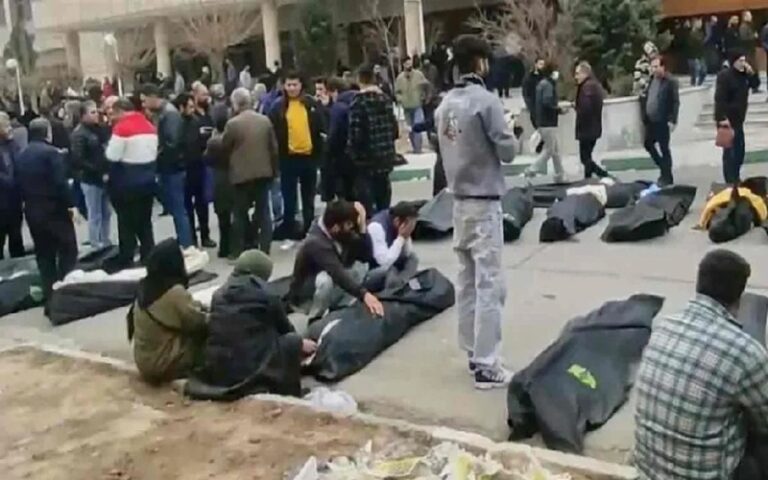
Amnesty International announced that since the beginning of 2025, more than 1,000 executions have been reported in Iran and called for their immediate halt. The international human rights organization reported that executions in Iran are carried out after unfair trials and with the aim of suppressing protests and minorities.
Hussein Baoumi, Amnesty International’s Deputy Director for the Middle East and North Africa, said on Thursday, October 16, “UN Member states must confront the Iranian authorities’ shocking execution spree with the urgency it demands.”
He added that since the start of the 2022 protests, officials of Iran’s regime have used the death penalty “to instill fear among the population, crush dissent and punish marginalized communities.”
According to the Amnesty official, “This year executions have reached a scale not seen in Iran since 1989.”
Baoumi stated that many of these executions are related to drug offenses and “Executions are being carried out following grossly unfair trials held behind closed doors, amid widespread patterns of torture and forced ‘confessions’.”
In response, political prisoners in various prisons have protested the widespread wave of executions through sit-ins, issuing statements, and participating in the “No to Execution” campaigns.
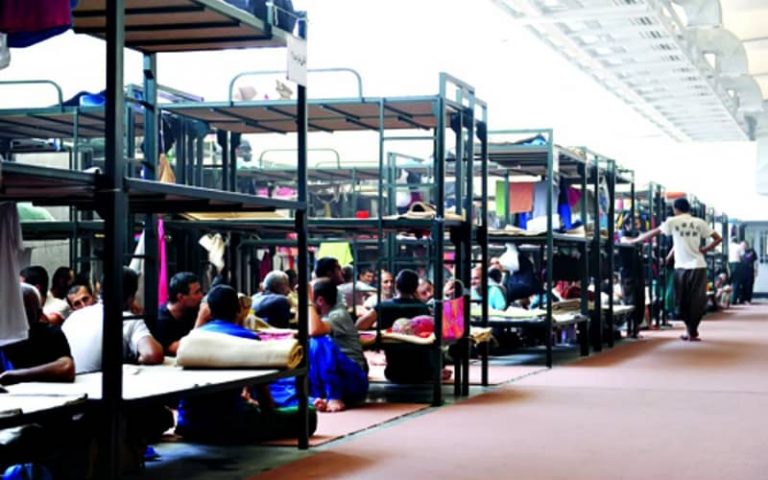
Reports indicate that hundreds of inmates in Ghezel Hesar Prison in Karaj continue to protest the sharp increase in executions, with a group of prisoners still on a collective hunger strike.
The disciplinary committee of Evin Prison canceled the next three visitation sessions for at least four political prisoners protesting against executions on Wednesday, October 15.
In a statement the National Council of Resistance of Iran (NCRI) announced the number of executions carried out over the past year as follows:
“Over the past year (from October 1, 2024, to September 30, 2025), the religious fascism ruling Iran has recorded a bloody and unprecedented record of cruelty and crime. During this period, the execution of 1,654 prisoners was documented across 31 provinces, representing a 2.3-fold increase compared to the same period the previous year (with 851 executions), and a 2.8-fold increase compared to the year before that (with 693 executions).”
These figures were compiled based on verification networks and independent sources due to the judiciary’s secrecy.
Call for immediate halt and abolition of death penalty laws
Amnesty International called on UN member states to seriously urge Iranian regime officials at upcoming UN General Assembly sessions, including the interactive dialogue of the Third Committee on Human Rights regarding Iran on October 30, to immediately halt all executions, overturn verdicts issued after unfair trials, and declare an official moratorium as a step toward the total abolition of the death penalty.
The organization also urged the UN Office on Drugs and Crime and the International Narcotics Control Board to pressure Tehran to reform its anti-narcotics policies to ensure they comply with human rights standards.
Amnesty International further called on world governments to use universal jurisdiction to open criminal investigations into torture and other international crimes in Iran and to issue arrest warrants for officials with criminal responsibility in these cases.
Minorities face the greatest danger
Amnesty International’s new statement notes that thousands of people in Iran are at risk of execution, including those convicted of drug-related crimes and individuals tried in political cases under vague charges such as “enmity against God” (moharebeh) and “corruption on earth” (efsad fel-arz).
According to the organization, Revolutionary Courts, which lack independence, issue death sentences in collaboration with security and intelligence agencies, with ethnic and religious minorities—including Afghans, Ahvaz Arab people, Baluchs, and Kurds—being the main victims of this practice.
Amnesty International emphasized that the death penalty is a violation of the fundamental right to life under all circumstances, describing it as “the ultimate cruelty and an inhuman and degrading punishment.”
According to an analysis by the TankerTrackers website, most oil tankers sailing under Iran’s regime flag are, for the first time since 2018, transmitting their real signals through the Automatic Identification System (AIS) without falsifying their location. Iranian regime officials have not yet responded to this development.
On Tuesday, October 14, TankerTrackers cited data from two global ship-tracking information providers, reporting that most Iranian tankers are now normally active on the global positioning system and, unlike previous years, no longer hide their real locations.
Samir Madani, co-founder of TankerTrackers, told the Splash website that the timing of this development is quite interesting, as it comes after seven and a half years of widespread signal spoofing by the National Iranian Tanker Company’s fleet.
He added that this event does not appear to be the result of a remote cyberattack, as in most cases, the National Iranian Tanker Company’s vessels used to switch off their transponders rather than falsify their locations.
History of Hacking Incidents in Iran’s Maritime Communication Network
In August, a hacker group claimed it had disabled the communication network of more than 60 ships belonging to two major Iranian regime maritime companies, disrupting their communication with one another, with ports, and with the outside world.
The same group, which had previously exposed information about the Iranian regime’s cyber and military operations, stated that as a result of this operation, communications were cut off for 39 ships belonging to the National Iranian Tanker Company and 25 ships owned by Iran’s state-run shipping line.
In March 2025, the hacker group Lab Dookhtegan also announced that it had targeted the communication networks of 116 ships belonging to two major Iranian companies, severing their connections with each other, ports, and the outside world.
Oil Tankers and International Sanctions
In the first weeks of his second presidential term, U.S. President Donald Trump imposed a new wave of oil sanctions against Iran, which have intensified in recent weeks. These sanctions target companies connected to the oil industry and Iran’s aging tanker fleet, which operate without Western insurance and transport oil for sanctioned countries.
On August 28, the United Kingdom, France, and Germany initiated a 30-day process to reinstate United Nations sanctions on Iran. Despite attempts by Tehran’s allies to pass resolutions delaying the reinstatement, the process ultimately led to the reimposition of sanctions against Iran’s regime.
Many of the Iranian regime’s sanctioned vessels, which operated in recent years as part of a “shadow fleet,” are now visible on tracking systems. However, investigations by Iran International show that the destinations of many of these ships remain unclear.
According to TankerTrackers data, at least 94 ships sailing under Iran’s flag in international waters are currently under U.S. sanctions, and 67 of them were added to U.N. sanctions lists following the activation of the snapback mechanism.
On October 7, Lebanon’s Hezbollah-affiliated Al Mayadeen network reported signs of U.S. preparations to intercept vessels linked to Iran’s regime, following the reinstatement of U.N. sanctions.
Unidentified sources told Al Mayadeen that the Islamic Revolutionary Guard Corps (IRGC) and Iran’s army are “capable of neutralizing any threat” in the Persian Gulf and the Sea of Oman.
Citing the same sources, Al Mayadeen wrote that Iran’s regime has warned regional countries that any cooperation with the United States aimed at targeting or obstructing Iranian commercial vessels “will not go unanswered” and “will be met with a proportional response.”
Mizan News Agency, the state-run outlet affiliated with Iran’s judiciary, reported that two French citizens accused of “espionage” in Iran have been sentenced to a total of more than 60 years in prison, without revealing their names.
On Tuesday, October 14, Mizan wrote that one of the defendants was sentenced to six years in prison for “spying on behalf of the French intelligence service,” five years for “assembly and collusion to commit crimes against national security,” and twenty years in exile for “intelligence cooperation with Israel, considered as waging war against God.”
The other defendant was sentenced to ten years in prison for “spying on behalf of the French intelligence service,” five years for “assembly and collusion to commit crimes against national security,” and seventeen years for “aiding intelligence cooperation with Israel.”
The report added that the initial verdicts for the two French citizens, who were arrested on March 9, 2023, have been communicated to their lawyers.
According to the judiciary, the verdicts can be appealed to the Supreme Court within twenty days of notification.
If the verdicts are upheld, the maximum sentences — twenty and seventeen years — will be enforced for the two individuals.
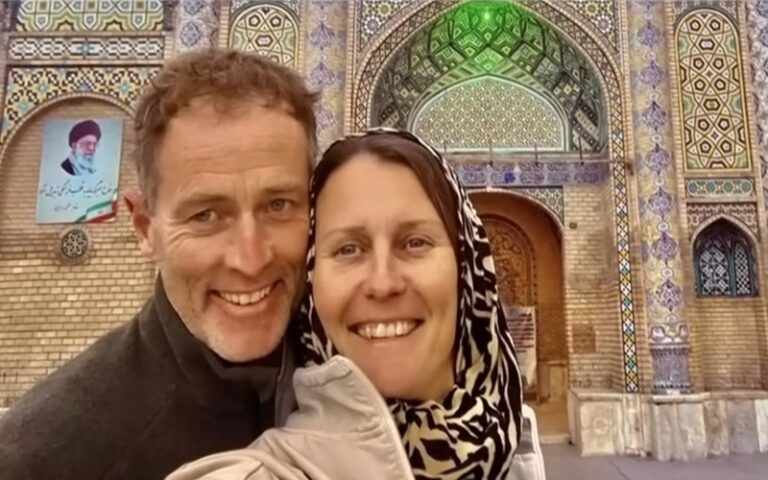
Cécile Kohler and Jacques Paris are among the most well-known French citizens currently imprisoned in Iran.
Kohler and Paris, both trade union activists, were arrested by Iran’s security agents in May 2022 after meeting with several labor and teachers’ rights activists in Tehran.
France and other European Union member states have previously accused Iran’s regime of systematically taking foreign citizens hostage to exert political pressure on Western governments.
Officials of Iran’s regime have denied these accusations, claiming that the arrests were carried out according to legal procedures and rejecting allegations of mistreatment of prisoners.
A few hours before the publication of the news about the French prisoners’ sentences, Asghar Jahangir, the spokesperson for the judiciary, stated that the French government had not fulfilled its promise to release Mahdieh Esfandiari from prison.
Esfandiari is an Iranian citizen imprisoned in France for supporting the Hamas group and on charges of “glorifying terrorism.”
Previously, Iran’s regime Foreign Ministry had announced that Tehran was negotiating with Paris over a potential exchange of the two French citizens for Esfandiari.
Carrying goods across the western borders of Iran — known as kolbari — is an old phenomenon, but in recent years, with rising unemployment and poverty in border regions, it has become the only means of survival for thousands. There are no official statistics on the number of porters (kolbars), but human rights organizations estimate that more than 70,000 people in the provinces of Kurdistan, Kermanshah, and West Azerbaijan are engaged in this dangerous work. Many of them are young men who are either educated or have no other employment opportunities.
The paths taken by kolbars usually pass through mountains under harsh weather conditions. In winter, temperatures drop below -10°C, and porters carry heavy loads on their backs for hours. Falling from cliffs, avalanches, frostbite, and gunfire from border guards are among the main dangers they face.
According to data from the Kurdpa Human Rights Organization, between 2012 and October 2025, at least 2,574 kolbars have been killed or injured in Iran’s Kurdish border regions — 656 killed and 1,918 injured. The data shows a general upward trend in casualties since the early 2010s, peaking between 2017 and 2024.
The year 2023 saw the highest number of casualties during this period, but in 2025, reports indicate a relative decline. However, this drop is not due to improved economic conditions or new welfare policies — it stems from increased militarization of border areas, the closure of main kolbar routes, installation of barbed wire along the frontier, and the construction of new military outposts.
“Legal” Kolbari: Structural Discrimination and Chronic Poverty
Despite the regime’s security-driven crackdown on kolbars, the Iranian government introduced a “border transit card” system a few years ago. These cards allow residents of border regions to import limited quantities of goods through designated routes. However, kolbars and civil activists say these cards provide neither safety nor support. Due to quota limits and administrative corruption, many are forced to use informal, high-risk routes. These cards provide no insurance or legal protection, leaving the government unaccountable in the event of death or injury.
Human rights activists argue that through such policies, the regime restricts and controls the livelihood of kolbars, fostering dependence that suppresses their social and economic demands.
According to economic experts, kolbari is a direct product of structural poverty and regional discrimination. Iran’s western border provinces suffer from some of the highest unemployment rates and lowest levels of development. Factories and job opportunities are scarce, and many infrastructure projects have been left unfinished for years. In these conditions, kolbari remains the only source of income for thousands of families.
The Iranian regime publishes no statistics on the number of kolbars, the scale of casualties, or the types of goods transported. All available information comes from field observations, interviews with families, and reports by human rights organizations. This gap between reality and official data is the result of censorship and the securitization of the kolbari phenomenon.
The roots of kolbari lie in poverty, discrimination, and security-driven policies. As long as the government refuses to take responsibility for job creation, economic development, and social support, this phenomenon will persist. Kolbari is not a choice—it is a necessity, and until the underlying structures change, this compulsion will continue.
A Kolbar’s Account
When winter arrives, kolbars sometimes set out for the border at night through snow-covered mountains to evade border patrols.
For each trip, kolbars earn about 2 million tomans (equivalent to 20 million rials or roughly $18 USD). But even this small amount comes at the risk of their lives.
Despite years of criticism from civil organizations and media outlets, the Iranian regime has not only failed to offer any solution but has intensified its security measures. Borders have been mined, and military presence has increased. However, as civil activists note, “greater pressure only forces kolbars to choose even more dangerous routes.”
In recent years, even children and teenagers have entered this line of work. Human rights groups have documented cases of kolbars under 18 among those killed.
From the Border to Tehran: A Distance Unseen
In regime-controlled media, kolbari is often described as “smuggling,” but for border residents, it is “life” itself.
While few in Tehran or other major cities are aware of the kolbars’ daily suffering, thousands of men and women in border regions end each night in fear and hope—only to climb the mountains again at dawn.
A member of the presidium of the Energy Commission of Iran’s regime Majlis (parliament) said that despite the oil and gas reserves having almost doubled compared to last year, power outages will likely return to the country starting in January.
On Monday, October 13, Farhad Shahraki told the state-run news website Shafaqna, expressing concern about energy supply in winter: “Given the restrictions on using fuel oil for environmental reasons and the red line regarding not cutting household gas supplies, despite good reserves, I believe from January we will again witness power outages.”
This member of the presidium of the Majlis Energy Commission, referring to the obstacles in implementing the “Seventh Development Plan,” said that the plan had set a “minimum 55% efficiency” for installed power plants. However, “the Ministry of Energy has stated in its correspondence that achieving this goal is impossible due to sanctions and costs and has requested to lower the efficiency ceiling to 50%.”
Earlier, on October 6, the state-run Mehr News Agency described Iran’s gas crisis as a “structural” and “chronic” problem, reporting that this challenge causes billions of dollars in “silent losses” for the petrochemical industry during winter.
The agency reported that the country’s daily gas deficit in the winter of 2025 exceeded 300 million cubic meters, and estimates indicate this figure may reach 600 million cubic meters by 2031.
This is while the daily gas deficit was around 155 million cubic meters in 2020 and about 174 million cubic meters in 2022.
Meeting on energy shortages
On the morning of Monday, October 13, a meeting to review energy shortages—referred to by officials of Iran’s regime as “energy imbalance”—was held with the participation of the Minister of Energy, several Majlis members, and senior representatives and managers of the oil and energy ministries and their subsidiaries.
Abbas Aliabadi, Minister of Energy, said at the meeting: “We are in difficult wartime conditions and have gone through five years of heat and drought… If today’s meeting resolutions are implemented, we will not face problems in winter because we have enough power plants to produce electricity, and with fuel supplied by the Oil Ministry, there will be no power outages.”
Ali Nikzad Samerin, deputy speaker of the Majlis, also said that the Minister of Energy, based on commitments made by oil ministry officials, “has pledged that there will be no power or gas cuts in the country during the winter.”
The continuous power outages in recent months went beyond temporary disruptions and, under the regime’s incapacity, turned into a widespread crisis affecting daily life and production processes.
In mid-September, amid ongoing power outages across Iran, Mostafa Rajabi Mashhadi, CEO of Tavanir (the state electricity company), admitted that the electricity supply crisis would not be resolved soon.
Moreover, widespread blackouts during this summer put severe pressure on industries, caused serious production consequences, and fueled concerns about worker unemployment.
Under these circumstances, and given the worsening economic situation and intensified sanctions, the gas and electricity crisis in Iran is expected not only to recur in the near future but also to become more persistent and costly.
As the sharp increase in executions continues in Iran, 16 prisoners held in Ghezel Hesar Prison in Karaj were transferred to solitary confinement for execution. At the same time, a number of inmates refused to receive their food rations in protest against the wave of executions.
On Monday, October 13, the Iran Human Rights Society reported that at least 16 prisoners had been transferred to solitary confinement in Ghezel Hesar Prison for execution. According to the report, 11 of them were sentenced to death on drug-related charges, while five others were convicted of murder.
In its report, Iran HRS stated that it is still investigating further details and the identities of the prisoners.
Meanwhile, the judiciary of Iran’s regime executed at least seven prisoners, including one woman, on the same day in Dastgerd Prison in Isfahan, as well as in Qazvin and Minab prisons.
A prisoner named Ebrahim Delaram, a 43-year-old resident of Dehdasht, who had been sentenced to death on drug-related charges, was also transferred to a solitary cell in Yasuj Prison to await execution.
As the group of prisoners was transferred to solitary confinement in Ghezel Hesar Prison, a number of inmates in Ward 2, Hall 16 of the prison refused to receive their food rations in protest against the wave of executions.
Prisoners in this ward are mostly held on drug-related charges, and their protest comes amid a sharp rise in executions carried out in Ghezel Hesar Prison in recent weeks.
Ghezel Hesar in Karaj is one of Iran’s most notorious prisons, where numerous executions are carried out for prisoners convicted of various charges.
In a statement the National Council of Resistance of Iran (NCRI) announced that Iran’s regime executed 1,654 people in the past year:
“Over the past year (from October 1, 2024, to September 30, 2025), the religious fascism ruling Iran has recorded a bloody and unprecedented record of cruelty and crime. During this period, the execution of 1,654 prisoners was documented across 31 provinces, representing a 2.3-fold increase compared to the same period the previous year (with 851 executions), and a 2.8-fold increase compared to the year before that (with 693 executions).”
On September 29, UN experts issued a press statement noting that Iran’s regime had executed more than one thousand people in less than nine months, describing this as “a dramatic surge in executions and a violation of international human rights law.”
On September 26, UN Special Rapporteur on Human Rights in Iran, Mai Sato, warned in a report that the human rights situation in Iran “is deteriorating alarmingly,” and that citizens are facing organized repression and widespread restrictions following the end of the 12-day war.
Hamid Haj-Jafar Kashani, a political prisoner, has been transferred to the ward for violent crime inmates in Ghezel Hesar Prison in Karaj after spending one month in solitary confinement.
According to reports, on Monday, October 13, this political prisoner was moved from solitary confinement to Unit 3, Hall 10 of Ghezel Hesar Prison—a ward mainly used to hold prisoners convicted of dangerous and violent crimes.
A source close to his family stated:
“Hamid Haj-Jafar Kashani, in a phone call today, reported repeated threats, an unsafe environment, and inhumane conditions in this ward. His family is deeply concerned for his life.”
The source added that Mr. Kashani had also spent the past month in solitary confinement as a form of punishment.
Sentenced to 15 Months in Prison and Two Years of Exile
Hamid Haj-Jafar Kashani, a well-known political prisoner, was previously tried in Branch 26 of Tehran’s Revolutionary Court, presided over by Judge Iman Afshari, and sentenced to 15 months in prison and two years of exile in Saravan, a city in southeastern Iran. His charge was “insulting Ali Khamenei,” the supreme leader of the Iranian regime.
This political activist was formally charged on April 29 by Branch 3 of the Evin Prosecutor’s Office and then transferred to Ward 4 of Evin Prison. Following airstrikes on Evin Prison, which resulted in the relocation of several prisoners, he was moved to Ghezel Hesar Prison in Karaj.
The transfer of political prisoners to public wards or those housing violent offenders is one of the illegal methods of psychological and physical intimidation repeatedly condemned by human rights organizations. Civil activists stress that such actions violate the principle of separating prisoners by type of offense and constitute psychological torture.
Arrested for Street Protest
Hamid Haj-Jafar Kashani, born in 1982 and a former futsal referee in Iran, was arrested on April 27 for holding a protest placard on Tehran’s Enghelab (Revolution) Street. He had joined the busy street to express civil dissent against the regime’s policies and was arrested by security forces and taken to a security detention center.
Charges and Court Hearing
On April 29, Hamid Haj-Jafar Kashani was charged in Branch 3 of the district 33 Prosecutor’s Office in Tehran with two specific accusations:
Propaganda against the regime
Insulting Ali Khamenei
Trial Held Under Pressure
On Wednesday, June 11, the trial of Hamid Haj-Jafar Kashani was held in Branch 26 of Tehran’s Revolutionary Court, presided over by Judge Iman Afshari. Informed sources have reported that he had repeatedly refused to attend the court session but was eventually brought there by force. The hearing was held without the presence of his chosen lawyer, and the entire process was conducted under the pressure of security forces.
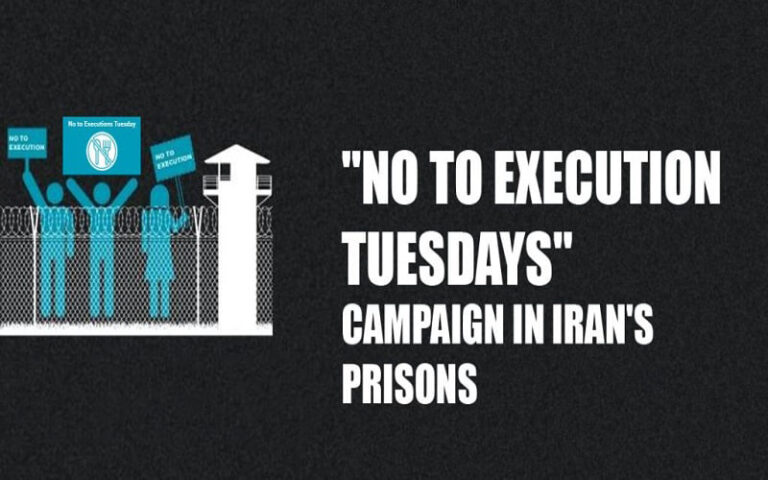
The 90th week of the “No to Execution Tuesdays” campaign was held in 52 prisons across Iran, with participating prisoners going on a hunger strike. A part of the statement referring to the World Day Against the Death Penalty reads:
“Coinciding with the World Day Against the Death Penalty, prisoners participating in the ‘No to Execution Tuesdays ‘ campaign in Ghezel Hesar Prison chanted slogans against the death penalty, expressing their disgust and abhorrence for these cruel and inhumane sentences.”
The full statement of the 90th week of the “No to Execution Tuesdays” campaign is as follows:
Continuation of the “No to Execution Tuesdays” Campaign in Its 90th Week Across 52 Prisons Nationwide
We sincerely thank all the brave and freedom-loving Iranians who participated in the nationwide campaign marking the World Day Against the Death Penalty and made their strong voices of opposition to executions resonate throughout Iran. This enthusiastic presence, relentless support, and ongoing solidarity have given us unparalleled strength and encouragement to continue our path toward an Iran free of capital punishment.
The “No to Execution Tuesdays” campaign still needs such support so that this voice of justice and humanity can reach the conscience of awakened individuals and the international community more powerfully each day.
While the growing pressures and inhumane conditions in Iran’s prisons persist, we have witnessed the transfer of female political and ideological prisoners from Qarchak Prison to Evin Prison. These women were relocated following the tragic killing of their fellow inmate, Somayeh Rashidi, and their widespread protest against Qarchak’s inhumane conditions. They now remain in Evin Prison deprived of basic necessities, including heating facilities, and are enduring extremely harsh conditions. These inhumane circumstances, not limited to Evin, are yet another example of the torture of prisoners and the gross violation of human rights.
Although these prisoners have escaped the hell of Qarchak, hundreds of women—among them death row inmates—remain imprisoned in this torture center. Like other infernal prisons, Qarchak must be shut down, and those responsible for human rights violations must be brought to justice.
Continuing the issuance of unjust sentences, a few days ago the death sentence of Ehsan Faridi, a student and political prisoner held in Tabriz Prison, was upheld—a decision made without due process, intended to instill fear among youth and students. This act violates human rights and human dignity and must be strongly condemned.
Political Prisoner, Ehsan Faridi
In a further attempt to intimidate society, we have witnessed the issuance of death sentences for three ideological prisoners—Nasimeh Eslamzehi, her husband Arsalan Sheikhi, and Amanj Karvanji. For us, these sentences symbolize the injustice of a despotic judicial system and compel us to continue raising our voices against these widespread and ruthless executions.
Under these circumstances, coinciding with the World Day Against the Death Penalty, prisoners participating in the “No to Execution Tuesdays” campaign in Ghezel Hesar Prison chanted slogans against the death penalty, expressing their disgust and anger toward these cruel and inhumane sentences.
Amid the recent wave of executions, particularly in Ghezel Hesar Prison, on Monday, October 13, following the transfer of several inmates from Ward 2 to solitary confinement for execution, prisoners in this ward—over 1,500 of whom are on death row—staged a sit-in, returned their prison meals, and demanded the return of their fellow inmates. We call on other prisoners to follow the example of Ghezel Hesar inmates by opposing the execution of their cellmates, and we urge anti-execution activists outside prison to take stronger steps to halt the regime’s execution machinery and to support the families of those sentenced to death.
Reports from various prisons indicate that between September 23 and October 12 alone, 162 prisoners were executed, and in the past six months and 20 days, more than 1,000 people have been hanged. These figures have deeply shaken the conscience of the Iranian public and the international community, demanding immediate and decisive global action to stop this criminal trend.
More than 100 Nobel Laureates have issued a strong condemnation of Iran’s human rights violations and declared their support for the country’s democratic resistance.
In an open letter addressed to UN Secretary-General António Guterres and signed in July 2025, the Laureates urged urgent international action to confront what they described as a “grave and escalating human rights crisis in Iran.” The letter denounces widespread executions, systemic repression, and Tehran’s destabilizing activities across the region.
Unprecedented Surge in Executions
The signatories condemned the regime’s reliance on mass executions as a tool of fear and control. According to the letter, at least 1,000 people — including 34 women — were executed in 2024 alone. Iran remains the world’s top executioner per capita, with an estimated 1,275 executions carried out within just the first ten months of the current presidency.
The Laureates emphasized that political dissidents, ethnic and religious minorities, and ordinary citizens are the main targets of these systematic abuses.
The letter recalled Iran’s nationwide uprising in 2022, when citizens expressed their rejection of both monarchical and theocratic rule, demanding instead a democratic republic. It also noted the widespread boycott of the regime’s presidential elections, underscoring the population’s call for freedom and democracy.
Growing Recognition of Iran’s Democratic Opposition
The Laureates’ statement reflects increasing international acknowledgment of the Iranian Resistance, particularly the Ten-Point Plan put forward by Mrs. Maryam Rajavi, President-elect of the National Council of Resistance of Iran (NCRI).
In February 2025, the U.S. House of Representatives passed bipartisan Resolution H. RES. 166 with majority support, condemning Tehran’s terrorism and human rights abuses while endorsing Rajavi’s democratic vision.
In June 2024, more than 4,000 parliamentarians, 130 former heads of state, and 80 Nobel Laureates publicly endorsed Rajavi’s Ten-Point Plan. Since then, parliamentary majorities in numerous countries — including the United Kingdom, France, Italy, Norway, Canada, Ireland, Malta, Switzerland, Romania, Portugal, Argentina, Costa Rica, Iceland, Moldova, and the Netherlands — have issued similar declarations of support.
A Blueprint for a Free and Peaceful Iran
The Nobel Laureates voiced their backing for “a democratic Iran, where sovereignty rests with the people.” They endorsed the Ten-Point Plan, which calls for universal suffrage, free elections, the separation of religion and state, gender and ethnic equality, a non-nuclear Iran, and peaceful relations across the region.
According to the letter, “The Iranian Resistance, with its democratic platform dedicated to human rights, offers a viable path toward national unity, an end to religious dictatorship, and the transfer of sovereignty to the people.”
A Global Call to Action
The Laureates concluded with an appeal to the UN and the international community not to remain silent in the face of Iran’s atrocities. “This vision offers the prospect of a democratic Iran and lasting peace across the Middle East,” the letter stated.
With the voices of more than 100 Nobel Laureates, the letter stands as one of the most powerful moral and academic endorsements yet for Iran’s democratic aspirations.
Mohammad Reza Raiszadeh, head of Iran’s regime Medical Council, warned about the growing crisis of specialist shortages, stating that “in a few years,” even Iran’s major cities will face a shortage of pediatricians.
On Sunday, October 12, Raiszadeh said: “We have a shortage of pediatric specialists in Iran, and we must ask why our general practitioners are not interested in specializing in pediatrics.”
He added that many general practitioners in Iran are turning to the beauty industry but show little interest in pursuing pediatrics as a specialty.
As extreme beauty standards spread across social media, specialized cosmetic clinics have experienced a sharp increase in the number of surgeries performed.
Previously, Ali Jafarian, deputy health minister of Iran’s regime, announced that over 80% of emergency medicine program positions and one-third of anesthesiology positions remain vacant due to lack of applicants.
On September 18, the state-run Nournews website, citing official data from the Medical Council, reported that about 29% of registered general practitioners in Iran are not practicing medicine.
In July, Abbas-Ali Raees-Karami, president of Tehran University of Medical Sciences, reported declining interest among applicants for six medical specialties and subspecialties, warning that a shortage of applicants in core medical fields poses a serious challenge to Iran’s healthcare system.
A Crisis Under the Shadow of Budget Shortages
The head of the Medical Council continued: “There are patients in various cities, but no specialist doctors. In the past four years, no medical education plans were implemented. We are short of 600 trillion rials (approximately 545.5 million dollars) to expand medical training capacity.”
Raiszadeh warned: “No one is considering the requirements for general practitioners to enter specialization programs; everyone’s focus is only on the number of general practitioners.”
In November 2023, the state-run Eghtesad24 website warned that the shortage of pediatric specialists in Iran had become a major challenge for the healthcare system across many provinces.
According to the report, many residents of smaller cities are forced to travel to Tehran for their children’s medical treatment.
According to the Iranian regime’s Parliamentary Research Center in November 2023, the share of pediatric graduates among all medical specialists in Iran has fallen to below 1% since 2017.
The increasing wave of physician emigration has further exacerbated the shortage of pediatric specialists in Iran.
Shahin Akhoundzadeh, deputy minister for research and technology at the Ministry of Health, stated on September 15 that meritocracy is the key factor in retaining talent. He revealed that “most of the top 100 students in the medical entrance exam migrate abroad because proper conditions for employment are not available in the country.”