Iranian Regime Puts Iran’s Oil on Sale in China with Bigger Discounts

Reuters reported, citing six trade sources, that the Iranian regime is selling its oil to small Chinese refineries with bigger discounts. On Tuesday, September 16, Reuters reported that Iran’s oil stockpiles in China had reached a new record, while import quota restrictions toward the end of the year had tightened. As a result, the Iranian regime has been offering its oil at deeper discounts than before. According to the report, this week the discount for Iranian light crude for October cargoes reached more than $6 per barrel compared to the Brent benchmark. Two weeks ago, the discount was about $5, and in March around $3. Record oil inventories in Shandong have reduced profit margins for small refineries, while the shortage of government-issued import quotas has further limited their purchases. A source familiar with Iran’s oil trade told Reuters: “Discounts for Iranian oil in China have widened on record stock levels at a major refining hub and as a shortage of import quotas towards year-end hindered buying by independent processors.” Based on tanker tracking data, imports of Iranian oil at Chinese ports have reached their highest level since before Donald Trump’s return to the White House in early 2025 and the revival of the so-called “maximum pressure” campaign. Data from the commodities analytics firm Kpler shows that the volume of Iranian oil discharged at Chinese ports last month surged significantly, indicating that the world’s largest oil importer has not been affected by U.S. efforts to curb Tehran’s exports.
Iran–China Cooperation in the Missile Field Is on the Rise
The increase was so significant that Iran’s unsold oil stocks floating in Asian seas—rising in recent months—fell by half in just one month. According to Kpler, discharges of Iranian crude at Chinese ports in August reached 1.68 million barrels per day, a 23% increase compared to July. Reuters reported on September 16, citing trade sources, that while Western sanctions aimed at halting Iran’s uranium enrichment program are targeting oil exports, declining demand from independent refiners in Shandong province—known as “teapots”—is adding pressure on the Iranian regime to maintain revenues from oil sales. According to Kpler, these sanctions have reduced shipments to a key Chinese port. On August 21, the U.S. sanctioned Hai Dongjiako port in Qingdao, which previously received 130,000 to 200,000 barrels per day of Iranian oil. This is the sixth Chinese terminal blacklisted by Washington for receiving Iranian oil. Three informed sources said operations at the terminal ceased shortly after the sanctions were imposed. In recent years, China has purchased over 90% of Iran’s oil exports. Data from Vortexa shows that between January and August, Chinese imports averaged 1.43 million barrels per day, reflecting a 12% increase compared to last year.
A New Oil Smuggling Scandal Involving Iranian Regime Leaders
To evade sanctions, traders usually disguise Iranian oil as Malaysian oil, transferring cargoes ship-to-ship in waters near Malaysia. Beijing has described its oil trade with Tehran as consistent with international law and labeled unilateral U.S. sanctions as illegitimate. According to a senior Kpler analyst, crude imports at Dongjiako port fell by 65% this month (September). However, Qingdao Xiehua, another terminal at the same port, has not yet been sanctioned. Three trade sources told Reuters that if vessels are not sanctioned, Iranian cargoes are redirected to nearby terminals. Kpler’s forecast data shows that Iranian oil imports at Huangdao—another discharge hub in Qingdao—will reach 229,000 barrels per day in September, double that of August. According to Vortexa Analytics, onshore commercial crude inventories in Shandong province reached a record 293 million barrels by August 22, an increase of 20 million barrels since early July, with a large portion consisting of Iranian oil.

Babak Shahbazi Executed in Ghezel Hesar; A Case Full of Ambiguities and Accused of Injustice

On the morning of Wednesday, September 17, Babak Shahbazi, a 44-year-old political prisoner and father of two, was executed in Ghezel Hesar prison. He worked as an installer and repairman of air conditioners. He was arrested in January 2024 and, after months of interrogation and severe pressure, was tried in Branch 15 of Tehran’s Revolutionary Court presided over by Judge Abolghasem Salavati. In May 2025, the court sentenced him to death on charges of “corruption on earth” and “espionage for Israel.” Shahbazi’s family repeatedly called the charges “ridiculous and baseless.” According to them, during the trial it was claimed that he had been trained by Israel to use a simple office software like Microsoft Word. This claim, which was met with public ridicule and disbelief, clearly showed that the charges lacked any legal or logical foundation.

Protest of Babak Shahbazi’s fellow inmates against his execution

According to the latest reports from Ghezel Hesar prison, Shahbazi’s fellow inmates staged a sit-in in front of the office of Unit Four’s chief from the moment of his transfer until late Tuesday night. With continuous slogans and protests, they declared their opposition to Shahbazi’s transfer for execution. The sit-in lasted several hours, creating a tense and alarming atmosphere in the ward. According to informed sources, his fellow inmates insisted that Shahbazi’s execution was unjust and violated the most basic principles of human rights, and it should be stopped immediately.
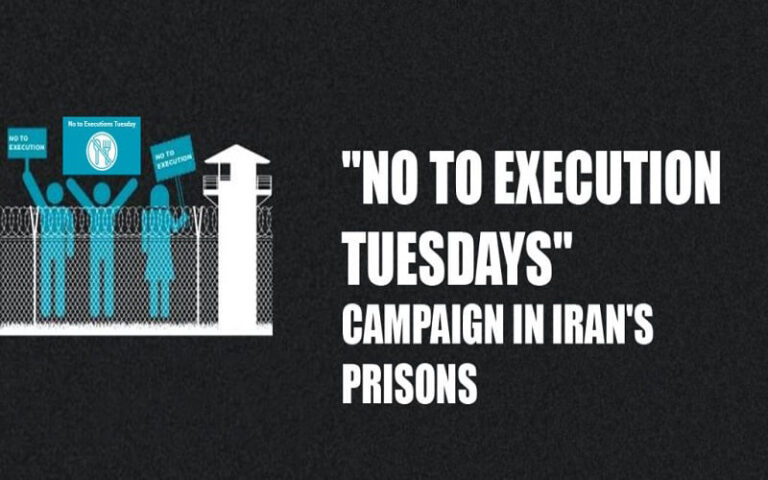
The Continuation of the ‘No To Execution Tuesdays’ Campaign In 52 Prisons Across Iran: 3,175 Executions In Three Years

Ambiguous judicial process

From the very beginning, Babak Shahbazi’s case was marred by violations of fair trial principles. His third request for retrial at the Supreme Court was also dismissed as “inadmissible” by Branch 29. The ruling stated that his lawyers, Milad Panahipour and Mohammad Saleh Noghrekhar, had failed to attach necessary documents such as the rulings issued by the Revolutionary Court and the Supreme Court. The judges argued that “what the aforementioned lawyers wrote lacks evidence and cannot be used as a basis for issuing a religious and legal judgment. Therefore, under current conditions, the case is incomplete and inadmissible.” This ruling was signed by Branch Chief Abbasali Alizadeh and advisor Reza Hatami. Critics stressed that the Revolutionary Court, under Judge Abolghassem Salavati, never provides the original ruling to the defendant or his lawyers and only allows limited copying. Therefore, citing the “absence of attached documents” is legally unacceptable.

Execution in silence

With this ruling, Shahbazi’s death sentence became final, and the risk of its enforcement sharply increased in recent weeks. Informed sources reported that he was several times taken out of his ward under the pretext of being transferred to the Ministry of Intelligence, but in fact placed in a cell for execution. Ultimately, on Wednesday morning, his execution in Ghezel Hesar prison was confirmed.

Legal ambiguities and blatant contradictions

Babak Shahbazi’s case provoked widespread reactions among the public and human rights circles. Many described the ruling as “a symbol of injustice in Iran’s judiciary” and a clear example of using espionage charges as a tool to suppress citizens. Critics called the ruling “ridiculous and illogical.” They emphasized that the Revolutionary Court under Judge Salavati never provides the original verdict to the defendant or his lawyers, allowing only limited copying. Thus, the Supreme Court’s reliance on the “absence of attached documents” is legally baseless and highlights the lack of transparency in the judicial process. These ambiguities once again raised serious questions about the independence of the judiciary and its commitment to fair trial standards. At the same time, reports emerged that Babak Shahbazi was taken out of his ward hours before the announcement of this ruling, under the pretext of being sent to the Ministry of Intelligence. When his family went to the prison, they were told by the security officer that his exit had not been registered and that he was still inside the prison.

Iran Marks Third Anniversary of 2022 Uprising as Protests Intensify Over Corruption and Mismanagement

On the third anniversary of the 2022 uprising—sparked by the state killing of 22-year-old Mahsa (Jina) Amini—Iran witnessed a fresh wave of protests and strikes across multiple cities. From the restive towns of Kurdistan to the capital Tehran, and from vital oil fields to provincial centers, Iranians from all walks of life took to the streets against the clerical regime’s corruption, repression, and inefficiency. The government’s response—marked by violent crackdowns, military deployments, and widespread intimidation—underscored its deepening fear of its own people.

Kurdistan: The Epicenter of Defiance

The anniversary was preceded by bloodshed in Kurdistan. On September 15, plainclothes forces opened fire on villagers in Pir Omran, Saqqez, who were protesting the environmental destruction caused by a local gold mine. Twenty-two-year-old Mohammad Amin Rashidi was killed, and two others were wounded. Authorities withheld his body from the family and blocked access to hospitals for the injured. Following the killing, the Saqqez Governor and the local IRGC commander personally pressured the victim’s relatives, forcing a secret nighttime burial. By denying the family the right to mourn publicly, the authorities sought to prevent Rashidi from becoming a symbol of resistance.
Families Of 2022 Protest Victims Summoned And Threatened On The Third Anniversary Of Nationwide Protests
On September 16, shopkeepers and merchants in Saqqez—Amini’s hometown—and in Divandarreh launched a sweeping general strike, shutting down markets in an act of civil defiance. The regime responded by effectively militarizing Saqqez, sealing off roads, deploying IRGC troops around Aychi cemetery, where Amini is buried, and even patrolling the skies with helicopters to prevent mourners from reaching Amini’s grave.

Tehran and Karaj: Defiance in the Capital

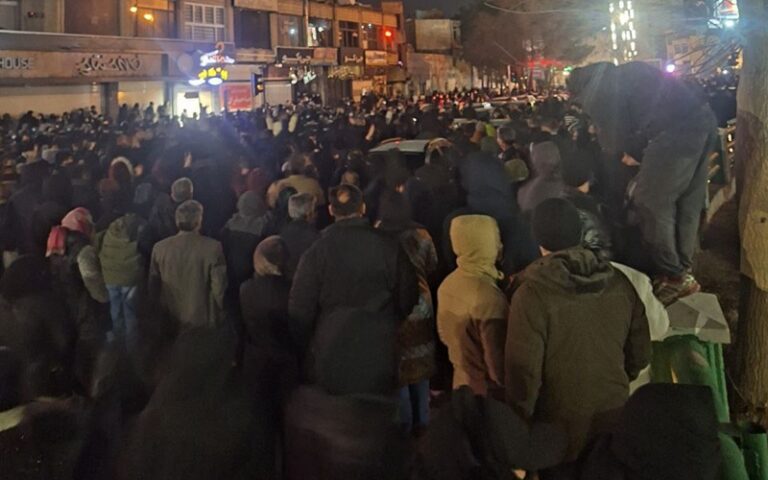
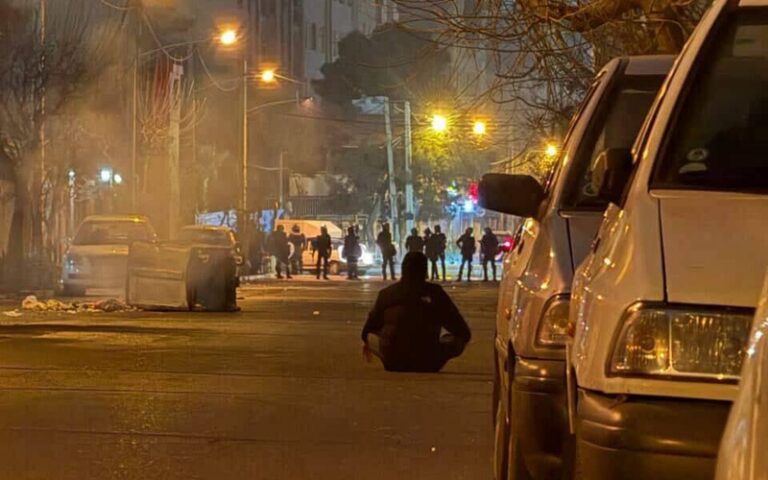
That evening, defiance spread to Tehran. In the Sadeghieh (Ariashahr) district, protesters chanted the uprising’s central slogan—“Death to the dictator!”—while creating traffic jams to disrupt security forces. When plainclothes agents moved to disperse them, the crowd countered with chants of “Bisharaf, Bisharaf!” (“Dishonorable!”). Other neighborhoods joined in: in Tehranpars, chants of “Death to Khamenei, damn Khomeini” rang out; in Jordan district, citizens voiced opposition from rooftops. In Karaj, a powerful symbolic protest emerged. In Gohardasht, a lone woman stood atop a public trash bin and shouted: “You have turned Iran into a prison!”—a message that resonated far beyond the city.

Nationwide Echo: Protests Over Rights and Livelihood

Parallel to political protests, economic unrest has surged across Iran. Oil workers at the Aghajari Oil and Gas Production Company held rallies demanding the removal of restrictive salary caps, pension reforms, and the implementation of Article 10 of state employment law. Similar protests have also rocked the Pars Special Gas Complex and offshore oil platforms. Teachers, retirees, and doctors joined the movement. In Kermanshah, retired teachers staged their seventh rally, chanting “Our pain is your pain, people join us!” One teacher summed up the despair: “We have become a collection of misfortunes and troubles: poverty, corruption, prostitution, unemployment, brain drain, land subsidence… I don’t know what’s left.” In Fars Province, family doctors protested four months of unpaid wages, warning of an impending collapse of the healthcare system. These demonstrations followed earlier unrest on September 15, which saw protests by telecommunications retirees in five cities, medical residents in Tehran, and educators from the Literacy Movement demanding job security.

A Convergence of Political and Economic Outrage

The events of September 15 and 16 highlight the merging of political defiance with economic despair. From the killing of Rashidi in Saqqez to the unpaid doctors in Fars, and from chants in Tehran’s streets to symbolic acts in Karaj, a consistent message has emerged: the regime has failed its people at every level. Unable to address grievances, the leadership in Tehran has resorted to force—deploying the IRGC to suppress protests, blocking cemeteries, and silencing grieving families. The reliance on brute repression is widely seen as a stark admission of illegitimacy. The struggle for a free, democratic, and prosperous Iran continues, fueled by the memory of martyrs and the daily fight for survival. Despite the regime’s heavy-handed suppression, the protests signal that its foundations are increasingly unstable.

Families Of 2022 Protest Victims Summoned And Threatened On The Third Anniversary Of Nationwide Protests

Information circulating on social media reveals threats and pressure exerted on the families of those killed during the nationwide uprising in Iran in 2022. Coinciding with the third anniversary of the regime’s killing of Mahsa (Jina) Amini, intelligence and security agencies summoned or threatened by phone several families of those killed and victims of the Iranian regime’s crackdown. According to reports, some family members were summoned to intelligence offices in Tehran and other cities.
Anniversary Of The 2022 Protest Movement, A Turning Point in Iran’s History
In the past two years, similar reports had emerged of widespread threats and attempts to prevent gatherings commemorating Mahsa and other victims of the revolutionary uprising. In early August 2023, the regime’s security forces summoned several detainees from the 2022 nationwide movement and demanded that they pledge not to leave their homes during the second week of September.

Amjad Amini: Kurdistan and Iran will not forget Mahsa

Despite the regime’s continued pressure, on September 15, Amjad Amini, Mahsa’s father, posted an Instagram Story, writing “on the anniversary of the martyrdom of Mahsa, the unforgettable Jina of Kurdistan and Iran,” honoring her and other victims of the protests. In this story, he wrote: “Kurdistan and Iran will never forget the withering beauty and the faded smiles of its flowers, and we too will never forget the butterflies of smiles on the lips of our flower of life, our Jina, our hope.” Amini, emphasizing that the memory and “justice seeking” for Jina and other protest victims will not be forgotten, added: “The loss of our beloved and the grief of this inner fire will continue to burn eternally like a volcano within us… A martyr of the homeland does not need lamentation; for they live eternally in the nation’s heart.” He had earlier reminded that September 16 would mark the third anniversary of his daughter’s state killing.
Iranian Regime Executes Detainee from 2022 Protests
The post sparked widespread reactions on social media, with many users interpreting it as an indication that a commemoration for Mahsa Amini would be held on September 16. In the past two days, Iranians abroad have taken to the streets in several European countries including Sweden, Switzerland, the Netherlands, the United Kingdom, Denmark, Germany, France, and Cyprus, as well as in the United States, Canada, Australia, and New Zealand. These demonstrations were held on the eve of Mahsa’s third anniversary to honor the memory of those killed in recent protests and to support political prisoners. On September 13, 2022, Mahsa Amini was arrested and beaten by the regime’s morality police. Three days later, she died from the severity of her injuries at Kasra Hospital in Tehran. Following this incident, protests first erupted in Tehran and then spread to many parts of Iran. According to the National Council of Resistance of Iran, during the revolutionary uprising at least 750 protesters, including 68 children, were killed.

Iran’s regime health ministry: Most top 100 medical exam entrants have emigrated

Shahin Akhoundzadeh, deputy minister for research and technology at the regime’s health ministry, said meritocracy is the most important factor in retaining elites. He reported that “most of the top 100 entrants in the university entrance exam” in medical sciences are emigrating because of the lack of suitable conditions for employment in the country. On Monday, September 15, in an interview with the state-run ISNA news agency, Akhoundzadeh said graduates in basic sciences often return to Iran after some time, but clinical specialists, especially doctors, show far less interest in coming back. He added: “If we show our young elites that university presidents, ministers, and deputies are chosen from among the elites—that is, if meritocracy rules—then talented youth will be motivated to serve in the country.” Akhoundzadeh reminded that one of the most important reasons for emigration is that “our elites do not see meritocracy in the country.” These remarks come as Iran’s regime president Masoud Pezeshkian has repeatedly pointed the finger at the educated class regarding elite emigration while ignoring the role of the ruling establishment. On September 11, Pezeshkian blamed the educational system for the wave of youth and elite emigration, saying: “The schools we have built today raise one-dimensional and arrogant individuals instead of well-rounded humans. People who do not believe in their country and homeland and think they can only achieve a position abroad.” In May, he had also said: “Why do we educate elites in a way that makes them want to go abroad? What kind of education is this, when 90% want to emigrate?”

Emigration of professors

The deputy minister for research and technology of the regime’s health ministry further stated that in the past one to two years, the number of faculty members emigrating from the country’s medical universities has not increased. At the same time, Akhoundzadeh said that whenever Iran’s economic and social problems intensify, the likelihood of new waves of elite emigration increases.
Growing Wave of Professor Migration Poses Serious Challenge To Iran’s Scientific Future
He emphasized that improving the research environment could prevent elite emigration: “A large number of top-ranked medical students working with me on research projects believe that if proper research conditions existed in the country, they would not emigrate.” Earlier, on March 23, Mohammad Jalili, head of the faculty recruitment center at the health ministry, warned that faculty departures had reached the country’s top universities. In recent years, the growing trend of youth and elite emigration has raised widespread concerns. On June 10, Bahram Salavati, researcher and former director of Iran Migration Observatory, reported that for the first time in the country’s history, the number of Iranian students abroad had exceeded 100,000, and only 1% of them return to Iran.

Several Cities in Iran Hit by Air Pollution and Dust Storms

Several cities across different provinces in Iran have been affected by air pollution and dust storms, disrupting the daily lives of residents. Hossein Zafari, spokesperson for the regime’s Crisis Management Organization, said on Monday, September 15, that the provinces of North Khorasan, Razavi Khorasan, Golestan, and Semnan are experiencing reduced air quality, lower visibility, and increased pollution levels. He attributed this pollution to the arrival of a massive dust front from Turkmenistan and predicted that the situation would continue until the end of the week. Iranian media reported that based on a decision by the North Khorasan provincial crisis management headquarters, government offices and executive bodies in the province (except Esfarayen) were closed from 11 a.m. on Monday.
More Than 35,000 Pollution-Related Deaths Recorded In Iran in 2024
The closure was attributed to rising dust levels in North Khorasan’s atmosphere. Videos circulating on social media showed the “very unhealthy” air quality in Bojnurd, North Khorasan, due to heavy dust. In recent weeks, the air quality index in Tehran, Mashhad, and Ahvaz had reached the red level and the dangerous “brown” status. Reports on September 15 also indicated that air pollution in Ahvaz worsened due to smoke from fires in the Iraqi section of the Huralazim wetland. These conditions are considered extremely dangerous for patients with respiratory issues, the elderly, children, and other vulnerable groups. Health officials have therefore advised citizens to avoid unnecessary outdoor activities. On September 14, Shahriar Askari, public relations director of Khuzestan’s Environmental Protection Department, reported that the air quality in four cities—Ahvaz, Dezful, Hoveyzeh, and Behbahan—was in the “unhealthy” and “red” zones. In past years, the air quality in Ahvaz and several other Khuzestan cities has repeatedly deteriorated due to fires in the Huralazim Marshes. In recent years, air pollution has repeatedly reached critical levels, while dust storms have intensified environmental challenges and public health risks. Despite the growing dimensions of this crisis, the Iranian regime has yet to adopt a systematic and sustainable approach to addressing it. Abbas Shahsavani, deputy director of the Air Pollution and Climate Change Research Center at Beheshti University of Medical Sciences, announced in late August that deaths attributed to air pollution in Tehran had increased by 5% between 2017 and 2024. In August, the state-run daily Etemad reported that more than 35,000 people in Iran died due to air pollution in 2024, a figure that has risen compared to two years earlier. The economic cost of these deaths and pollution-related diseases is estimated at around $12 billion, equivalent to about 5% of the country’s GDP.

The Continuation of the ‘No To Execution Tuesdays’ Campaign In 52 Prisons Across Iran: 3,175 Executions In Three Years

0
Political prisoners across Iran are on hunger strike in the eighty-sixth week of the “No to Execution Tuesdays” campaign, held in 52 prisons, to protest the execution-driven policy of the ruling dictatorship. In this week’s statement, the prisoners referred to the anniversary of the nationwide protests of 2022 and declared: “As the anniversary of the 2022 nationwide protests arrives, the day that shook the very foundations of the ruling regime, we honor the memory of Jina (Mahsa) Amini and all the martyrs of that great and historic movement. The uprising, which the despotic regime sought to suppress only by opening fire on youth and women and shooting into the eyes of protesters, continues to resist in the alleys and streets.” The regime was so terrified of the uprising that it had no choice but to reveal its inhumane nature. After the 2022 popular uprising, it horrifyingly escalated death sentences, and in these three years alone, it has executed more than 3,175 people by hanging. Among them, 49 were political or ideological prisoners, and 95 were women. Furthermore, at least 34 prisoners were executed last week alone, and since late August 2025 more than 126 people have been hanged. These figures expose the growing human catastrophe and violations of human rights in Iran, making the responsibility of the international community and all freedom-loving people heavier in supporting the struggle against these merciless executions. It is also fitting to remember champion wrestler Navid Afkari, who was executed on September 12, 2020, sacrificing his life in the path of freedom and justice. The sacrifices during the uprisings of January 2018, November 2019, and 2022 have shown that the people of Iran will never surrender to repression and tyranny. The “No to Execution Tuesdays” campaign strongly condemns the issuance of the death sentence for Pejman Toubrehrizi on the fabricated charge of “corruption on earth” and for Kurdish prisoner Naser Bekrzadeh on security-related charges. It calls upon all human rights activists and society to oppose these unlawful and unjust rulings.
Death Sentence Issued for a Political Prisoner in Iran
We, as members of the “No to Execution Tuesdays” campaign, while expressing solidarity with the honorable people and oppressed miners of Saqqez, and with the family of Mohammad Rashidi who was killed last night by regime suppression forces, declare that we will not rest until the complete abolition of the death penalty and the establishment of true justice in Iran. We will continue to raise this powerful voice of justice, and the defense of human rights and dignity, with greater strength every week. On Tuesday, September 16, 2025, in its eighty-sixth week, the “No to Execution Tuesdays” campaign will continue with hunger strikes in 52 prisons across Iran.

Anniversary Of The 2022 Protest Movement, A Turning Point in Iran’s History

The killing of Mahsa Zhina Amini, which ignited the nationwide protests of 2022, turned into one of the largest protest movements in Iran’s modern history. Mahsa’s killing in 2022 was the spark for a movement that had been forming for years, with its most important achievement being the active presence of women at the heart of society. With Mahsa Amini’s death on the night of Friday, September 16, 2022, the largest nationwide protests against Iran’s regime began. This movement created significant and lasting changes in society, and its achievements continue to this day.
Iranian Authorities Block Roads to Burial Site of Teenager Killed by Security Forces
In today’s modern world, even among developing countries, Iranian women—despite their remarkable abilities, outstanding talents, and historic courage, regardless of their level of knowledge and education—are among the most oppressed women in the world. This is because the dictatorship’s structure, along with the rulers’ regressive culture and unjust laws rooted in gender discrimination, has placed women in such a deadlock that no path remains for them to live based on freedom, choice, and human dignity. Amjad Amini, Mahsa Amini’s father, a few days ago on the eve of the anniversary of his daughter’s death in the custody of the regime’s morality police, posted a picture of her and wrote: “Mahsa (Zhina), my shining world, your name is still on everyone’s lips and has a place in every heart. Your memory and name are cherished.” During the 2022 uprising, which lasted more than 10 months, many young people were killed by gunfire from regime forces, and the total number of martyrs exceeded 750.

Conflict And Disputes Over the Agreement with Rafael Grossi in Iran Regime’s Parliament

Following the announcement of the agreement between Rafael Grossi, Director General of the International Atomic Energy Agency (IAEA), and Abbas Araghchi, the foreign minister of Iran’s regime, some members of Majlis (parliament) reacted harshly to the deal. This behavior raises questions about the hidden objectives behind these actions and their contradiction with the foreign policy of Iran’s regime. Even though any international agreement is made in full coordination with Ali Khamenei, the supreme leader of Iran’s regime, and higher security institutions, why do Majlis members take such positions?
U.S. State Department Warns to Hold Tehran Accountable if No Nuclear Deal Is Reached
One day after the announcement of the agreement between Iran’s regime and the IAEA, Javad Hosseini-Kia, a member of Majlis, stated: “We know for sure that the Agency has given information about nuclear sites to Mossad.” He also added: “Grossi himself is a Mossad agent, and we demand his prosecution.” Before him, Fatemeh Mohammadi-Beigi, a representative from Qazvin, had made the same claim. She said: “Grossi will not be allowed to enter our country.” She further added: “If he enters, he must be arrested and tried as an accused for his crimes.” She continued: “The Iranian people will never forget the betrayals of the Director General of the International Atomic Energy Agency, Mr. Grossi.” In the same line, Hossein Shariatmadari, the editor-in-chief of the state-run Kayhan newspaper and a close confidant of Khamenei, had called for the execution of Rafael Grossi. These statements come at a time when Iran’s regime foreign policy is working to prevent the implementation of the “trigger mechanism” or snapback sanctions, which are being pursued by the three European countries at the United Nations Security Council. Its implementation would lead to the re-imposition of crippling and broad UN sanctions against Iran’s regime. This situation clearly highlights the contradiction between the statements of some Majlis members and the regime’s diplomatic approach. On June 9, Mojtaba Zarei, a Majlis representative from Tehran, made claims in a Twitter post. He alleged: “We now know which bombs of the Israeli gang are located at which point and in which shelter.” He also referred to technical details and calculations regarding these bombs. He also stated: “We brought more than 10 million pages of documents.” According to Zarei, the publication of parts of these documents would cause crises in Asia, Europe, and the United States. These remarks were followed, four days later, by an Israeli attack against Iran’s regime and the assassination of its military commanders and scientists. Such behaviors from some Majlis members are not unprecedented. On May 9, 2018, in reaction to the U.S. withdrawal from the nuclear deal (JCPOA), Majlis members burned the U.S. flag and a copy of the JCPOA during a public session. This action increased the level of tension between Iran’s regime and the United States. Ultimately, following the deadlock in negotiations and escalating tensions, including an attack by Khamenei’s proxy forces on the U.S. embassy in Iraq, Qassem Soleimani, commander of the Quds Force of the IRGC, was assassinated on the orders of U.S. President Donald Trump. Then, the Ukrainian passenger plane was shot down by the IRGC’s air defense on orders. This incident triggered widespread protests within Iran’s regime. The accusations against Rafael Grossi and demands for his prosecution by some parliament members faced a reaction from another representative. Mojtaba Tavangar, a representative from Tehran, on September 9, 2025, objected to these behaviors during a parliament session. He said: “The cost of the words and actions of some individuals should not be paid by the entire parliament.” Tavangar added: “They make such a mess that they overshadow the parliament’s historic action.” He further said: “This is happening in a parliament that proudly carries the sign of being revolutionary.” Then he posed a critical question: “Does revolutionary behavior have any meaning without ethics and rationality?”

Question regarding parliament members’ behavior and explanation of their conduct

Now the question is, why do parliament members, despite knowing about the coordination of the foreign ministry with Khamenei and higher authorities, take such positions? A former parliament member said in this regard: “The troublemakers in the parliament are Khamenei’s proxy representatives.” He believes that just as Khamenei authorizes the signing of international agreements, he also orders the application of pressure and disorder. He added: “They do not accuse the IAEA Director General of espionage on their own.” According to this former parliament member, if one looks at the backgrounds of these representatives, they are generally long-standing figures. These individuals are not reprimanded for their crisis-provoking remarks. He added: “On the contrary, they are even encouraged, and their eligibility is approved in every election.” In his view, a representative who makes unconventional statements does not act independently but carries out an assigned mission. He named Gholam-Ali Haddad-Adel and Hossein Fadaei as intermediaries between Khamenei’s office and the parliament. The former member said: “In the past, Khamenei’s messages were conveyed to the parliament troublemakers through them.” These remarks clearly show that this policy, like Khamenei’s “hardliner vs. reformist” scenario, is used domestically to influence the shaky base of loyal regime forces, giving them the impression that part of the regime opposes such negotiations. Ultimately, if things go wrong, these same figures place the blame on the defeated faction of the regime, just as they did with the failure of the nuclear deal (JCPOA). In this way, Khamenei and his faction are always whitewashed. This policy, however, seems to have lost its previous effectiveness in the current context of Khamenei’s deepening weakness across foreign, regional, proxy, and especially domestic fronts.

Iran’s Regime Unveils the ‘Winter Drill’ Plan While the Energy Crisis Continues

0
Even before the summer has ended, the CEO of Tavanir (Iran’s Power Generation, Distribution, and Transmission Company) announced that the electricity crisis in Iran will not end anytime soon. Along with unveiling a plan called “Winter Drill,” he said preparations are underway for the cold season. The chain of the energy crisis—from gas to water and electricity—has also affected other sectors such as communications. Mostafa Rajabi-Mashhadi, on Sunday, September 14, in a meeting on “Managing the Passage of Summer Peak Load,” said that the “serious imbalance in electricity” will not be resolved soon and preparations must be made for the winter season. He announced the preparation of a plan named “Winter Drill” and said that this year’s fuel situation is better compared to last year, but this does not mean neglecting continuous tasks of consumption management.
Iran’s Electricity Crisis Pits Industry Against Energy Ministry
These remarks in the last week of summer 2025 come as in recent years, the frequency and duration of blackouts have been reported to increase year after year. The continued power outages this summer, accompanied by water cuts, sparked widespread protests in many cities across the country. The protests even reached small towns such as Khoshk-e Bijar in Gilan province. As in many other protests, Iran’s regime carried out mass arrests of demonstrators. The blackouts were not only problematic for citizens. According to Ebrahim Sheikh, deputy minister of Industry, Mine, and Trade, despite a sixfold increase in electricity costs for industrialists this summer, the “imbalances” in this sector were not reduced. This has led to disputes between the Ministry of Industry, Mine, and Trade (known as “SAMT”) and the Ministry of Energy within the government. The widespread blackouts in the summer of 2025 also claimed lives. Reports published in Iranian media about the consequences of repeated outages show that the continuation of blackouts and fluctuations became a deadly threat to patients dependent on electrical equipment, and at least five citizens lost their lives in recent months due to these outages. At the same time as the Tavanir CEO’s remarks, Mostafa Pourdehghan, a member of the presidium of the parliament’s Industry Commission, referred to disruptions in Iran’s mobile phone network—recently reported to have increased—and attributed the cause to frequent power outages. Pourdehghan explained: “When we ask the Minister of Communications and Information Technology about it, he responds that on one hand electricity is cut off, and on the other hand, our batteries are worn out and acidic.” The frequent blackouts, along with the regime’s inability to provide drinking water for citizens, have created a multifaceted crisis. A crisis that officials of Iran’s regime themselves warn is intensifying.