Border Residents of Sistan and Baluchestan Prevent IRGC Fuel Smuggling

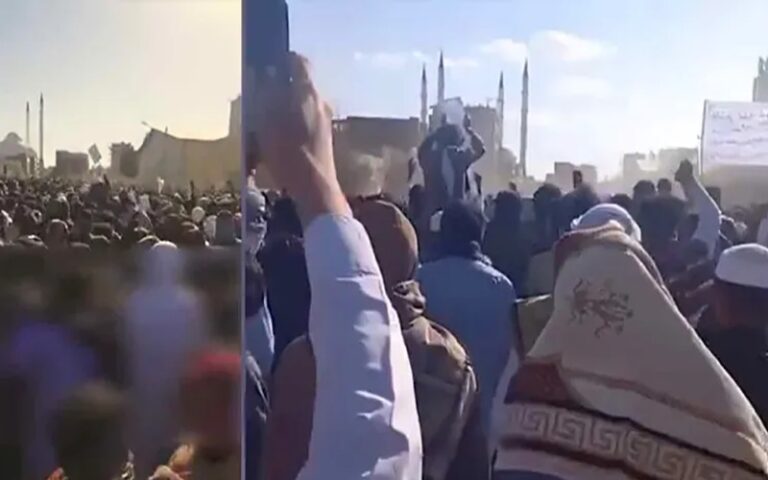
Border residents of Sistan and Baluchestan province in Iran blocked the Mirjaveh-to-Rutak route by burning tires in protest against the Islamic Revolutionary Guard Corps’ (IRGC) fuel smuggling schemes. Locals said that while independent fuel carriers are barred from transporting fuel, regime forces, in collaboration with tribal leaders, smuggle fuel into Pakistan. On Saturday, September 13, the Baluch Activists Campaign reported that after border residents blocked the transport routes, fuel carriers connected to tribal leaders were forced to turn back.
Increasing Gasoline Price in Iran: Social Experiment or Preparation for Fuel Price Hikes?
According to this report, on the evening of September 12, border residents burned tires and blocked roads in protest against the IRGC’s “Fuel Tanker” and “Cooperation” projects. The campaign stated that the IRGC’s goal in implementing these projects is to bypass sanctions and transfer fuel to Pakistan. It added that residents have said they will not allow traffic for the implementation of these schemes. Fuel carrying has existed for decades in Sistan and Baluchestan as a livelihood for border residents. At times, the government sold fuel at higher rates to some carriers so they could deliver it across the border in Pakistan and Afghanistan. With sanctions tightening, the IRGC has sought to “fully control this cycle and centralize the profits,” and within this framework, it has advanced projects such as “Razagh,” “Fuel Tanker,” and now “Cooperation,” in collaboration with certain tribal leaders. In this system, “no one is allowed to carry fuel independently.” Tanker and vehicle owners must act as “renters,” transporting fuel to designated border points, handing it over to IRGC agents, and only receiving transport fees. Protesters announced that they will not allow tankers and vehicles linked to this scheme to pass. Reports indicated that these vehicles have “retreated,” and at present, the situation on the ground is under the people’s control.
Iran’s Gasoline Smuggling Crisis Exposes Systemic Corruption and Military Involvement
The Baluch Activists Campaign further reported that the “Cooperation” project is being carried out under the leadership of an IRGC commander in collaboration with several Baluch tribal leaders. According to the report, fuel carriers in this project are required—despite all risks—to deliver fuel to points designated by the IRGC and tribal leaders with “minimal profit,” while the transfer to Pakistan and final sales remain under the IRGC’s control. In the past seven years, military forces have killed or injured more than one thousand Baluch fuel carriers.

Iran’s Regime Majlis Research Center: Snapback Mechanism Manageable Through Sanctions Evasion

The Research Center of Iran’s regime Majlis (parliament) announced that according to its assessments, the activation of the snapback mechanism does not have a “serious economic impact” on Iran and is mostly related to restrictions on dual-use technology exports. It added that Iran’s regime, with its experience in circumventing sanctions and the opposition of China and Russia, can manage this restriction. In its report titled “Review of the Snapback Mechanism and the Economic Consequences of UN Security Council Resolutions Against Iran,” the center wrote: “Sanctions by the Security Council, unlike US secondary sanctions (which are economy-based and target vital sectors such as oil and banking), are proliferation-based and focused on limiting nuclear and missile programs.”
Reward For Disrupting Iran’s Oil Sanctions Evasion Network
The center added: “The important point is that activating the snapback mechanism does not create a sanctions regime harsher than the current pressures.” On August 28, the three European signatories to the JCPOA—France, the United Kingdom, and Germany—triggered the 30-day snapback process in a letter to the UN Security Council to reinstate UN sanctions. This move was welcomed by the United States and Israel, while officials of Iran’s regime called it “null and illegal” and vowed an appropriate response. The parliamentary research center also wrote in its report: “The economic effect of the snapback mechanism is mainly limited to the implementation of an export control regime on dual-use technologies, which, given Iran’s experience in bypassing restrictions and the lack of full alignment by China and Russia, is manageable.” It added: “The cargo inspection mechanism, due to certain conditions such as requiring the flag state’s consent and the risk of reciprocal actions by Iran, rules out the possibility of a naval blockade or seizure of Iranian ships.” In recent weeks, officials of Iran’s regime have insisted that the implementation of the snapback mechanism is mostly “psychological.” The likelihood of international consensus against Iran’s regime is “low.” While some Iranian media outlets had earlier warned about an international consensus against Iran’s regime, the parliamentary research center put forth a different claim. On August 4, the state-run newspaper Farhikhtegan, affiliated with Islamic Azad University, warned about rising tensions, the possibility of military confrontation, and the formation of a global consensus against Iran’s regime after the potential activation of the snapback mechanism by European countries.
U.S. Sanctions 13 Shipping Companies and 8 Tankers to Counter Iran’s Regime
But the research center wrote: “The hopeful point is that in the multipolar world of 2025, due to the opposition of powers such as China and Russia—as reflected in the very important letter of the foreign ministers of the three countries Iran, China, and Russia—the possibility of forming an international consensus against Iran will be greatly reduced.” This refers to the September 1 joint statement by the foreign ministers of Iran’s regime, China, and Russia, in which they declared that the European Union’s attempt to activate the snapback mechanism against Iran is “legally baseless and politically destructive.” The parliamentary research center wrote: “Adding new names to the sanctions list or reestablishing an expert panel is difficult because it requires consensus in the Security Council and can be vetoed by China and Russia. While US political pressure on Iran’s trade partners, such as China, is possible, it is independent of the use or non-use of the snapback mechanism.” The center predicted that after the reinstatement of UN sanctions against Iran’s regime, “Iran’s large-scale transactions in oil exports, petrochemicals, and financial settlements will continue without serious challenges, although short-term psychological shocks may occur in asset markets.” This claim comes at a time when Iran’s economic situation has worsened in recent weeks. Even the Ministry of Intelligence, warned ministries and major companies that the consequences of activating the snapback mechanism could lead to a halt in Iran’s oil sales, trigger major economic and security crises, increase unemployment, and intensify social discontent in the country. While regime media and institutions are attempting to downplay the impact of the snapback mechanism and the return of UN sanctions by publishing aligned reports, earlier reports revealed that the Supreme National Security Council had ordered media outlets to normalize the atmosphere in the country through such reports and portray the possible return of sanctions as having no effect on people’s lives. The directive stated that media outlets must, by “maintaining the psychological calm of society,” refrain from publishing any “emotional,” “crisis-inducing,” or “provocative” headlines or analyses in their coverage of the snapback mechanism.

Iranian Middle-Class Youth Suffer from Chronic Anxiety Due to Economic Concerns

The state-run newspaper Shargh reported that young people from Iran’s middle class are suffering from chronic anxiety caused by economic concerns about their future. On Saturday, September 13, Shargh published a report titled “Fall into the Field of Poverty,” stating that despite earning monthly salaries between 20 million and 30 million tomans (200 to 300 dollars), these young people can no longer afford routine purchases they used to make in previous years. According to the report, many young people no longer have money for small leisure activities such as going to restaurants, attending gyms, or buying routine skincare products.
Iran’s Economy in Crisis: Investment Collapse and Soaring Inflation
A young woman, noting in her interview with Shargh that her income had risen from 5 million tomans to 30 million tomans over the past four years, said: “Clearly, I am struggling to make ends meet each month. My friends are in the same situation. Our only entertainment now is to meet at each other’s houses a few times a month, and we have completely given up going to cafes and restaurants.”

Eliminating some goods from the shopping basket

A young couple, both employed, told Shargh that they had cut their monthly purchases from chain stores, adding that they could no longer even afford a certain type of coffee they used to buy every month. Another young woman working in the human resources department of a well-known dairy company told the newspaper: “I haven’t signed up for any classes, nor do I go out with my friends like I did last year, yet life has become harder.” She added: “What bothers me more than financial pressure is the fear of running out of money at the end of the month. That’s why I watch my spending from the beginning of the month, so I don’t end up broke.”

Multiple reports on the rise of poverty in Iran

In recent years, various media outlets and institutions have published multiple reports on the rise of poverty in Iran. In June 2023, the Research Center of Iran’s regime parliament confirmed in a report the “increase and deepening” of poverty in the past decade, stating that about one-third of the population has been living below the “absolute poverty line” in the past five years. According to the report’s data, over the past decade, the number of poor people in Iran has increased by about 11 million. Hopelessness among the educated class has also been on the rise, with growing concerns about the migration of students and academics. Meanwhile, Massoud Pezeshkian, the president of Iran’s regime, in response to this crisis, has pointed the finger at the educated class and, using gendered language, accused them of “cowardice.” On June 10, Bahram Salavati, a researcher and former director of the Iranian Migration Observatory, announced that only 1% of Iranian students who migrate abroad return to the country. In March, Mohammad Jalili, head of the faculty recruitment center at the Ministry of Health, Treatment, and Medical Education, also warned that the exodus of faculty members has reached Iran’s top universities.

U.S. State Department Warns to Hold Tehran Accountable if No Nuclear Deal Is Reached

0
The U.S. State Department, expressing doubts about the recent agreement between Iran’s regime and the International Atomic Energy Agency (IAEA), warned that if no nuclear deal is ultimately reached, Washington will “hold Tehran accountable.” An unnamed U.S. State Department spokesperson said in an interview with Al Arabiya news channel on Friday, September 12, that the United States is waiting for details of the agreement between Tehran and the IAEA to be clarified. The official added that it is essential to reach an agreement under which Iran’s regime abandons its ambition to build nuclear weapons and halts uranium enrichment—an action that would benefit the people of Iran, the region, and the world.
Is The Iranian Regime Ready to Reduce Uranium Enrichment Levels To 3.67%?
The official emphasized that if this goal is not achieved, the United States will continue to hold Iran accountable for its actions. On September 9 in Cairo, IAEA Director General Rafael Grossi and Abbas Araghchi, the Iranian regime’s foreign minister, reached a new arrangement for continued cooperation between the two sides. Grossi said this agreement concerns “practical measures for resuming inspections in Iran” and outlines the inspection procedures for the regime’s targeted nuclear facilities. In a contradictory account, Araghchi declared on September 10 that under this agreement, “no access will be given to IAEA inspectors, except regarding the Bushehr power plant.”

We want concrete steps from Tehran, not symbolic moves

The U.S. State Department official further stressed in the Al Arabiya interview that what is expected from Tehran regarding the nuclear file are “practical and tangible actions,” not “symbolic moves.” Al Arabiya reported that although it was initially thought the recent Cairo agreement would put Iran’s nuclear case on a path to resolution, the deal left many issues between Tehran and the IAEA unresolved, and Washington is dissatisfied with the outcome. Citing the remarks of this U.S. official and the recent positions of Donald Trump’s administration, Al Arabiya reported that the coming weeks will play a decisive role in the trajectory of relations between Iran’s regime and the West. According to this report, this period will either lead to a new agreement between Tehran and Western powers or mark the beginning of a phase of severe economic pressure against Iran—during which the U.S., with Europe’s support, will use broad sanctions to curb the regime’s nuclear program. On September 10, at the IAEA Board of Governors meeting in Vienna, the European Union and the U.S. warned that Tehran must immediately resume cooperation with the agency. On August 27, France, the UK, and Germany—the three European members of the JCPOA—announced in a letter to the UN Security Council their decision to begin the process of activating the snapback mechanism and reimposing UN sanctions against Iran’s regime. Thus, Iran’s regime has only until the end of September to reach an agreement with the West and prevent the return of sanctions.

Polish Company Sold Shahed Drone Parts to Iran

0
According to the local Polish daily Glos Wielkopolski, the Polish company WSK Poznań sold parts to Iran that were used in the production of Shahed-136 suicide drones—drones that were recently employed in Russian attacks against Poland. The case was first exposed by an investigative journalist from Radio Zet, who reported that fuel pumps directly exported from the Polish factory eventually ended up on Iranian drone production lines. According to him, WSK Poznań sold the parts to Iran Motorsazan, a manufacturer of agricultural tractors, which then delivered them to drone factories. The completed drones were later transferred to Russia and used in the war in Ukraine. After uncovering the matter, Poland’s Internal Security Agency prosecuted the company’s director. In April 2025, following his voluntary acceptance of punishment, the court sentenced him to a one-year suspended prison term with a two-year probation, a fine, and mandatory regular reporting to the court.
Crashed drone in Lublin likely an Iranian Shahed
This scandal coincided with a September 10 attack in which 19 Russian drones struck Polish territory, several of them crossing from Belarus. Four drones were shot down, but one hit a residential building in Lublin province. Although no casualties were reported, NATO invoked Article 4 and held a consultative meeting. However, the alliance declared that the Russian drones’ incursion into Polish airspace was “deliberate” but did not constitute a “direct attack.” The foreign ministers of Poland, Lithuania, and Ukraine condemned the incident and called for strengthening Ukraine’s air defense system and NATO’s eastern flank. Ukrainian President Volodymyr Zelensky also warned that the attack could be a test by Moscow to gauge Western allies’ readiness, likening it to the psychological atmosphere of the Crimea crisis. U.S. lawsuit filed to seize $584,000 from Iranian linked to IRGC drone program In another development, the U.S. Department of Justice announced a lawsuit to seize $584,000 in Tether cryptocurrency linked to Mohammad Abedini Najafabadi, 39, CEO of Sanat Danesh Rahpooyan Aflak. According to the Massachusetts Attorney’s Office, the company produced “Sepehr” navigation systems for drones and missiles of the Islamic Revolutionary Guard Corps (IRGC), with 99% of its sales in 2021 and 2022 going to the IRGC Aerospace Force. This technology was used in a Shahed drone during the January 2024 attack on the “Tower 22” base in Jordan, which killed three U.S. soldiers. The U.S. Attorney’s Office declared that all assets linked to terrorist activities against the U.S. will be confiscated. Abedini, who had previously been indicted in the U.S. for materially supporting the IRGC, was arrested in Milan in December 2024 but freed in January 2025 in exchange for the release of an Italian journalist detained in Iran—an incident described as an example of the Iranian regime’s hostage-taking policy.

U.S. Lawsuit Filed to Seize $584,000 From Iranian Linked to IRGC Drone Program

The U.S. Department of Justice announced a lawsuit to seize about $584,000 in Tether cryptocurrency linked to 39-year-old Iranian national Mohammad Abedini Najafabadi, CEO of Sanat Danesh Rahpooyan Aflak, due to his role in the IRGC drone program. On Thursday, September 12, the U.S. Attorney’s Office in Massachusetts announced that this Iranian company had been producing Sepehr navigation systems for the Islamic Revolutionary Guard Corps (IRGC), which were used in drones and guided missiles. The Attorney’s Office stated that between 2021 and 2022, about 99% of the sales of this navigation system went to the IRGC Aerospace Force, where it was used in one-way suicide drones. Earlier, on May 6, a U.S. federal judge denied bail to Mehdi Mohammadsadeghi, who is awaiting trial for his alleged involvement in a deadly drone attack on a U.S. military base in Jordan. Prosecutors also linked the technologies produced by Sanat Danesh Rahpooyan Aflak to the January 2024 drone attack on the U.S. military base in northern Jordan, known as “Tower 22.” Three U.S. soldiers were killed and more than 40 injured in that attack. Investigations revealed that the drone used was an Iranian Shahed model, and its navigation system had been produced by this company. Under U.S. law, all assets belonging to individuals or entities involved in planning or carrying out terrorist acts against the United States or its citizens are subject to confiscation. According to the Massachusetts Attorney’s Office, the asset forfeiture case is being pursued by Carol E. Head, chief of the Asset Recovery Unit, while the criminal case is being handled in coordination with Justice Department prosecutors and the counterterrorism and counterintelligence divisions of the U.S. Department of Homeland Security. The statement emphasized that all allegations in this case remain at the accusation stage, and the defendants are presumed innocent until proven guilty in court.
Italian Journalist Cecilia Sala Arrested in Tehran: Mystery Surrounds Detention
On July 9, the Swiss newspaper Neue Zürcher Zeitung reported that Abedini had worked in a drone research laboratory at a Swiss university that had been funded by the European Union and Switzerland’s State Secretariat for Innovation. The German-language daily wrote that his activities helped Tehran gain access to advanced Western technology for its drone program.

The Abedini–Sala swap

Abedini, 39, a Tehran resident, is the founder and CEO of Sanat Danesh Rahpooyan Aflak, which builds navigation modules for the IRGC drone program. He had previously been charged in the United States with providing material support to a foreign terrorist organization, namely the IRGC Aerospace Force. He was arrested in Milan, Italy, in December 2024 at the request of the U.S., but was released in January 2025 after Iran’s regime detained Cecilia Sala, an Italian journalist, just three days after Abedini’s arrest. Many have described the arrest of Cecilia Sala and her exchange for Mohammad Abedini as the latest example of the Iranian regime’s policy of hostage-taking and blackmail.

Death Sentence Issued for a Political Prisoner in Iran

On Monday, September 8, the Iranian regime’s judiciary informed political prisoner Pejman Toubere Rizi, who is held in Evin Prison, of his death sentence on charges of membership in the People’s Mojahedin Organization of Iran (PMOI/MEK) and “corruption on earth.” The verdict had already been typed in advance and was ready to be read out by Judge Amouzad. Pejman’s trial was held on September 1 in Branch 28 of Tehran’s Revolutionary Court, presided over by Judge Amouzad. Earlier, on July 27, Pejman was taken to court in handcuffs and shackles, where the judge asked him to confess to the charges and cooperate with Iran’s Ministry of Intelligence in exchange for exile to Saravan instead of execution, but Pejman refused. Again, on August 16, he was summoned to court without a lawyer, and the judge, citing the charge of “corruption on earth,” demanded that he sign under the death sentence, which Pejman did not accept.
The 85th week of the ‘No to Execution Tuesdays’ campaign in 52 prisons across the country
Pejman Toubere Rizi, a 31-year-old from Kermanshah, was arrested in Tehran on January 28. He was held for more than two and a half months in Evin Prison’s wards 209 and 240, where agents of the Iranian regime’s Ministry of Intelligence subjected him to interrogation and torture. On July 23, regime agents raided Pejman’s father’s home again, and due to their violent behavior, his stepmother, Fariba Vahedi, who was suffering from cancer, went into shock and later passed away. In this regard, the National Council of Resistance of Iran (NCRI) called on the United Nations and the UN Special Rapporteur on human rights in Iran to take urgent action to save the lives of prisoners sentenced to execution and to secure the release of political prisoners.

Reward For Disrupting Iran’s Oil Sanctions Evasion Network

The U.S. State Department, under the “Rewards for Justice” program, has offered up to $15 million for information that leads to the disruption of Iran’s oil sanctions evasion network and the financial mechanisms of the Islamic Revolutionary Guard Corps (IRGC). The State Department, through the “Rewards for Justice” program, announced that it will pay up to $15 million for information that disrupts the financial mechanisms of the IRGC, including its Quds Force, or the network linked to “Wang Shaoyun.” According to official announcements, the reward covers two categories of information: first, any leads that disrupt the IRGC and Quds Force financial systems; second, information that undermines the illegal financial activities of Wang Shaoyun. U.S. officials say Wang and his associates, through shell companies in China, Oman, and Turkey, sold Iranian sanctioned oil to Chinese state-owned refineries and channeled the proceeds for the benefit of the Quds Force. The FBI stated that this network conducted over $100 million in transactions using the U.S. financial system illegally.

How did the sanctions evasion scheme work?

The official account describes a cross-border network scheme involving ship-to-ship transfers to conceal the Iranian origin of cargoes, issuing falsified or misleading documents about destination and ownership, and routing payments through U.S. banks.
Nine Iranian individuals and entities added to the European Union’s new sanctions list
Among the key figures was “Mahmood Al Hasbi,” an Omani citizen, who in June 2020 purchased the tanker M/T Pride of Oman using a $16.5 million loan from U.S. financial institutions. From July that year, he began transferring Iranian oil cargoes to third-party vessels for shipment to Chinese buyers. U.S. officials say some Turkish, Omani, and American individuals and entities also facilitated the process.

Legal status and charges

On January 25, 2024, a federal court in Washington, D.C. issued an arrest warrant for Wang. The charges include violations of the International Emergency Economic Powers Act (IEEPA), violations of the Iranian Transactions and Sanctions Regulations (ITSR), conspiracy to commit money laundering, and laundering of monetary instruments. An arrest warrant was also issued for Al Hasbi around the same time. According to the FBI, Wang was in contact with senior IRGC officials to coordinate purchases, and millions of dollars of related transactions were processed through U.S. banks. As a legal reminder, all individuals named remain under indictment until a final ruling is issued.

Why is this important now?

According to Washington’s assessment, China is the main buyer of Iranian oil, and most of Iran’s shipments head there. Therefore, shutting down sanction evasion routes, particularly those linked to Chinese state-owned refineries, is a key pillar of sanctions pressure. The U.S. State Department has called on anyone with information about Wang Shaoyun, Mahmood Al Hasbi, their associates, and related financial networks to contact the designated channels for review under the “Rewards for Justice” program.

Evacuation of 40 Schools And A Residential Complex in Northern Isfahan Due to Land Subsidence

0
The head of the risk division at the Road, Housing and Urban Development Research Center announced that with the expansion of land subsidence, a residential complex and 40 schools in northern Isfahan have been evacuated. On Thursday, September 11, Ali Beitollahi, in an interview with the state-run ILNA news agency, described Isfahan as “the most dangerous city” in terms of land subsidence and said that, similar to Tehran, Mashhad, and other cities in Iran, excessive extraction of groundwater is the main cause of this problem. Beitollahi added: “Isfahan has faced an aggravating factor, which is the permanent cutoff of water flow in the Zayandeh Rud river… From the mid-2010s, with worsening drought, the river began to dry up temporarily every few months, and by 2018 and 2019 it became a permanent cutoff. When water is not flowing on the surface, it does not infiltrate underground, and aquifers are not recharged.”
Iran’s Subsidence Five Times the Global Average
This official from the Ministry of Roads and Urban Development of Iran’s regime had previously reported that Iran ranks third in the world in terms of the extent of land subsidence. On August 30, Mehdi Zare, a professor at the Seismology Research Institute, warned that the draining of groundwater, in addition to causing land subsidence, could also lead to “changes in stress on active faults.”

Why is northern Isfahan more vulnerable to subsidence?

The head of the risk division at the Road, Housing and Urban Development Research Center continued in his interview with ILNA, stating that Isfahan ranks first among Iranian cities in terms of subsidence area and that “the entire city of Isfahan is affected by this phenomenon.” Beitollahi said that the northern areas of Isfahan are more prone to subsidence due to the “different” type of soil and the “fine-grained nature of the sediments.” He added: “The subsidence phenomenon is so serious that out of 285 schools located in these areas, 40 have been evacuated. Several historical monuments in these regions have developed visible and tangible cracks. One residential complex was completely evacuated, and in some neighborhoods I saw room walls with cracks wide enough for my hand to pass through.” On August 12, Isa Bozorgzadeh, spokesperson for Iran’s water industry, warned that 70% of Iran’s plains are in “prohibited” or “critically prohibited” conditions, and more than 300 plains, including Tehran, face serious threats of land subsidence. Bozorgzadeh described subsidence as a direct consequence of excessive withdrawal of groundwater and said that a significant portion of this extraction occurs due to “inefficient management, legal loopholes, and lack of coordination among responsible institutions.”

How can subsidence in Isfahan be controlled?

Criticizing the absence of “any urgent and effective measures” to control subsidence in Isfahan, Beitollahi offered several solutions. He suggested measures such as regulating unauthorized orchards upstream of the Zayandeh Rud dam and preventing excessive water extraction, maintaining a minimum water flow in the Zayandeh Rud river, categorizing high-consumption wells and reducing usage by at least 10% through smart meters, and implementing artificial groundwater recharge programs modeled after other countries’ experiences as necessary steps to combat subsidence in Isfahan.

EU, US Warn Iranian Regime: Resume IAEA Cooperation Now

This week, the IAEA Board of Governors’ meeting in Vienna became the stage for serious warnings from Europe and the U.S. about the state of Iran’s nuclear program. In a statement, the European Union stressed that Iran must immediately resume cooperation with the IAEA, declaring that Tehran’s withdrawal from its commitments under the 2015 nuclear deal (JCPOA) and its halt of safeguards cooperation have “seriously undermined” the agency’s ability to assess the nature of Iran’s nuclear program. The EU representative, referring to the initiation of the “snapback mechanism” at the UN Security Council, said that a critical moment has arrived, and Tehran must take immediate and concrete steps to show it is seeking a diplomatic solution. Europe also welcomed the recent agreement between Iran and the IAEA to resume inspections, reminding that its immediate and full implementation is “non-negotiable.”
NCRI-US Reveals Iran’s Secret Nuclear Weapon Program – The Kavir Plan
At the same time, Howard Solomon, the U.S. representative to the IAEA, called immediate action by Iran’s regime “vital and necessary” and warned that if non-cooperation continues, the Board of Governors must be ready to take tougher measures. He described Iran’s suspension of its nuclear commitments as “unacceptable and deeply concerning,” emphasizing that Washington is ready to negotiate in good faith, but it is Tehran that refuses to engage. The three European countries—Britain, France, and Germany—also issued a joint statement declaring that future promises are not enough and that Iran must show evidence of diplomatic readiness today. They warned that the IAEA’s oversight of Iran’s nuclear program has “almost reached zero” and that thousands of kilograms of enriched uranium remain unverified. These countries also pointed to recent reports about the construction of new enrichment facilities in Isfahan, which, due to Tehran’s lack of cooperation, have not even been open to inspection. According to them, Iran is the only country without nuclear weapons that has enriched uranium beyond JCPOA limits and has provided no credible civilian justification for it. In contrast, Russia criticized Europe and the U.S. for pressuring Iran. Russia’s mission in Vienna described the stance of the three European countries as “stubbornness” and said they had failed to resolve issues related to the JCPOA. Mikhail Ulyanov, Russia’s representative, suggested that the original JCPOA parties hold urgent consultations to prevent a new crisis. In conclusion, the EU and the U.S. stressed that diplomacy will only be meaningful if Iran fully resumes cooperation with the IAEA. Otherwise, triggering the snapback mechanism will automatically reinstate UN Security Council sanctions against Iran’s regime.