


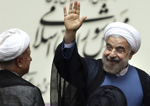
 Fox News: These are vital questions as the U.S. and European nations grapple with the question of easing sanctions against Tehran in return for changes in Iran’s nuclear program. The truth is, no one has definitive answers.
Fox News
By Jonathan Hunt
Who’s really running Iran?
President Hassan Rouhani is the public face of the leadership, but is he the moderate reformer the West hopes he is, or is he, as Israeli Prime Minister Benjamin Netanyahu said, a “wolf in sheep’s clothing?” And does it even matter if Supreme Leader Ayatollah Khamenei and his hard line allies are really running the show?
These are vital questions as the U.S. and European nations grapple with the question of easing sanctions against Tehran in return for changes in Iran’s nuclear program. The truth is, no one has definitive answers. But there are clues in certain aspects of Iranian life and politics. And human rights is one of those areas.
“There is some discussion that the spike (in executions) is in fact a message from the hard liners in Iran that are in the judiciary and otherwise to Rouhani and the more reformist-minded leaning elements of government that they are not going to go down without a fight.”
– Gissou Nia, Iran Human Rights Documentation Center
The self-described non-partisan Iran Human Rights Documentation Center keeps a running tally of the number of executions in Iran, based on the organization’s extensive range of contacts and the Iranian government’s general willingness to announce most executions.
According to the IHRDC, at least 529 people have been executed in Iran this year (Iranian officials admit to about 400 of those). Nearly half of the death toll has occurred since Rouhani took power on Aug. 4. The frenetic pace of executions, often of rapists, drug dealers and petty criminals, works out to a little over 13 executions every week, or about two per day.
In the U.S., the death penalty is reserved for what are considered the most heinous of crimes. There have been 35 executions in the United States this year, among a population of 317 million. Iran, which has a population of approximately 80 million, executes more people per year than any nation except China, and more – by far – than any other nation on a per capita basis.
The brutal brand of justice has led some observers to embrace Netanyahu’s view that, not only is his “moderate” posture an illusion, but that he is even more hard-line than his predecessor, Mahmoud Ahmadinejad. Those critics say Rouhani is a man who will say one thing while doing another, making him an especially dangerous man to deal with when it comes to nuclear issues.
There’s another possibility, according to Gissou Nia, executive director of the IHRDC, and formerly a lawyer with the International Criminal Court in the Hague.
“There is some discussion that the spike (in executions) is in fact a message from the hard liners in Iran that are in the judiciary and otherwise to Rouhani and the more reformist-minded leaning elements of government that they are not going to go down without a fight,” Nia said.
In Nia’s view, the rise in the number of executions might in fact be a “reaction to moderation” and part of an ongoing political battle in Iran.
“There is definitely a power struggle that’s playing out right now internally inside Iran between those more reformist-leaning elements of government, like Rouhani and (Foreign Minister Javad) Zarif and his cabinet, and those who are conservative hard-liners [who are] in the judiciary and control the sentencing,” she said.
The judges may have the Khamenei on their side, which, in Nia’s view makes human rights an urgent issue for the West to deal with, and one which shouldn’t be left aside while we focus on Iran’s nuclear program.
“Human rights needs to be elevated when Iran is at the table discussing nuclear issues,” she said. “I’d like to see human rights be a part of that conversation, very much in the mold of a Helsinki process where human rights were a core part of what was agreed upon in a way moving forward.”
Rouhani, who pledged from the campaign trail earlier this year to advocate for human rights, must be judged on actions, not words, when it comes to human rights, Nia said.
“He has talked about the rights of ethnic minorities, religious minorities, women, making sure that to improve gender equality, and bring equality to the sexes,” Nia said. “So this is a president who in my view was elected on a human rights mandate. “
There are many Iranian activists who feel that Rouhani has already betrayed the campaign promises and that the Obama administration is being naive in engaging the Iranian regime. Nia sides with those who would talk with, rather than isolate, Rouhani.
“I am cautiously optimistic,” she said. “Now we have a president and elements in his government with whom one can have a conversation. Iran was essentially black for the previous eight years. So I think that him taking office is a very positive step but that step needs to be coupled with action.”
Nia argues, essentially, that we should give peace a chance, in the hope that it can change the lives of millions of Iranians, and perhaps reduce the frightening rate of executions.
“I’d say that engagement but with a high priority on discussing human rights,” she says. “It cannot be that the only things at the table to be discussed are the nuclear situation, the conflict in Syria, resolution of the Israel Palestine dispute. There needs to be discussion of human rights. What is affecting the citizenry inside the country. So I think that needs to be elevated and with engagement and conditioning, different conditioning, and opening some of these human rights benchmarks, then we’ll see real progress.”
Someone is right about President Rouhani. Someone is wrong. And at some point we’ll find out whether he is a wolf or a sheep. It’s a high-stakes guessing game. And the result will affect every Iranian, and every one of us too, if we guess wrong.


