


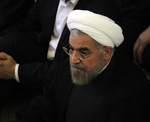
 Reuters: Iran and the United States signaled a fresh will on Sunday to seek to end the dispute over Tehran’s nuclear program after Hassan Rouhani was sworn in as president and called for dialogue to reduce “antagonism and aggression”.
By Yeganeh Torbati and Marcus George
DUBAI (Reuters) – Iran and the United States signaled a fresh will on Sunday to seek to end the dispute over Tehran’s nuclear program after Hassan Rouhani was sworn in as president and called for dialogue to reduce “antagonism and aggression”.
Hopes for a diplomatic resolution increased with Rouhani’s win over conservative rivals in June, when voters replaced hardliner Mahmoud Ahmadinejad with a cleric whose watchword is “moderation” but who is still very much an Islamic Republic insider.
“The only way for interaction with Iran is dialogue on an equal footing, confidence-building and mutual respect as well as reducing antagonism and aggression,” Rouhani told parliament after taking his oath of office.
“If you want the right response, don’t speak with Iran in the language of sanctions, speak in the language of respect,” he said.
Within hours, the United States said it was ready to work with Rouhani’s government if it were serious about engagement.
“The inauguration of President Rouhani presents an opportunity for Iran to act quickly to resolve the international community’s deep concerns over Iran’s nuclear program,” White House spokesman Jay Carney said in a statement.
“Should this new government choose to engage substantively and seriously to meet its international obligations and find a peaceful solution to this issue, it will find a willing partner in the United States.”
Iran’s critics say it has used previous nuclear negotiations as a delaying tactic while continuing to develop nuclear weapons-related technology – something Tehran denies.
Signaling both his wish to get straight down to work and a likely willingness to engage with the United States, Rouhani immediately presented a list of cabinet nominees to the parliament speaker that included Iran’s former ambassador to the United Nations, Mohammad Javad Zarif, as foreign minister.
Parliament must approve the proposed ministers before they can take office and the speaker said the assembly would review the nominees in the next week.
Zarif is a respected diplomat involved in negotiations with the United States since the 1980s and well known to top U.S. officials including Vice President Joe Biden and Defense Secretary Chuck Hagel.
“GULF OF MISPERCEPTIONS”
Western envoys familiar with Zarif have said his appointment may be a sign of Rouhani’s interest in breaking the deadlock with the United States.
Ali Vaez, Iran analyst at the International Crisis Group, said Zarif had unique skills that “allow him to bridge the great gulf of misperceptions between Iran and the West.”
“No one else is better suited to take on the grim but grand task of ending Iran’s isolation at this time of national peril,” he told Reuters.
Any new overtures to the West would have to be approved by Ayatollah Ali Khamenei, who has maintained a staunchly anti-Western stance since becoming Iran’s supreme leader in 1989.
After eight years of Ahmadinejad’s confrontational government, under which the West tightened sanctions making daily life tougher for normal Iranians, Khamenei is likely to give Rouhani a chance to resolve the issue, but has publicly expressed more skepticism of the chances of a solution.
Though less hard line than his predecessor, Rouhani has held important military and security posts since the Islamic revolution of 1979. He was head of the Supreme National Security Council for 16 years and one of two personal representatives of Khamenei on the same body for another eight years.
Rouhani did not name a candidate to head the Supreme National Security Council. The person occupying that position is usually also Iran’s chief negotiator in its talks with world powers over its nuclear program.
Iranian news agencies last month said Rouhani would nominate Mohammad Forouzandeh, a former Revolutionary Guard, defense minister and member of Iran’s Security Council, for the post.
(Writing by Jon Hemming; Editing by Robin Pomeroy)


