


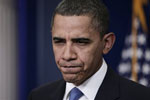
 AFP: US President Barack Obama in an annual video message marking Nowruz, Iran’s new year celebrations on Thursday, called on the “entire” government in Tehran to seize on nuclear talks with world powers to end Iran’s economic isolation.
WASHINGTON (AFP) – US President Barack Obama on Thursday called on the “entire” government in Tehran to seize on nuclear talks with world powers to end Iran’s economic isolation.
Obama made what appeared to be a direct effort to build political pressure among Iranians in favour of the nuclear diplomacy led by the government of President Hassan Rouhani in an annual video message marking Nowruz, new year celebrations.
Obama noted in his message that Iranians had elected the comparatively moderate Rouhani last year to strengthen the economy, improve their lives and engage constructively with the world.
Blaming Iran’s recent economic hardship on “the choices of Iranian leaders,” he said “you deserve better,” as he made a highly political case to the Iranian people on the importance of reaching a final nuclear deal, which could loosen the damaging grip of economic sanctions on Iran’s economy.
But, a day after the latest round of talks between P5+1 powers and Tehran wrapped up, Obama warned he was under “no illusions” and knew the work to cement an interim deal last year, in which Iran froze aspects of its nuclear program in return for limited relief from sanctions, would be difficult.
Obama also sought to build political pressure on hardliners in the Iranian government, noting that Supreme Leader Ayatollah Ali Khamenei had said Iran was not developing nuclear weapons.
– ‘A new chapter’ –
“There is a chance to reach an agreement if Iran takes meaningful and verifiable steps to assure the world that its nuclear program is for peaceful purposes only,” Obama said.
He openly tried to sell the benefits of a full nuclear deal, which he said would mean more trade with the rest of the world, higher economic growth, and jobs for young Iranians and the chance for Iranian students to travel the globe.
“If Iran seizes this moment, this Nowruz could mark not just the beginning of a new year, but a new chapter in the history of Iran and it’s role in the world,” he said.
Obama has faced a tough battle to convince critics in the US Congress about the wisdom of his diplomatic approach and fought off a bid by lawmakers to impose new sanctions which he said could scupper the diplomacy.
Israel has also expressed extreme skepticism over the interim deal and said a final agreement must include a complete dismantling of all Iran’s nuclear infrastructure.
Obama has previously argued that such a “perfect” solution to the years-long standoff is not practical, but that a way could be found to verifiably ensure that Tehran is not producing nuclear weapons.
The Nowruz message was the latest in an annual series that Obama began addressing to Iranians in the first year of his presidency in 2009. But until the election of Rouhani — with whom he spoke in a historic telephone call during UN meetings in New York last year — his advances were rejected.
US Secretary of State John Kerry, who was instrumental in opening the talks, said in his own statement that although America and Iran had suffered “harsh winters” in the past, a new opportunity was at hand.
Iranian Foreign Minister Mohammad Javad Zarif said on Wednesday he saw “signs” a long-term nuclear deal could be reached after the latest talks in Vienna.
“An understanding is possible that respects the rights of the Iranian nation,” the Fars news agency quoted Zarif as saying.
The next meeting will come in April and will begin drafting the text of an agreement.
Under an interim agreement Iran struck with the six powers in November, the two sides are aiming for a long-term deal by July 20.
There are four key issues in any agreement — the status of Iran’s Arak heavy water reactor — which Israel fears could offer an alternative route to a bomb — its enrichment of uranium, civil nuclear cooperation and the lifting of Western sanctions.
The six powers — Britain, China, France, Russia and the United States plus Germany — want Iran to reduce permanently, or at least long-term, the scope of its nuclear activities to make it extremely difficult for it ever to develop nuclear weapons.
Iran has always denied any such ambition.


