


By Jubin Katiraie
Iran’s theocratic government has not only been condemned for human rights abuse, it allows its 80 million citizens to struggle to feed their families, its corruption and mismanagement has led to power outages and water shortages. Food prices that have risen by more than 50 percent, and the people are fed up with the government using its money and resources for the export of terror.
The second round of U.S. sanctions that came into effect on November 5th target oil and banking. Today, Iran produces 1 million fewer barrels of oil per day than it did prior to the sanctions.The Iranian economy has lost $2 billion since November. Still, the government continues to fund terrorism.
Many blame Supreme Leader Ayatollah Ali Khamenei and President Hassan Rouhani. Aggressive military expansionism across the Middle East has had a high cost in men and resources. Ordinary Iranians don’t support Bashar al-Assad’s civil war, or the campaign against the Sunni population of neighboring Iraq, or support for the Houthi rebels in Yemen. They especially don’t support the $750 million a year used to fund Hezbollah terrorists in Lebanon.
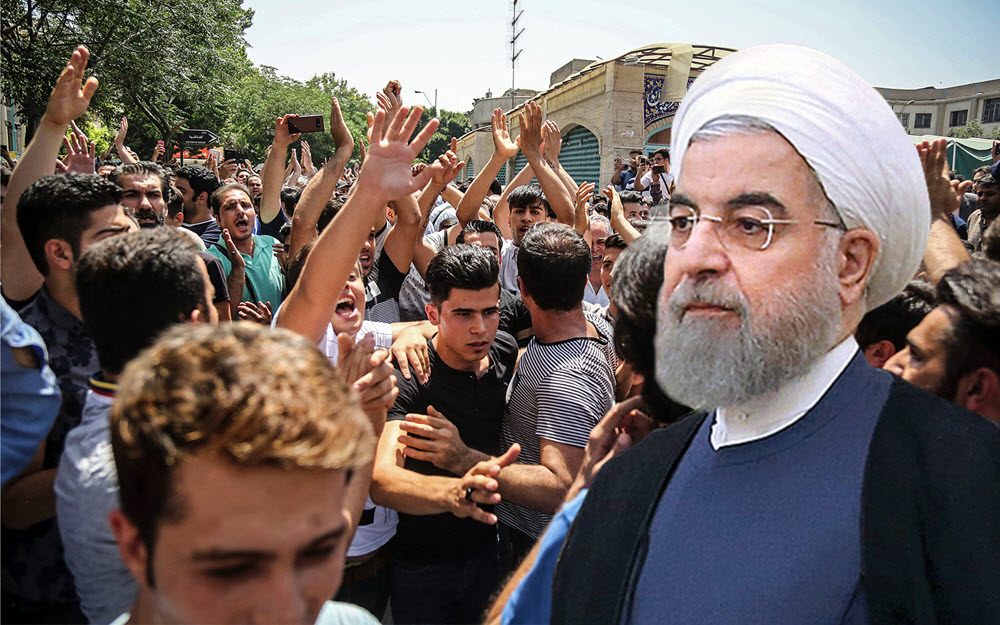
A country with the world’s second-largest gas reserves and fourth-largest crude oil reserves is facing an economic catastrophe, which fuels the nationwide protests. Every day for more than a year, Iranians have taken to the streets, to protest corruption and spending on terror.
The Islamic Revolutionary Guards Corps have cracked down on protesters and strikers. Dozens have been killed, and over 12,000 are believed to have been arrested.
In response, the government has staged a number of trials of prominent businessmen, labeled as “sultans.” Several of these “sultans” have been executed for corruption, including Vahid Mazlumin and Hamid Darmani. Another 31 merchants have been charged with corruption and systematic smuggling.
After the revolution, the government established the Foundation of the Underprivileged. Twenty-eight private banks and industries were confiscated by the state, together with the properties of many businessmen active in the Iranian economy. All were nationalized and given to the foundation — which was wholly controlled by the founder of the Islamic Republic, Ayatollah Khomeini. In 2013, this foundation was valued at $95 billion.
Foundations like this get their funding directly from the government, pay no taxes, and are not held accountable for how they spend their money. The IRGC is enmeshed with these foundations. Some of the IRGC companies also run missile factories.
Coordinator of the Campaign for Iran Change, Struan Stevenson, former member of the European Parliament, president of the Parliament’s Delegation for Relations with Iraq, and chairman of Friends of a Free Iran Intergroup states, “The IRGC’s stranglehold on the Iranian economy has been disastrous. There are 75,000 unfinished construction projects in Iran. Money is allocated annually, but never spent on these projects. The government owes $150 billion to contractors. So, the government has been held hostage by the IRGC for years because of these escalating debts. The resulting devastation of Iran’s production capabilities has been massive. Thirty-eight cotton companies closed last year. A thousand factory units building fridges, TVs, textiles, etc., have also closed. Mass unemployment has been the inevitable result. There are 1.2 million more unemployed people in Iran every year, mostly young people. The government’s own statistics say the average monthly wage of a worker today is only enough to last for one week. People are now selling their organs, kidneys and bone marrow to try to avoid starvation. Twenty thousand people are sleeping rough in Tehran alone, of which 5,000 are women.”
In 2018 the International Monetary Fund said that Iran had 1.5 percent negative growth. It predicts 3.6 percent negative growth in 2019 and a decrease of $97 billion in GDP. Iranian society is facing chaos.
The government has turned their attention to demonizing the main democratic opposition movement, the Peoples’ Mojahedin of Iran (PMOI or MEK) to distract from the reality of their economic mismanagement. That is why the protesters on the streets of every town and city in Iran can be heard shouting “death to this deceiving government.”


