


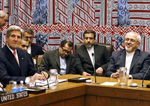
 AP: The top U.S. and Iranian diplomats searched Monday for a breakthrough in nuclear talks, their efforts complicated by crises across the Middle East and beyond that have Washington and Tehran aligned in some places but often opposed. The state of U.S.-Iranian relations was adding a new wrinkle to the long negotiation aimed at curbing the Islamic republic’s uranium and plutonium programs.
The Associated Press
By Bradley Klapper and George Jahn
VIENNA (AP) — The top U.S. and Iranian diplomats searched Monday for a breakthrough in nuclear talks, their efforts complicated by crises across the Middle East and beyond that have Washington and Tehran aligned in some places but often opposed.
The state of U.S.-Iranian relations was adding a new wrinkle to the long negotiation aimed at curbing the Islamic republic’s uranium and plutonium programs.
While the two sides are arguably fighting proxy wars in Israel, Gaza and Syria, they’re talking cooperation in Iraq and Afghanistan. And, perhaps in a first, the nuclear matter is battling for full attention.
U.S. Secretary of State John Kerry and Iranian Foreign Minister Mohammed Javad Zarif spoke for about two hours around midday Monday, the second day of talks in Vienna. They gathered again in the afternoon, hoping to make progress before Sunday’s initial deadline for a comprehensive nuclear agreement. An extension of the deadline is possible, though there are opponents of that idea on both sides.
“We are in the middle of talks about nuclear proliferation and reining in Iran’s program,” Kerry told U.S. Embassy staff in Vienna during a break in the conversations. “It is a really tough negotiation.”
But other matters were being discussed, too, including Afghanistan, where Kerry visited before Vienna to broker a power-sharing agreement between rival presidential candidates and a full audit of their contested election.
As the two diplomats sat down Sunday, Zarif called Kerry’s Afghan mediation “extremely important” for the Afghan people and echoed the need “to ensure the national unity of Afghanistan and prevent its breakup.”
“We agree,” Kerry said. “And it’s good to begin with an agreement.”
But even as the U.S. and Iran have recently found increasing areas for cooperation, such as stemming a flow of Sunni extremists into Iraq, they remain diametrically opposed elsewhere.
The U.S-Iranian regional divide was underscored Monday as the Israeli military downed a drone launched by Gaza militants – the first such unmanned aircraft encountered since the start of the Jewish state’s offensive last week.
Iran is Hamas’ primary benefactor and the presumed source of its newfound drone capacity. Washington provides billions in aid each year to Israel.
The State Department didn’t say if Kerry and Zarif broached the escalating Israeli-Palestinian violence or the civil war in neighboring Syria, where the U.S. is providing political and military support to moderate rebels fighting President Bashar Assad’s Iranian-backed government.
But one change appeared clear in this week’s talks. Unlike in years past, where U.S.-Iranian interaction appeared largely limited to nuclear matters, the two countries’ interests now crisscross at multiple levels, and their discussions are broader.
Nevertheless, American officials said Kerry was focused on tackling the many differences between the U.S. and Iran on nuclear matters. His goal is to gauge “Iran’s willingness to make the critical choices it needs to make,” according to a senior State Department official.
The official wasn’t authorized to be quoted by name and demanded anonymity.
Monday’s talks came a day after Kerry and the foreign ministers of Britain, France and Germany failed to reach a breakthrough with Iran on uranium enrichment and other issues standing in the way of a deal that would curb Iran’s nuclear program in exchange for the end of nuclear-related sanctions on Tehran. Each official cited significant gaps.
Iran says it needs to expand enrichment to make reactor fuel and insists it does not want atomic arms. But the U.S. and others fear Tehran could steer the activity toward manufacturing the core of nuclear missiles. Washington is leading the insistence on deep enrichment cuts.
Under a six-month interim agreement that went into effect in January, world powers and Iran have until July 20 to conclude a final deal. The goal for the West is a long-term agreement setting clear limits on Iranian activity and locking in place an international monitoring regime to ensure that the Islamic republic cannot develop nuclear weapons.
The interim arrangement also offers the option of an additional six-month period for negotiations, an extension that appears increasingly likely. Officials have suggested they may agree on a shorter window, however.
In Washington, White House spokesman Josh Earnest wouldn’t say whether President Barack Obama had authorized Kerry to extend the deadline if necessary.
“To its credit, Iran has defied the expectations of some,” Earnest said, by fulfilling some of the steps it agreed to take. But he said on other key issues Iran hasn’t yet made the decisions needed to prove the world its intentions are peaceful. “That’s ultimately where the gaps remain,” he said.
For the U.S. and Iran, an extension makes sense in multiple ways. With so much at stake, and the potential for U.S.-Iranian cooperation in other areas being explored, neither side wants to terminate the nuclear talks. Such a course could put Tehran back on a path toward isolation and even set the stage for U.S. military action if Iran proceeded again toward nuclear weapons capacity.
Even if their interests in continuing nuclear talks align, both face difficult internal pressures against a deal – or an extension for that matter.
Iranian hardliners oppose almost any concession by President Hassan Rouhani’s government. In the U.S., some lawmakers have threatened to scuttle any emerging agreement if it would allow Iran to maintain some enrichment capacity.
A letter being circulated in Congress by Sens. Bob Menendez, D-N.J., and Lindsey Graham, R-S.C., emphasizes that a lessening of U.S. sanctions should be conditional on the nuclear agreement making tough demands on Iran.
These would include international inspections lasting for a minimum of two decades and full disclosure by Iran of any military aspects of its nuclear program.


