


 Washington Post: A diplomatic breakthrough resulting in a peaceful and verifiable termination of Iran’s nuclear weapons program is the preferred outcome of the Obama administration’s negotiations with Iran.
The Washington Post
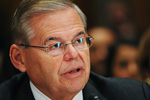
By Robert Menendez, chairman of the Senate Foreign Relations Committee
A diplomatic breakthrough resulting in a peaceful and verifiable termination of Iran’s nuclear weapons program is the preferred outcome of the Obama administration’s negotiations with Iran.
Backing up this achievement by taking out a diplomatic insurance policy is an act of reasonable pragmatism.
The need for additional prospective sanctions is already clear. Since an agreement was reached in Geneva in November:
●Iran has continued elements of construction in Arak, a heavy-water nuclear reactor site that, if completed, would provide an alternate plutonium track to a nuclear weapon.
●Iran announced that it is building a new generation of centrifuges for uranium enrichment and conceded that it has 19,000 centrifuges, a thousand more than previously disclosed.
●The Iranians fired a rocket into space, expanding their space technology program and improving their ability to develop a long-range ballistic missile.
●Iranian lawmakers have proposed legislation to enrich uranium up to 60 percent, well beyond any potential use for peaceful purposes.
●And when the Treasury Department blacklisted 19 companies for sanctions evasion last month, the Iranians, demonstrating their customary bluff-and-bluster techniques, walked out of negotiations.
These actions cannot be accepted as simply the price of doing business with Iran.
Opponents of prospective sanctions against Iran argue that sanctions are like a spigot — easy to turn on and easy to turn off.
But the story of sanctions, while effective, is more complicated.
Passing anything in Congress takes time. Writing regulations and implementing sanctions takes even longer, and enforcement of sanctions is an ongoing process.
The Nuclear Weapons Free Iran Act, a bill with bipartisan support in the Senate, guarantees immediate additional sanctions if Iran breaches its diplomatic commitments.
The legislation endorses the Obama administration’s efforts and the Joint Plan of Action achieved in November. It supports continued negotiations, gives the administration a year of flexibility to secure a comprehensive agreement, respects the sanctions relief Iran is set to receive and prevents any new sanctions from taking effect while good-faith negotiations are underway.
If the Iranians abide by their commitments, they’ll receive the economic relief they desperately want.
Should Iran breach this agreement or fail to negotiate in good faith, the penalties it would face are severe. Nations would be required to further reduce their purchases of Iranian petroleum, and new sanctions would be applied against Iran’s mining, engineering and construction sectors.
Iranian Foreign Minister Mohammad Javad Zarif has said that “the entire deal is dead” if prospective sanctions are passed by Congress. “We do not like to negotiate under duress,” he told Time magazine.
But the opposite is true. The proposed legislation is a clarifying action. It allows all sides to negotiate in certainties and provides one year of space for the parties to continue talking. It spells out precisely the consequences should the agreement fail. This should motivate Iranians to negotiate honestly and seriously.
At the same time, these prospective sanctions play a positive and reinforcing role in negotiations. The big winner is the administration. Its ability to pursue a diplomatic path is enhanced by being able to communicate this position in its negotiations with Iran.
This is hardly a march to war, as some critics have suggested. The legislation explicitly does not authorize the use of force, though it does restate the language of a resolution, passed 99 to 0 by the Senate, supporting the United States’ commitment to Israel, should Israel be forced to defend itself against Iran.
The American public supports diplomacy. So do I.
The American public doesn’t trust the Iranian regime. Neither do I.
During this pivotal time, we have a responsibility to work together across parties and branches of government in the interest of achieving U.S. national security objectives.
As the Senate returns to work, let us concentrate our efforts on achieving shared goals: a diplomatic resolution to Iran’s pursuit of nuclear weapons, coupled with a diplomatic insurance policy should negotiations fail.
Robert Menendez, a Democrat from New Jersey, is chairman of the Senate Foreign Relations Committee.


