


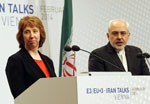
 Daily Caller: Three days of negotiations in the fourth round of Geneva discussions ended in arguments and confrontations when the Iranian team presented new “red lines,” diminishing any hope by the Obama administration to claim victory in its approach to Iran’s nuclear ambitions.
The Daily Caller
By Reza Kahlili
Iran has thrown up new roadblocks to reaching a deal with the P5+1 world powers over its illicit nuclear program.
Three days of negotiations in the fourth round of Geneva discussions ended Friday in arguments and confrontations when the Iranian team presented their country’s new “red lines,” diminishing any hope by the Obama administration to claim victory in its approach to Iran’s nuclear ambitions, according to reports from Iran.
Hossein Shariatmadari, a former torturer and now managing editor of the conservative newspaper Keyhan, the mouthpiece of the country’s supreme leader, in an Op-Ed published Saturday revealed details of the Geneva negotiations and congratulated the Iranian delegation for its steadfast demand that the country has a right to pursue nuclear development.
The Obama administration hoped that with Iranian President Hassan Rouhani and Foreign Minister Javad Zarif showing an eagerness to solve the nuclear issue and address the West’s concerns, there would be a possibility for a negotiated solution. An interim agreement penned last November in Geneva was touted as a “historic nuclear deal.”
Under that agreement, Iran — in return for billions of dollars in sanctions relief — limited its enrichment activity to the 5 percent level with a current stockpile of over 10 tons (enough for six nuclear bombs), converted much of its 20 percent enriched stock to harmless oxide and agreed to allow more intrusive inspections of its nuclear plants by the International Atomic Energy Agency, whose inspections were limited to only agreed-on facilities.
The final draft of the agreement to address all of Iran’s nuclear facilities and activities, along with its missile program, was planned to be finalized this July.
“The Obama administration and its allies were drunken happy after the initial agreement,” said Shariatmadari, who had previously criticized the Iranian negotiating officials for being soft with their Western counterparts. “With this delusion, that with the continuation of negotiations they could wrap up the issue, they had come prepared to Geneva with their demeaning requests of security ‘breakout’ or preventive measures of (possible military dimensions). … To present these conditions as their winning cards on the negotiating table, they could not imagine in their wildest dreams that this time the Iranian negotiators on the other side of the table … were aware of the opponents’ tricks.”
The red lines that the Iranian delegation presented, as stated by Shariatmadari, are:
• The expansion of Iranian nuclear research and development.
• The acceptance of Iran’s need for enrichment on a level that feeds the need of the country (the country has over 19,000 centrifuges, far more than is needed for peaceful nuclear purposes, and would like to expand).
• The preservation of the Arak heavy-water plant (the plant once operational could produce plutonium and serve the ruling clerics with a second path to nuclear weapons).
• No interference or limitation to the country’s military and defensive measures (the Islamic regime is under U.N. sanctions for developing ballistic missiles and it currently holds the largest missile stockpile in the Middle East with ranges capable of reaching as far as Europe).
• The removal of all sanctions at once as opposed to step-by-step relief (the U.N. resolutions and sanctions in place are the results of efforts by several U.S. administrations and over a decade of negotiations).
“These (red) lines, which the enemy had never expected to see, at first caused their disbelief and then their anger to the level of shouts and arguments,” Shariatmadari wrote. “The opponents thought that the conditions set by the Iranian delegates were meant to increase (Iran’s) negotiating power, but when faced with their absolute resolve … they realized that their dreams were swept away and that the Geneva 4meeting had failed.”
According to a source within the regime’s intelligence community, the leadership will not give up its nuclear ambitions, and the Revolutionary Guards see themselves as the dominating power in the Middle East and beyond. They believe that the Obama administration will not engage militarily and that the regime needs to weather the sanctions regime, which has already cracked due to the initial Geneva agreement.
Reza Kahlili is a pseudonym for a former CIA operative in Iran’s Revolutionary Guards and author of the award winning book “A Time to Betray” (Simon & Schuster, 2010).


