


 Wall Street Journal: As Iran approaches the anniversary of Hasan Rouhani’s presidential victory, the Islamic Republic’s human-rights record, particularly its treatment of religious minorities, remains abysmal. This is especially true for the Baha’is, Iran’s largest non-Muslim religious minority.
The Islamic Republic’s persecution of the Baha’i has intensified under President Rouhani.
The Wall Street Journal
By Robert P. George and Katrina Lantos Swett
As Iran approaches the anniversary of Hasan Rouhani’s presidential victory, the Islamic Republic’s human-rights record, particularly its treatment of religious minorities, remains abysmal. This is especially true for the Baha’is, Iran’s largest non-Muslim religious minority.
As with the cases of jailed Christian pastors, such as Saeed Abedini and Farshid Fathi, the Tehran regime shows no signs of wanting to free the so-called Baha’i seven—Baha’i leaders jailed on spurious charges, from espionage to “spreading corruption on the earth”—nor of stopping the persecution of its Baha’i population, which numbers more than 300,000.
Both houses of the U.S. Congress have spoken out for the Baha’is and other religious minorities in Iran. The Senate last December passed a resolution condemning Baha’i persecution. We urge the House to pass the companion measure speedily. Without continued attention from the U.S. and other members of the international community, the future of the Baha’is in the birthplace of their faith will be bleak, as will the fate of Iran’s other minorities.
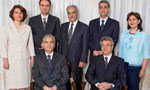
May 23 marks the 170th anniversary of the birth of the Baha’i faith in Iran. The faith emphasizes the unity of humankind. May 14 marked six years that the Baha’i seven—Jamaloddin Khanjani, Afif Naeimi, Saeid Rezaie, Behrouz Tavakkoli, Vahid Tizfahm, Fariba Kamalabadi and Mahvash Sabet —have been incarcerated for their faith. And as the U.S. Commission on International Religious Freedom (USCIRF), on which we serve, noted in its just-released annual report, the number of Baha’i religious prisoners has increased under Mr. Rouhani. As of February 2014, at least 135 Baha’is remained jailed for their beliefs. Hundreds more, though no longer detained, have cases pending.
Enlarge Image
Seven Baha’i leaders jailed for their beliefs in the Islamic Republic of Iran. Bahai World News Service
It is well-known that Baha’is seek peace, not political power, and pose no conceivable security threat. Yet Iran’s theocracy persecutes them, revealing a deep aversion to those whose only “crime” is embracing beliefs other than the regime’s.
While all religious communities in Iran have suffered persecution since the 1979 Khomeinist revolution, none have fared worse than the Baha’is. The government has since killed more than 200 Baha’i leaders and removed more than 10,000 from government and university positions.
Baha’is are mistreated in nearly every stage and station in life. Last year, USCIRF received reports of Baha’i babies incarcerated with their mothers. Baha’is are barred from attending colleges and universities, from starting their own schools, and from establishing houses of worship to raise their children in their faith. Baha’is can’t serve in the military and face job bias elsewhere. Authorities won’t recognize their marriages, and Iran’s media demonize Baha’is, reinforcing their pariah status.
When Baha’is die, their relatives can’t inherit their property, have difficulty obtaining their death certificates and often witness the desecration of their grave sites, not just by vandals but by the government. Recently Iran’s Revolutionary Guards began excavating a Baha’i cemetery that is the resting place for 10 women the government hanged in 1983. They were convicted of “crimes” that included teaching children’s classes. The women chose to die rather than renounce their faith.
Taking their cue from the regime and media, extremists have attacked Baha’i property in several cities. In August 2013, following months of interrogation, a local Baha’i leader, Ataollah Rezvani, was killed for his faith. No one has been charged with his murder.
In the face of these abuses, the U.S. should recognize that when it comes to human rights and religious freedom, Mr. Rouhani has yet to bring reform. Second, Washington must ponder the implications of Baha’i persecution. The Baha’is threaten no one; religious dictates and doctrine alone drive their persecution. Baha’i repression confirms Tehran’s theocratic character and suggests that change won’t come easily.
Third, in dealing with Tehran, the U.S. should push for religious freedom and related rights, while continuing to identify Iranian agencies and officials responsible for severe abuses, and then freezing their assets and barring them from entering the U.S. as required under American law.
Finally, the U.S. Congress should continue drawing attention to the Baha’is and other abused Iranians through legislation and other measures. Congress also should keep spotlighting the names, faces and stories behind these abuses.
Through the Defending Freedoms Project, an initiative of the Tom Lantos Human Rights Commission in collaboration with USCIRF and Amnesty International U.S.A., members of Congress have “adopted” prisoners of conscience, including Pastors Abedini and Fathi and the Baha’i seven, and advocated for their release. President Obama in February called for Pastor Abedini’s release. It’s time to call for the release of the Baha’i seven and other Iranian prisoners of conscience.
In the end, as go the Baha’is, so go freedom’s prospects in Iran.
—Mr. George serves as chairman of the U.S. Commission on International Religious Freedom and is a professor of jurisprudence at Princeton University. Ms. Lantos Swett serves as USCIRF vice chair and is president and CEO of the Lantos Foundation for Human Rights and Justice.


