


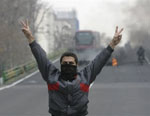
 UPI: Most people say predicting the future is a difficult thing to do. However, when it comes to predicting the political future of a country, especially an authoritative, dictatorial country, the task becomes rather simple. The upcoming elections in Iran may signal the start of a process that will replace the ruling clerics.
By MURIEL TURNER, UPI Outside View Commentator
LONDON, May 29 (UPI) — Most people say predicting the future is a difficult thing to do. However, when it comes to predicting the political future of a country, especially an authoritative, dictatorial country, the task becomes rather simple.
Forget about the crystal ball, forget about reading the tea leaves or the coffee grinds. You don’t need those to make a proper prediction. All that is required is a look at history books and you’ll see the answer.
They say that history repeats itself, yes, that’s true. Take a quick look at history and you will know what’s in store for Iran’s political future. Yes, indeed, Iran’s future is easy to predict.
These are the facts and they don’t lie. Much like all the other dictatorships that have come and gone before it, Iran’s authoritarian regime can’t last very long. Yes, you will say, but the mullahs been ruling Iran for the last 34 years now. Sure, but as far as history is concerned, 35 years in the greater context of history is but a very short paragraph, just a few lines in a very thick book.
And today Iran may have well reached the last sentence in that paragraph dedicated to the country’s disastrous experience with the mullahs and the helm. The epitaph on the tombstone of the Islamic Republic may well read something like this: “Here lies the remnants of the Islamic Republic, brought down by hard headedness of the supreme leader.”
By banning Akbar Hashemi Rafsanjani from running in the presidential elections next June, Iran’s supreme leader may have crossed the symbolic Rubicon, the deciding line from which there is to be no return. Rafsanjani was one of the founders of the Islamic Republic back in 1979. The fact that the revolution is turning against its founders is indicative that it has entered its final phase.
This recent call by Ayatollah Ali Khamenei may bring about a repetition of the street violence that accompanied the previous presidential elections and which almost brought down the regime. This time they may not be so lucky. If that doesn’t happen, as a result of the internal purge at the apex of power, its base will be rendered much weaker and significantly more vulnerable.
Rafsanjani played a decisive role in propelling Khamenei to the position of the supreme leader. As the chairman of the Expediency Council, Rafsanjani has been appointed by Khamenei personally, and as a member of the Assembly of Experts, he has a vote on appointing the supreme leader and assessing his qualifications within the framework of the clerical regime. Thus, his elimination is astonishingly scandalous and will discredit and de-legitimize the regime as a whole in the eyes of even its most ardent supporters.
At the same time the opposition is more energetic than ever. With a historic victory scored by the People’s Mujahedin of Iran, having been taken off the terrorist list by the European Union and the U.S. Department of State, the largest organized resistance group in Iran is spearheading the drive to label the election what it really is a sham, a farce, a joke.
In recent weeks Iranian activists have picked up the pace of their activities calling for regime change as the ultimate vote. Despite widespread crackdowns, graffiti and posters against the illegitimate election and the regime have surfaced, some of them with the portraits of Maryam Rajavi, the charismatic Iranian opposition leader.
Outside Iran the resistance is also gaining momentum. Last year, some 100,000 Iranians from all over the world gathered in Paris. They were joined by a stellar group of political personalities from the United States, France, Europe and the Muslim world along with hundreds of parliamentarians. This year a stronger show of force is expected June 22 in Paris.
And this farce will help expedite the matter, sending the mullahs to the confines of history where they will soon become a bad memory. And you don’t necessarily have to take my word for it; just ask the former leaders of Tunisia, Egypt, Libya, Yemen and Iraq. Where are they now the once mighty men who ruled over their countries, much like the “supreme leader” in Iran does today?
Still not convinced? Well then ask the former leaders of Romania, Poland, Bulgaria, Czechoslovakia and the rest of the former Soviet Union.
The trouble with dictators, be they in Iran, Syria, or North Korea, is that each and every one believes he is invincible and he will succeed with where others have failed.
But guess what? They all make the same mistake; they push a little too much and reach a point where the people will no longer be afraid.
That point has now been reached in Iran.
—
(Baroness Muriel Turner of Camden was deputy speaker of the British House of Lords until 2008 and she is a leading member of the British Parliamentary Committee for Iran Freedom.)


