


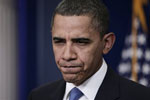
 Huffington Post: See for example where a lack of a policy has taken us in the killing of more and more Iranian dissidents – the MEK – in Iraq. Although the U.S. pledged repeatedly to protect them through various agreements, it did nothing after Iraq killed more than 50 of them more than a week ago.
The Huffington Post
By Allan Gerson
After all the convulsing it comes down to this: whether to extricate President Obama from his own folly in dealing with Syria.
The President is in a predicament of his own creation. Had he enforced the red-line he drew, had he authorized some small military strike, whatever turmoil might have followed from Congress or others would have been short-lived. Now the entire international spotlight rests on him. And the stakes are enormously higher, because if he does now what he might have easily done before – just a shot across the bow – we will be seen as toothless. And, if Congress fails to authorize action, paralyzing the President, U.S. national security will indeed suffer as our red-lines will become meaningless, leaving us to be perceived as a paper tiger or a faint-hearted “humanitarian”, or both.
Of course, the President never had to press for unilateral punishment, an idea that runs counter to the accepted principle of international law of non-resort to force except in self-defense. Nevertheless, if humanitarian instincts pull the president and the nation in a different direction when chemical weapons are employed, then so be it. At this point, the function of the president is to lead, not to summon Congressman from their vacations for a discussion (when their vacations are over). Yet, despite the fact that Congress had raised no hue and cry against the red-line he had drawn, President Obama experienced a crisis in self-confidence. He asked Congress to get him out of his dilemma. But this came at substantial risk: without congressional authorization, American and Presidential prestige would be at a low ebb. And with authorization, a military strike that proved inconsequential would damage U.S. credibility.
Now the President has the good fortune – or is it a Faustian bargain? – to have Russia as well as Congress to bail him out of his dilemma as an unwilling sheriff. But Russia’s proposal to put Assad’s chemical arsenal under UN control — one Assad rushed to accept – begs the question of who can be trusted to ensure this would work? And at the end of the day, whose standing would be enhanced, that of United States or Russia? For clearly, Russia as well as Congress would exact a price for being the President’s savior.
The lesson should be clear, last minute scramblings are no substitute for leadership. America cries out for a sound policy: a policy that is not a strait-jacket, but serves as a moral and political compass and an antidote to expediency.
See for example where a lack of a policy has taken us in the killing of more and more Iranian dissidents — the MEK — in Iraq. Although the U.S. pledged repeatedly to protect them through various agreements, it did nothing after Iraq killed more than 50 of them on a shooting spree in a “protected” camp more than a week ago. Yet, Iran judges America’s readiness to use all means to deter its nuclear ambitions based, at least partially, on whether we stop Iraq from doing Iran’s bidding in killing anti-mullah dissidents. When we turn a blind eye despite pledges to protect the MEK, when we do not offer them shelter in the United States, when we have no genuine policy of humanitarian concern, U.S. actions in Syria, regardless of what they are, are bound to ring hollow.
Allan Gerson is Chairman of AG International Law in Washington D.C.; Former Counsel to UN Ambassadors Jeane J. Kirkpatrick and General Vernon A. Walters


