


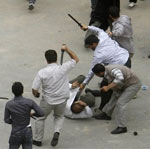
 The Hill: “Don’t give them an excuse to crack down on dissent,” is a favorite sophism spread among foreign-policy elites, lazy bureaucrats and big-chair academics. Dictators love it. The Obama administration remained shamefully silent throughout that tragic crackdown on Iranian dissent.
The Hill
By Mauricio Claver-Carone
“Don’t give them an excuse to crack down on dissent,” is a favorite sophism spread among foreign-policy elites, lazy bureaucrats and big-chair academics. Dictators love it. Why? Because as soon as it’s uttered, it shifts blame, immunizes them and effectively silences freedom’s advocates, even in the face of egregious violations of human rights and crimes against humanity.
Opponents of U.S. policy toward Cuba have seized “Don’t give them an excuse to crack down…” to fuel their attack on a USAID program that introduced and cultivated Twitter-style communications. Officially known as “Zunzuneo” (Cuban slang for hummingbird), the U.S.-funded effort gave the Cuban people a social-media means for communicating freely with each other, with no regard for the dictates of the Castro regime. Zunzuneo ran from 2009-2012. It ended not because it was ineffective, but because it was so successful, so quickly. Eventually, its success became disproportionate to its funding. That demonstrates the repressed hunger the Cuban people have to communicate freely.
In a recent report, “Freedom on the Net,” issued by Freedom House, Cuba is ranked as the world’s second-worst suppressor of freedom on the Internet and in digital media. Only Iran has a worse record. (North Korea was not ranked due to lack of any information.)
Yet, critics argue that the revelation over U.S.-backing of “Cuban Twitter” now gives the Castro regime an “excuse” to crack down on dissent.
Seriously? If so, what was the Castro regime’s “excuse” for its widespread repression before the “Cuban Twitter” revelation? What’s the “excuse” for the Castro regime’s weekly harassment, arrest and beating of peaceful pro-democracy Cuban women, known as The Ladies in White, for trying to congregate and attend Sunday Mass? What “excuse” does Cuba’s dictator Raul Castro use to justify his continuing repression? Political arrests are averaging more than 1,000 per month. Why? And what’s the “excuse” for the recent mysterious deaths of such Cuban democracy leaders, as Laura Pollan of The Ladies in White and of Oswaldo Paya, head of the Christian Liberation Movement?
Since taking office, the Obama administration has been implementing an “extended hand” policy toward the Cuba, by unilaterally easing sanctions and reinstating bilateral talks. Of course, there are some who blame Cuba’s repression on the U.S. embargo. But how does that explain Fidel Castro’s repression, mass executions and illegal confiscation of properties before the embargo?
Some critics try to extrapolate: A University of North Carolina Professor, Zeynep Tufekci, has called the revelation of U.S. funding the “Bay of Tweets.” She argues that the U.S. effort to provide Cubans with a Twitter-like platform has “just put Internet activists all over the world in danger” because oppressive regimes throughout the world will use it as an “excuse” to crack down on dissent.
Did Radio Free Europe and other historic U.S.-funded efforts to facilitate communications for democracy activists in the Soviet Bloc endanger them? Or did it empower them in their struggle against those repressive regimes? Former Czech dissident-turned-President Vàclav Havel and Poland’s Lech Walesa would argue the latter. They, too, were labeled as “U.S. fascist mercenaries” — to no effect.
Let’s look at some of today’s repressive regimes: What’s the Nicolas Maduro government’s excuse for arresting, torturing and killing Venezuelan students? There are no U.S. sanctions on Venezuela and the Obama administration repeatedly sought to accommodate Maduro’s predecessor, Hugo Chavez. What was Iran’s excuse for the 2009 arrest, torture and killing of courageous democracy activists during the Green Revolution? The Obama administration remained shamefully silent throughout that tragic crackdown on Iranian dissent. What’s Bashir al-Assad’s excuse for the genocide he is waging against the Syrian people? What’s Kim Jong-un’s excuse for his crimes against humanity against the North Korean people?
If the United States and other democratic nations embrace these dictatorial regimes, does anyone truly believe that they’ll stop repressing their people? Of course not.
Dictators use repression to stay in power. They repress because they’re afraid of dissent. They don’t need excuses. When for some reason they feel they must justify their actions, they’ll make up an “excuse,” just as Russia is doing in the Ukraine. The only people who believe a dictator’s “excuse” are the minions that propagate them.
Knowing that dictators make up excuses for their repression – regardless of what the United States and the free-world does – it should be a no-brainer for the American government to stand and actively support the development of civil societies and the democracy activists that strive to establish them within closed regimes throughout the world.
The United States should not subsidize repression or remain silently complicit, while wishfully awaiting the “good-graces” of dictators.
Claver-Carone is an attorney who formerly served with the U.S. Department of the Treasury and has served on the full-time faculty of The Catholic University of America’s School of Law and adjunct faculty of The George Washington University’s National Law Center.


