


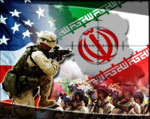
 The Hill: Images of unrest emerging from Iraq are deeply troubling and concerns relating to the rise of ISIS come from a noble place – an American belief that bullies should be held accountable. But such convictions are misplaced when it comes to the ongoing crisis on the Iraqi street. The real threat to peace and security in the Middle East is the Islamic Republic of Iran.
The Hill
By Ivan Sascha Sheehan
Images of unrest emerging from Iraq are deeply troubling and concerns relating to the rise of ISIS come from a noble place – an American belief that bullies should be held accountable.
But such convictions are misplaced when it comes to the ongoing crisis on the Iraqi street.
The real threat to peace and security in the Middle East is the Islamic Republic of Iran.
What is worrisome is that White House officials seem to lack a strategy to counter the larger threat posed by the ayatollah’s regime.
Confronting Tehran’s interference in Iraqi affairs requires that U.S. officials acknowledge that Iraqi anger is, in large part, a function of Iranian meddling.
Tehran’s systematic, deceptive, and unrelenting pursuit of nuclear weapons has heightened regional tensions; their failure to protect minority voices has led to human rights abuses; and their retaliation against anyone that fails to subscribe to their export of terrorism, instability, and religious fundamentalism has become an ideological commitment that fuels regional frustration.
The regime’s continued interference in the sovereign affairs of Iraq’s fledgling democracy now poses a challenge to U.S. interests.
It remains unclear whether the appointment of new Iraqi Prime Minister-designate Haider al-Abadi represents cosmetic change or an actual break with Tehran.
But what is absolutely certain is that Nouri al-Maliki’s departure will be a positive development for Iraq and an opportunity for the creation of a more inclusive, representative government in Baghdad.
But establishing the new Iraqi government will be challenging.
During his tenure as prime minister, Maliki served as a puppet of the Iranian regime, stoked sectarian conflict, and created tensions that inspire the civil unrest we see on the Iraqi street.
The new prime minister will inherit these tensions as well as very deep concerns by many in Iraq that their affairs are actually governed from Tehran and that Iranian mullahs will scuttle any hope of actual democracy flourishing.
The ongoing social unrest in Iraq arises from a deep concern that Sunnis, Kurds, and the plurality of voices that make up the country will have no voice in its future. Were it not for Maliki there would be no momentum to fuel the insurgent anger and resentment channeled by ISIS. In fact, ISIS appears much stronger than it actually is because it enjoys the support of disenfranchised Sunnis that make up about 20% of Iraq.
This marriage of convenience is hardly a declaration of common cause but rather an act of defiance against Iranian interference and a show of displeasure with Maliki’s rule.
The new Iraqi prime minister will need to go out of his way to demonstrate that he is not acting on Iran’s behest, that he is not Maliki 2.0, and that he does value religious and political pluralism.
As a preliminary measure, the new prime minister can immediately show that he is his own man by working with U.S. officials to resettle Iranian dissidents detained at a prison-like facility in Iraq called Camp Liberty.
The dissidents – members of the primary Iranian resistance to clerical rule, the MEK or PMOI – represent the best hope of regime change from within in Tehran.
The opposition group’s commitment to building a nuclear-free, democratic, gender-equal, secular state that is at peace with her neighbors has led to their repeated mistreatment by Maliki’s forces acting as Tehran’s proxies.
The failure to protect the 3,000 political refugees at Camp Liberty is the real impending humanitarian catastrophe in Iraq.
In the final analysis, Iraqi citizens want to know that their voices will be heard, that they can engage in opposition without fear of persecution, and that Iranian influence in their politics will be curtailed.
The real challenge in Iraq is the creation of a government that is inclusive enough to represent all of Iraq’s voices and promote grassroots reconciliation.
This will only be achieved when Tehran no longer has a seat at the political table in Iraq.
The new prime minister can cut the legs out from under ISIS and address the resentment many Iraqis feel by ending Maliki’s policy of doing Iran’s bidding.
But U.S. policy on Iran must also ensure significant consequence for continued Iranian interference in Iraq. The failure to act against Assad by enforcing the red line in Syria or push back on Putin’s adventures in Ukraine diminished U.S. credibility and squandered valuable influence. But Congress can correct these missteps by insisting that the White House lean in on Iran by giving the ayatollahs a new problem to keep them busy.
Since Tehran fears internal threats more than external ones, U.S. legislators should embrace a policy of regime change from within via Iran’s organized opposition.
Obama’s declaration that there is no military solution to Iraq’s troubles and that a legitimate Iraqi government must be established is an accurate diagnosis insofar as it goes. But the intoxication resulting from a combination of U.S. impotence, Iranian interference, and Iraqi frustration will only lead to continued regional instability.
Solving the Iraq puzzle requires that U.S. officials double down on the real threat in the Middle East and increase the prospect of collapse in Tehran.
Sheehan is director of the graduate programs in Negotiation and Conflict Management and Global Affairs and Human Security in the School of Public and International Affairs at the University of Baltimore.


