Home Blog Page 288

Iran-China Deal Unpopular With People and Officials

Iran and China signed a 25-year economic deal on Saturday, which liquidated much of Iran’s wealth and resources, as well as the “forfeiture of the Caspian Sea”, to China in exchange for a $400 billion investment into various sectors.

Little is known about the deal, which has been in talks since 2015, but even the small amount made public is so damaging that Iranian officials are comparing it to the Turkmenchay Treaty when the Qajar monarchy gave up much of their northern territory to Russia.

MP Hassan Norouzi said: “During the negotiations, the government agreed to forfeit Kish Island [an economic centre in the Persian Gulf] to China for 25 years.”

Even the little that China is paying for the resources will be mitigated by a reported two-year delay in payments, as well as the ability to pay in the Yuan, rather than the dollar. Iran is not getting a good deal, but the government is. The deal will help keep the mullahs in power after even the appeasement policies of Western powers were not enough to protect the Iranian economy, which is why they negotiated it.

Maryam Rajavi, the president-elect of the National Council of Resistance of Iran (NCRI), said: “The mullahs only think of preserving their own religious fascist dictatorship, which [regime founder Ruhollah] Khomeini said is the most important issue. He said they could even forsake the precepts of Islam to preserve the regime. Therefore, the mullahs could not care less about protecting the Iranian people’s assets and resources.”

Iran has no domestic production infrastructure, while any money earned from the export of natural resources, like oil and gas, is spent on ballistic missiles, nuclear projects, terrorist groups, and domestic repression. It’s a system designed to help the rich grow richer and keep the poor impoverished.

The Iranian opposition, People’s Mojahedin Organizaton of Iran, in this regard wrote: “The Iran-China deal will weaken an economy that is already on the verge of total collapse. Iran’s people are already dealing with skyrocketing prices, rampant inflation, and an unbridled coronavirus outbreak. The situation has left the people in utter outrage of the mullahs’ regime. Under such circumstances, instead of dealing with the country’s economic woes, the regime has decided to wholesale Iran’s resources to a foreign power.”

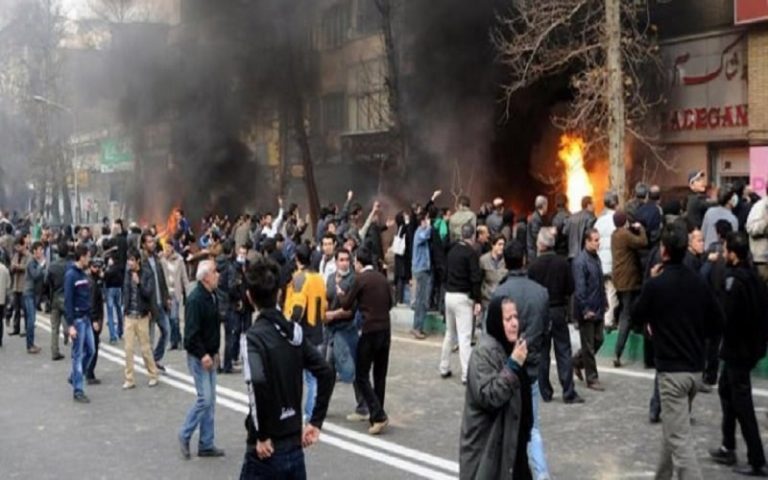
One thing is clear. This is an unpopular deal has angered people, and led to protests across the country.

Iranian Officials Endanger People’s Lives

These days, governments across the globe are doing their best to accelerate the vaccination pace against the deadly coronavirus. They could take significant steps to eradicate this ominous disease by decreasing the death rate. However, Iranian officials completely drive the country in the opposite direction.

Officials in Iran do not show any hurry in vaccinating the population. Instead, high-ranking authorities, including the Supreme Leader Ali Khamenei and President Hassan Rouhani, had deprived society of reliable Covid-19 vaccines.

“The import of American and British Covid-19 vaccines is forbidden,” said Khamenei on January 8. “I have said this [point] to officials, and now, I am saying it publicly.”

On the other hand, the officials justify their imprudence in procuring coronavirus vaccines by questioning their efficiency. “The side-effects of the vaccines are not truly clear for us, and which vaccine is more effective and until when they are effective,” said Rouhani on February 27. “Some people across the globe are even afraid of injecting the vaccine!”

Furthermore, in the best-case scenario, mass vaccination in Iran would start six or seven months from now. “Mass production of this vaccine needs certain infrastructure, and the Covid-19 vaccine in Iran will begin mass production in July or August of 2021,” the semiofficial ISNA news agency quoted Yahya Ebrahimi, a member of the Parliament (Majlis) Health Commission, as saying on December 29, 2020.

Iranian Officials Test Cuban Vaccines on Impoverished People

“Cuba said late on Friday it had signed an accord with Iran to transfer the technology for its most advanced coronavirus vaccine candidate and carry out last-stage clinical trials of the shot in the Islamic Republic,” Reuters reported on January 9.

Also, the former Health Ministry Spokesperson Kianush Jahanpour, who is currently the head of the Food and Drug Organization, acknowledged that 50,000 volunteers would be recruited to carry out the Phase III clinical trials. “Technology transfer and joint production were preconditions for allowing human testing in the country,” Jahanpour said.

Officials immediately denied the news about the last-stage clinical trials of Cuban Covid-19 vaccines. However, their secrecy and contradictory claims and bragging prompted observers to scrutinize the issue.

On March 24, the state-run TV reported that the government vaccinated 1,000 sweepers of Shiraz Municipality in Fars province. A day later, the TV acknowledged the vaccination of sweepers in Mashhad in the northeastern Iranian province of Razavi Khorasan. “Today, the second phase of vaccination of this group was started,” the TV reported on March 25.

However, the state-run media did not specify when these impoverished people received their first shot of vaccine and why the government had not announced the first phase. Meanwhile, the Iranian government refuses to pay municipal workers’ salaries and even insurance rights. Therefore, it is too odd that the government had vaccinated low-income workers for free.

The news about injecting experimental vaccines into sweepers prompted Iranian citizens’ anger. Particularly, the netizens severely slammed the government for putting impoverished people at risk. Following the eruption of public ire against the government’s bleak decisions, Jahanpour attended the state-run TV on March 26, denying the injection of Cuban vaccines into sweepers. “The trial of the Iranian-Cuban coronavirus vaccine has yet to start,” he added.

Jahanpour’s claims were contrary to remarks raised by Ali Reza Biglari, the head of the Pasteur institution. As the Cuban Vaccine custodian in Iran, Biglari had provided a report around two months ago. “In primary days, we could perform around 2,000 to 3,000 [experimental] tests per day. However, our capacity was immediately grown, and today, we perform around 50,000 tests every day. We can reach a higher number if the country needs it,” Biglari said in an interview with ISNA on February 3.

Iranian officials exploit the health crisis as a means to ensure their survival in power, dissidents say, reckoning that “Iran is not in another world, and it is impossible that the world achieves significant successions and decreases the death rate while the coronavirus victims in Iran are on the rise.” Notably, Khamenei had described the coronavirus as a ‘blessing’ on March 4, 2020. Today’s developments prove why he described it as such.

NSA Reveal Chatter About Planned Iran Terror Attack in DC

The US National Security Agency intercepted communications between Iranian Quds Force operatives in January about a concrete Iranian terrorist plot on American soil – an attack on Fort McNair in Washington DC – in an effort to kill Army Vice Chief of Staff General Joseph M. Martin.

This attack would have been Iran’s revenge for the January 2020 killing of Quds Force head Qassem Soleimani, the second most powerful figure in Iran. It shows that the Quds Force and the regime have not altered their objectives or tactics since the 2013 assassination attempt of Saudi Arabia’s ambassador to the US Adel al-Jubeir, which would have killed hundreds of civilians if the US hadn’t thwarted it.

The Iranian Resistance wrote: “While these two incidents are unique in terms of the amount of attention they received from American media, it would be foolish to assume that no other plots were unravelled or abandoned in the intervening period.”

After all, Iran did plot to bomb a 2018 opposition rally in France, with the intention of killing opposition leader Maryam Rajavi, and this would have killed hundreds or even thousands had European authorities not foiled it. This plot was even orchestrated by Iranian diplomat Assadollah Assadi and the three underlings he hired – all of whom are now serving time in Belgium after being found guilty earlier this year. The prosecutors said Assadi worked under the direction of high-ranking officials, including Foreign Minister Javad Zarif.

The Iranian Resistance wrote: “The European Union, the United Kingdom, and even the United States seem hesitant to acknowledge that these plots all stem from the Iranian regime’s topmost leadership and its theocratic system. Fortunately, that hesitancy is not shared among all lawmakers and politicians in the countries that are most capable of enforcing that accountability. Various US [members of Congress], members of the European Parliament, and current and former European government officials have signed their names to statements in recent months, which urged much more assertive policies aimed at confronting Iran’s status as the world’s leading state sponsor of terrorism.”

The statements call for increased “economic and diplomatic isolation” of Iran unless it dismantles its terrorist infrastructure and ends its plots against the West. Even the US, which doesn’t have trade ties with Iran or an Iranian embassy, must do more to hold Iranian government to account for terrorism, including increased sanctions, before the NSA gets there a little too late.

Iran Media on Economic Crisis

The Iranian state-run media is acknowledging how mismanagement by the mullahs has resulted in an economic crisis that has caused great hardship for the people in terms of rising prices and inflation

The Young Journalist Club (YJC) wrote Sunday: “There have been over a month since we face poultry scarcity around the country, and there are difficulties in distributing it. Each kilogram of poultry should be sold at 20,400 tomans. Unfortunately, a limited number of poultry is distributed among people standing in long lines to purchase [poultry at a government-set price].”

This story was also picked up by the Tasnim news agency, which explained that one kilo of poultry now goes for 40,000 tomans in most shops and stated that officials would know that if only they went to the market themselves. Tasnim further stated that, despite promises to distribute 2,000 tons of chicken per day, only 90 tons have arrived in Tehran.

The new Iranian year began on Sunday, with 80% of the country in poverty and Supreme Leader Ali Khamenei saying that this year would bring the “elimination of obstacles”.

The state-run Tejarat daily wrote Thursday: “As we enter [the Persian year 1400], not only is there no point of hope, but the expected inflation torments us. In all these years, people have always struggled with difficulties, and the [system] has only praised them for resisting. Officials now face this question, that when would people have their share of peace and comfort? How long do people have to walk through hundreds of shops to buy oil? Really, how long do people have to stand in long queues for hours so that maybe it will be their turn to get poultry, not at a reasonable price, but at a price several times higher than the price they bought a month ago? How long is the people’s share of [the so-called] resistance supposed to be skyrocketing prices and empty tables? How long should salaries be below the poverty line?”

So why is Iran in an economic crisis? Well, the Iranian Resistance dismisses the idea that sanctions are the sole cause, highlighting that Iran’s policy of banknote printing has increased point-to-point inflation, citing Iran’s Central Bank chief Abdolnasser Hemmati as saying that the previous two years’ budgets were dependent on this and MP Alireza Salimi as saying that this devalues the currency and reduces people’s purchasing power.

Salimi said of the Iranian government: “Once they blame the previous government, once people, once Donald Trump, and now they say they would reveal the problems later. Each time they are looking for someone to blame.”

Iran’s Government Fears Stagnation in the Election

Currently, various factors about Iran’s political situation are showing that the regime’s supreme leader Ali Khamenei has decided to contract his government and replace the so-called reformist faction and its president Hassan Rouhani with his desired President from his own faction. But this is not without consequences for him and his regime, as some of the elements of this regime have warned.

Seyed Mohammad Sadr, a member of regime’s Expediency Council, warned about this political surgery and said: “If such a thing happens, it is a dangerous issue for the country and even a security risk, because if the presidential election is like the previous parliamentary elections, the legitimacy of the system will be questioned, and this will pave the way for foreign greed to create a series of conspiracies against the Islamic Republic.” (Etemad Online, March 27, 2021)

In relation to these statements, two points can be considered and pondered:

  1. From the perspective of the Iranian people, the Velayat-e-Faqih (supreme religious rule) system has lacked any legitimacy for many years.
  2. The concern of such people is never the interests of the Iranian people and their freedom and livelihood. Their only concern is the fate of a rule that calls itself the ‘Islamic Republic’. A system that is neither republican nor Islamic, a medieval tyranny rooted in the depths of the worst dark history.

In Iran, free elections are nothing but a bitte joke and have never been held and the people have never had the right to free choice. Were free elections to be held under the auspices of the United Nations, no one would vote for this regime, except those in power, their associates and the IRGC (Iran’s Revolutionary Guard).

It was after June 20, 1981 that the regime completely lost its political and social legitimacy, not now that the interests of the so-called reformist faction have been jeopardized. So-called ‘reformists’ are playing the role of an opposition in regime to collect the people’s vote and make populistic remarks. From the point of view of the Iranian people, they are another version of this system and its elements.

Below is just one paragraph expressed by such people who are playing the role of the regime’s opposition and who try to collect votes for the so-called reformist faction.

“There are some religious authorities, whether Shiites or Sunnis, who believe that the people have no right or role. The head of government is also determined from above, and the people’s votes are considered merely as an ornament, and in fact the people do not have the right to want to form a government, which naturally turns the system into a terrible dictatorial government.

“Religious dictatorship is a terrible dictatorship in which, for example, one acts violently and violently eliminate its opponents, while at the same time imagining that by doing so, he also goes to heaven because he has executed God’s command in a way.” (Etemad Online, March 27, 2021)

Has the government in Iran taken another course of action in the past four decades? That terrible religious dictatorship, probably not on Mars but on the plateau of Iran, is happening now in Iran and its perpetrators are people like this figure who is still a member of the Expediency Council.

Iran: ‘Outcome of the JCPOA, Long Queues for Chicken and Oil’

While Iran’s President Hassan Rouhani had previously promised that by entering the JCPOA (2015 Iran nuclear deal) with world powers, his government would make “so much economic prosperity that people would not need the 45,000 tomans subsidies at all”, after eight years in office, his so-called rival faction that backs Iran’s supreme leader Ali Khamenei announced that “the outcome of the JCPOA are long queues for chicken and oil.”

After the end of Mahmoud Ahmadinejad’s presidency, when Khamenei found out that he cannot continue his aggressive policy with the international community, he brought Hassan Rouhani to power as a so-called moderate to continue his rule with the “heroic flexibility”. Khamenei later confessed this policy started by his direct order with the help of one of the “respected people of the region”, which was the Omani’s Sultan Qaboos bin Said.

But at that time, he could not reveal his own role in the negotiations with the US, fearing the defection in the ranks of his regime, especially because at that time he had removed former president Akbar Hashemi Rafsanjani from the power circle with the help of the Guardian Council.

But behind the curtain, Rouhani’s role was not to create an economic boom, but to advance negotiations for the government and maintain the regime’s rule under the shadow of a threat of war by world powers. And the question here raised is why was this the main policy of Rouhani?

Because Rouhani was proud to deceive Europeans in negotiations before, as the head of the National Security Council of the Government, and once he said, “while we negotiated with them, we continued the enrichment” so he could probably defraud the West for a second time.

The result of this policy was the JCPOA. Rouhani claimed the solution to all the country’s problems was linked to the JCPOA. But after six years, the only result for the Iranian people from the JCPOA was nothing more than more poverty and misery. Dissidents say not even a cent of the money freed under the JCPOA was used for the people.

The regime to clear its budget deficit was forced to hike the prices of fuel which led to the 2019–2020 Iranian protests also known as Bloody November. Those were a series of nationwide civil protests, initially caused by a 50–200 percent increase in fuel prices, leading to calls for the overthrow of the government in Iran and Supreme Leader Ali Khamenei.

Now Khamenei’s faction, which celebrated the negotiations and the JCPOA, once as one of Khamenei’s ‘miracles’, are attacking their self-made government for the negotiations, while they themselves are the main culprits of this situation.

Mohammad Nabavian, an MP, on March 25, 2021 pointed to the presence of one of the ministers that, when he questioned him, “why people should stand for oil and chicken in the queue” he answered, that the “monthly oil consumption in the country is 350,000 tons, and we have injected 170,000 more than the people’s requirements into the market.” Nabavian added: “The outcome of the JCPOA are long queues for chicken and oil.”

Problems are not related to sanctions

Nabavian, quoting Rouhani’s Program and Budget deputy, who announced the increase in oil exports and gas condensate at the peak of the sanctions at 350 percent adding $400 million to the government’s revenue from gasoline exports. Nevertheless, “From the 80 million Iranians, 60 million receive livelihood subsidies.”

Nabavian also claimed more than 70 percent of the country’s problems are caused by “weakness, corruption and disability in the administration of the country”. This is true, but incomplete, because the country’s economic problems cannot be explained only for the period of Rouhani’s presidency. In which of the regime’s governments, was the economy and livelihood of the Iranian people booming?

Nabavian also stated that “80 percent of the power, money and management of the country” are attributed to the president. This is false because in recent years, many within the government explicitly state that more than 60 percent of Iran’s economy is in the hands of the Revolutionary Guards (IRGC) and Khamenei, and the IRGC is the foremost and unrivaled military power in this regime.

Nabavian also pointed to the subject that Rouhani and his foreign minister Mohammad Javad Zarif have promised that, “87.5 percent of the sanctions” should remain. This is also true, but incomplete, because he did not mention the fact that Khamenei has the last word on the JCPOA and its negotiations.

The JCPOA has started and continued with the order and confirmation of Khamenei. Now why are elements of Khamenei’s faction attacking Rouhani? The answer is very simple. The upcoming presidential election and Khamenei’s decision to unify the rule in his own favor.

Iranian Officials Brag About Their Economic ‘Accomplishments’

For over four decades, Iranian officials have resorted to deceitful methods and fabricated statistics to downplay their economic failures. They have frequently bragged about their financial accomplishments while most of Iran’s population live below the poverty line.

However, the ayatollahs still raise odd figures despite definite facts and evidence. “Experts affiliated with the World Bank say, ‘Iran’s economy is among top economies across the globe and stands at 18th rank,’” said the Supreme Leader Ali Khamenei on March 21 on the occasion of the Persian new year.

This is while many people suffer from poor nutrition, according to official sources. The government’s economic failures and bankruptcy have diminished Iran’s middle-class families and driven them to misery. Many citizens have to search garbage bins for something to eat.

Such circumstances have prompted public ire against the entire political system. “God damn Khamenei and [the Islamic Republic founder Ruhollah] Khomeini. At the midnight, the people have to rummage in garbage bins for some breadcrumbs,” said a citizen.

On the other hand, not only does the government provide no aid for the people but also adds insult to their injuries by its oppressive and plundering plans. For instance, municipalities commonly harass vendors and even shopkeepers on bogus charges.

“Yesterday, I saw municipal agents had spread a shopkeeper’s seeds and nuts on the floor… I am 24 years old and have nothing for Nowruz expenditures… Damn officials for what they have done to our youths and younghood,” said another citizen.

However, high-ranking officials boast of their ‘financial achievements .’ On March 24, President Hassan Rouhani once again spoke about his government’s contributions. “We offered many loans to ordinary people in the past Persian year. We paid one million rials [$4.00] to each citizen every month,” said Rouhani.

This is while the official statistic centers had estimated the poverty line at between 100-130 million rials [$400-520] for a family of four. In other words, Rouhani’s administration gave only $16 to each family of four, which covers their  expense for a single day of the month in the best-case scenario.

Surprisingly, in March 2020, Rouhani had claimed that “we aren’t among those countries whose COVID19 patients are lying on pavements and floor of hospitals. Thank God, we are not among those countries whose death toll is too high and those who transfer their dead with freezer trucks.”

At the time, the official death toll declared by the Health Ministry was 2,900 while according to the Iranian opposition Mojahedin-e Khalq (MEK/PMOI), more than 14,700 people had lost their lives to the novel coronavirus until the end of March 2020. The MEK had provided the number through reports obtained by its domestic networks in 237 cities across the country.

Iranian officials, however, time and again address sanctions and isolation as the main economic dilemma. Despite officials’ disastrous performance which had led the international community to punish the world’s foremost state-sponsor of terrorism, systematic corruption and non-standard decisions are the main obstacle for Iran’s economy.

“Even if there were no sanctions, the flawed and anti-productive structure had been driving the country to collapse,” said a government-backed economist Farshad Momeni.

However, the Islamic Republic has been challenged by social crises before economic ones. The government faces an unprecedented ire, and the volcano of public fury may erupt each moment.

“God damn Khamenei… Why did you take power? You have damaged the entire people’s lives… Why should this be so?… What is the distinction between our children with yours?… We are the sons of people who wish to have a normal lives,” said a citizen.

Tehran Expresses Its Disappointment About U.S. Approach

In the past year, Iranian officials had gazed at the U.S. Presidential election, hoping that developments in Washington would rescue them from hypertensive crises inside the country and abroad. In this respect, they constantly blamed former U.S. President Donald Trump for withdrawing from the 2015 Iran nuclear deal, formally known as the Joint Comprehensive Plan of Action (JCPOA).

Evidence shows that Iranian officials not only waited out the Trump presidency but also interfered and colluded in the U.S. elections, hoping to take advantage, according to the FBI. They expected that a Democratic administration would restore the Obama-era policy. However, they have since seemingly been disappointed by the Democratic administration.

In its March 17 edition, Javan daily, affiliated with the Islamic Revolutionary Guard Corps (IRGC), expressed the government’s frustration about the new U.S. administration. “Joe Biden entered the Presidential campaign with the slogan of returning to the JCPOA. This issue was so important in the Democrats’ campaign that both Biden and his vice-president Kamala Harris criticized the Republicans and Donald Trump for withdrawing from the JCPOA,” Javan wrote. “Eight weeks after Biden’s inauguration, evidence shows that he is still not reluctant with the ‘maximum pressure’ policy.”

Furthermore, Tasnim news agency, affiliated with the IRGC Quds Force, posted a cartoon showing President Biden with a pair of boxing gloves with the words ‘maximum pressure.’ Furthermore, the cartoon claimed that this policy was fruitless for Trump, let alone Biden. This is while the Supreme Leader Ali Khamenei has implicitly admitted to sanctions’ impact several times, seeking removal of the sanctions at all costs.

Likewise, Khamenei has declared that the Islamic Republic would comply with nuclear restrictions mentioned in the JCPOA after the sanctions are lifted, which openly displays the effectiveness of sanctions and economic pressure.

President Hassan Rouhani also reiterated his enthusiasm for negotiations with the new U.S. administration, signaling that Tehran is ready to comply with its obligations under the JCPOA. He implicitly begged Biden and his team to loosen sanctions and give his government a lifeline. However, U.S. officials like  Jake Sullivan, Antony Blinken, and Robert Malley, the JCPOA designers, have rejected any talks before Tehran reserves its breaches and obeys the deal’s articles.

Notably, Iran’s lobbies also declared their disappointment about the U.S. approach toward Iran. “Trump to Iran: starve under sanctions until you give in to our demands… Biden to Iran: starve under sanctions until you give in our demands and happy Nowruz,” tweeted Assal Rad, a known lobby for Tehran, on March 20.

Meanwhile, Javan daily expressed the government’s concerns over a surge of bipartisan legislation, including eight pieces in recent weeks addressing Tehran’s nuclear ambitions and malign behavior in the Middle East.

“The eight pieces of legislation address issues including tightening sanctions enforcement, expressing disapproval of the 2015 Joint Comprehensive Plan of Action (JCPOA), opposing easing sanctions on Iran and seeking to block the U.S. from reentering the JCPOA entirely,” the daily cited Jewish Insider’s piece on March 15.

In such circumstances, even Iranian Foreign Minister Mohammad Javad Zarif, as the JCPOA architect, showed his despair over the new U.S. administration’s policy toward Iran. “The U.S. economic measures against the people of Iran, particularly during the pandemic, is not less than an economic war. However, we currently witness that there is no distinction between former and current presidents of the U.S. in pursuing the defeated policy of maximum pressure,” said Zarif on March 15.

And on March 21, Iran’s final-say official Khamenei explicitly and sarcastically announced the government’s disappointment, saying, “We believe that the circumstances have changed but, in our favor… We do not hasten for renegotiating, and even if the U.S. lifted sanctions, we first verify then will comply with our obligations.”

Iran’s Judiciary Hangs Mother in Front of Her Teenage Girl

According to human rights defenders, a mother was legally hanged with the blessing of her daughter at the Rasht Prison in the northern Iranian province of Gilan on March 13. Activists reported that the execution was carried out under the pretense of ‘retribution.’

The executed woman was Maryam (Masoumeh) Karimi. She had been on death row for around 13 years. She had been accused and sentenced to death for killing her husband in collaboration with her father. It is said that Maryam Karimi was exposed to ill-treatment. Furthermore, the husband had refused to divorce and put her wife in overwhelming conditions.

Notably, her father’s execution was delayed at the last moment. However, authorities took her father to the gallows to see the hanged lifeless body of his loved one. This is another kind of mental torture applied by Iranian authorities against inmates. They had visited each other for the last time in mid-February.

Earlier in November 2020, interrogators tortured 19-year-old inmate Mohammad Davaji to death in front of other prisoners to teach them an unforgettable lesson. To intimidate society, Iranian officials frequently hang inmates in public for different reasons.

According to the Islamic Republic’s Penal Code, family members of slain must be present as the execution takes place. This is another indicator of barbarism in Iran under the ayatollahs’ thumb. Worse, judiciary officials misused a girl to carry out her mother execution sentence.

Notably, at the time of the murder, the girl was just six years old. Following the murder, her paternal family took her in their custody. During the past 13 years, they had told her that both her father and mother had died. However, some weeks in advance, they told the true story to the young woman, preparing her psychologically for the execution of her mother Maryam .

“Recruiting a girl for hanging her mother is an inhuman and merciless action prone to a firm response on behalf of human rights organizations across the globe,” Iranian dissidents stressed. “The international community should do whatever it takes to stop performing death penalties in Iran.”

According to Iran Human Rights Monitor, Iranian authorities have executed at least 80 individuals in 2021, including 31 inmates in January, 37 in February, and 12 in the first 20 days of March. There are several political activists and female prisoners among the executed individuals. However, given the secret executions that are carried out in Iran, the real number of executions is thought to be much higher.

On the other hand, many prisoners are currently on death row. They have been convicted to death during rigged proceeding and trials, Iran experts say. Iranian authorities reportedly file forced confessions as evidence in courts which issue their biased rulings based on flawed documents.

Iran’s Forests at Risk of Complete Destruction

Iran’s forests are at full risk while environmental crises in Iran, especially the crisis of destruction of forests and pastures, are incomparable with other countries in the Middle East.

In 2020, a significant portion of the forests in the west of the country was burned and turned into ashes because of the neglect of the government.

Reza Bayini, assistant deputy of the Forest Organization, said that in 2020 more than 21,000 hectares of Iranian forests were burned.

Is fire the only cause of destruction of pastures and forests in Iran?

The vast dimensions of environmental degradation, and especially the destruction of forests, are due to the plundering of natural resources of the country by government officials and offices affiliated with Iran’s supreme leader Ali Khamenei and the Revolutionary Guards (IRGC).

The following are examples that show the dimensions of the destruction of forests by the Revolutionary Guards:

The construction of a Navy base of the IRGC in the Forest Park of Sarkheh and destroying the wildlife in this national park.

Destruction of nearly 100,000 hectares of Zagros forests for the construction of IRGC’s bases, villas, corporate homes and ammunition depo.

Occupation and destruction of 13000 hectares of forests of Golestan province by the IRGC forces called Lashkar 25 of Karbala.

The destruction of 93 hectares  of the best place of the Hirkani forests for the construction of Shafarood Dam in Gilan.

Construction of the “Mahalati” (resident units) set for members of the IRGC in 500 hectares of Lavasan region in Tehran.

The capture of 10 hectares of Gorgan’s Naharkhoran forests in Gorgan province by the IRGC in 2012, despite the construction prohibition.

Construction of a museum by the IRGC with the destruction of the Tahlijan forest in Shahrekord.

Cutting over 13500 old oak trees in the protected region of ‘Dena’ in Kohgiluyeh and Boyerahmad province by the IRGC’s construction base Khatam al-Anbia for implementation of a gas pipeline project.

Setting on fire deliberately the forests in the western region of the country by the IRGC, with the pretext of “security threats” by the opposition groups. Or, due to the military operations of the IRGC, such as the forest fire in Marivan and Paveh in 2010.

Today we are witnessing the removal of fallen trees in the forests of the north of the country, which is mainly done by the companies of the IRGC forces. This act has led to the destruction of the soil of these forests.

Iran is the only country in the world that consumes 100 percent of its renewable water, while the average consumption of renewable water should not be more than 40 percent. In such conditions and in such a way, how is it possible that the environment would survive? Certainly, forests cannot be preserved in such conditions.

The trend of destruction of Iranian forests is moving faster and the head of Iran’s Forest Organization has predicted that in 30 years the north forests of Iran which were once one of the biggest forests in the world would not exists anymore.