


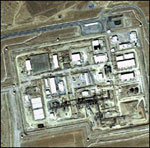
 Wall Street Journal – REVIEW & OUTLOOK: For six months, global attention has fixed on the historic upheavals roiling the Arab world from Tunisia to Bahrain. But the biggest Middle Eastern story continues to be the steady progress Tehran has made toward acquiring the components of a deliverable nuclear weapon. The most recent news is disquieting, to say the least.
The Wall Street Journal
Tehran gets closer to having a bomb. World wags finger.
REVIEW & OUTLOOK
For six months, global attention has fixed on the historic upheavals roiling the Arab world from Tunisia to Bahrain. But the biggest Middle Eastern story continues to be the steady progress Tehran has made toward acquiring the components of a deliverable nuclear weapon. The most recent news is disquieting, to say the least.
On Thursday, the International Atomic Energy Agency “de-restricted” its most recent report on Iran’s nuclear progress. Despite hopes that the 2009 Stuxnet computer virus had slowed or even crippled Tehran’s efforts, the IAEA reports that in the last six months Tehran had enriched some 970 kilos of uranium to reactor-grade levels, or LEU, bringing its total stockpile of LEU to 4,105 kilos.
Iran has also enriched 56.7 kilos of uranium to a 20% level, ostensibly to produce medical isotopes but bringing it measurably closer to the 90% level needed for a bomb. Iran also announced this week that it will begin installing a more efficient type of centrifuge to enrich uranium at its once-secret facility near the city of Qom.
The IAEA devoted considerable space to what it calls the “possible military dimensions” of Iran’s nuclear program, noting that “there are indications that certain [undisclosed nuclear related activities] may have continued beyond 2004.” This further discredits the flawed and politicized 2007 U.S. National Intelligence Estimate that suggested Iran had halted its nuclear weaponization efforts after 2003. The authors of that estimate, which undermined Western efforts to stop Iran, have a lot to answer for.
Iran’s suspected activities, says the IAEA, include “producing uranium metal . . . into components relevant to a nuclear device”; “multipoint explosive initiation and hemispherical detonation studies”; and “missile re-entry vehicle redesign activities for a new payload assessed as being nuclear in nature.”
Perhaps there’s an innocent explanation for all this, like Iran wanting to achieve technological independence in the manufacture of a new generation of refrigerators. And there will always be credulous Western reporters who will take Mahmoud Ahmadinejad’s word that Iran’s intentions are peaceful.
We wonder what those reporters think of an article that appeared in April on the website of the regime’s Revolutionary Guards Corps and talks openly about the prospect of an Iranian nuclear test—a break from the usual Iranian policy of denying any interest in a bomb.
“The day after [the] Islamic Republic of Iran’s first nuclear test will be an ordinary day for us Iranians but in the eyes of some of us there will be a new sparkle,” reads the article. The author goes on to imagine that “the strength of the explosion was not so great as to cause severe damage to the region nor so weak that Iranian scientists face any problems running their test.”
The day of that test may not be far off. In an analysis this month for the Nonproliferation Policy Education Center, Rand scholar Gregory S. Jones writes that even in the absence of a clandestine nuclear program, “Iran can now produce a weapon’s worth (20 kilograms) of HEU [weapons-grade uranium] any time it wishes. With Iran’s current number of operating centrifuges, the batch recycling process would take about two months.”
Rand later issued a press release saying that Mr. Jones’s analysis was not an official Rand study, which suggests to us how reluctant members of America’s foreign policy elite are to hear the truth about Iran’s ambitions. If we admit the danger, then we might have to do something about it before Iran becomes a nuclear power.
The Obama Administration has begun to take the nuclear threat from Iran more seriously after squandering a year in the fruitless pursuit of a negotiated settlement. The Administration also seems to have gotten wise to Iran’s efforts to shape this Arab Spring to its own purposes, not least by backing the Assad regime in its repression of Syrians and providing support to radicals in Lebanon, Gaza and elsewhere.
Yet so far, neither American nor U.N. sanctions have been much of a brake on the mullahs’ nuclear pursuits. If President Obama is serious when he says a nuclear Iran is “unacceptable,” he’ll need to do more than arrange another round of sanctions and wag a stern finger at a regime that’s grown emboldened by the perception of American weakness.


